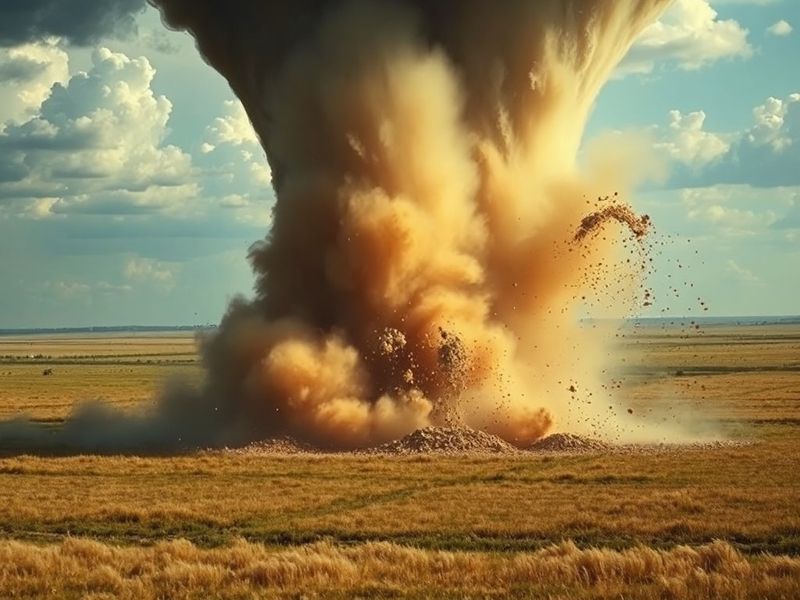
Few forces of nature command both terror and fascination quite like tornadoes. These rapidly rotating columns of air extend from thunderstorms to the ground, capable of producing winds exceeding 300 miles per hour. While they occur worldwide, the United States experiences more tornadoes than any other country—an average of 1,200 annually—primarily in the region known as Tornado Alley. But these destructive vortices are not confined to the American heartland; they appear across every continent except Antarctica, leaving behind a trail of destruction and reshaping landscapes in minutes.
The Science Behind the Swirl: How Tornadoes Form
Tornado formation begins with the collision of warm, moist air and cool, dry air, often during severe thunderstorms. When these air masses meet, they create instability in the atmosphere. A key ingredient is wind shear—the change in wind speed and direction with altitude—which causes the air to rotate horizontally. If this rotating air gets caught in an updraft, it tilts vertically, forming a mesocyclone within the storm cloud. When this rotation tightens and stretches downward, it can descend as a funnel cloud. Once it touches the ground, it officially becomes a tornado.
Not all thunderstorms produce tornadoes. Only about 20% of supercell thunderstorms—long-lived, rotating storms—generate them. The most violent tornadoes form from these rotating storms, often marked by distinctive wall clouds and rotating updrafts. These storms can persist for hours and spawn multiple tornadoes. The Enhanced Fujita (EF) scale, ranging from EF0 (minor damage) to EF5 (total devastation), measures tornado intensity based on observed damage.
Types of Tornadoes: From Landspouts to Waterspouts
While most people picture the classic wedge-shaped tornado, these storms come in several forms:
- Supercell Tornadoes: The most powerful and long-lasting, often associated with large, rotating thunderstorms.
- Landspouts: Form from ground-up rotation, typically weaker and shorter-lived than supercell tornadoes.
- Waterspouts: Occur over water, often forming from fair-weather cumulus clouds. While generally less intense, some can move inland and cause damage.
- Multiple-Vortex Tornadoes: Contain smaller sub-vortices rotating within the main funnel, increasing destruction.
- Gustnadoes: Small, weak tornadoes forming along gust fronts of thunderstorms, usually causing minimal damage.
A Global Phenomenon: Where Tornadoes Strike Beyond the U.S.
The United States leads in tornado frequency, but other regions experience these storms with deadly regularity. Bangladesh ranks second globally in tornado-related fatalities, with dense populations and poor infrastructure amplifying risks. In 1989, the Manikganj tornado killed an estimated 1,300 people—the deadliest in recorded history. Similarly, parts of Europe, including Germany and France, experience tornadoes annually, though they are often weaker and less frequent.
In South America, Argentina and southern Brazil face tornadoes due to the clash of warm tropical air and cold polar air. The 2015 storm in Formosa, Argentina, produced an EF4 tornado, devastating entire neighborhoods. Australia records dozens of tornadoes yearly, particularly in the southeast. While most are weak, the 1999 Sydney hailstorm—accompanied by an EF2 tornado—caused $1.7 billion in damages, making it one of the costliest natural disasters in Australian history.
Even in unexpected places, tornadoes have made their mark. In 2020, a rare tornado touched down in the Outer Hebrides of Scotland, surprising meteorologists. Japan experienced its first EF4 tornado in 2012, striking the city of Tsukuba. These events highlight that no region is entirely immune, though certain geographic and climatic conditions favor their formation.
Cultural Impact: Tornadoes in Myth, Media, and Memory
Tornadoes have long occupied a place in human consciousness, woven into folklore and modern storytelling. Indigenous cultures in the Americas often viewed tornadoes as spiritual forces—whirlwinds carrying messages or spirits. In Lakota tradition, the Wakinyan, or thunderbirds, were said to create tornadoes with their wings. Similarly, ancient Greek mythology associated tornadoes with the god Zeus, symbolizing divine wrath.
In the 20th century, tornadoes entered the public imagination through cinema. The 1939 film The Wizard of Oz immortalized the tornado as a symbol of transformation and chaos, with Dorothy’s farmhouse lifted into the sky. Later, disaster films like Twister (1996) glamorized storm chasing, blending science with spectacle. While these portrayals entertain, they also shape public perception, sometimes blurring the line between education and dramatization.
Tornadoes also leave indelible marks on communities. The 2011 Joplin, Missouri, tornado—a catastrophic EF5 event—killed 161 people and destroyed 7,000 homes. The disaster became a turning point for emergency preparedness, inspiring improved warning systems and building codes. Similarly, the 2013 Moore, Oklahoma, tornado led to enhanced school safety protocols after an EF5 storm killed 24, including seven children at Plaza Towers Elementary.
Survivors’ Stories: The Human Cost of the Storm
Behind every statistic lies a personal narrative. After the 2011 Alabama tornado outbreak, survivor Linda Davis recalled watching the sky turn green before the storm hit. “It sounded like a freight train,” she said. “We had 15 minutes to get to the basement. That’s all.” Her home was leveled, but she and her family survived, thanks to preparation. Stories like hers underscore the importance of tornado awareness and drills, particularly in high-risk zones.
In contrast, some communities have rebuilt with resilience. In Greensburg, Kansas, an EF5 tornado in 2007 destroyed 95% of the town. Rather than relocate, residents chose to rebuild as a model of sustainability, constructing LEED-certified buildings and adopting green energy. Today, Greensburg stands as a testament to renewal, proving that even nature’s most violent forces cannot erase human determination.
Preparation and Prediction: Can We Stay Ahead of the Storm?
Advances in meteorology have extended warning times, but tornadoes remain unpredictable. The National Weather Service’s Doppler radar detects rotation within storms, allowing for earlier alerts—sometimes up to 30 minutes before a tornado hits. Yet, false alarms remain a challenge, with nearly 75% of tornado warnings not resulting in a touchdown. Improving precision is critical to balancing safety with public trust.
Community-based strategies also play a role. The Community Collaborative Rain, Hail and Snow Network (CoCoRaHS) enlists volunteers to report severe weather, enhancing real-time data. Meanwhile, initiatives like the NOAA’s StormReady program help towns prepare by designating safe rooms and establishing emergency communication plans.
At the individual level, preparedness saves lives. The Federal Emergency Management Agency (FEMA) recommends having a weather radio, identifying a safe room (preferably underground or in a small interior space), and practicing drills. Simple steps—like securing outdoor furniture and knowing evacuation routes—can reduce risks. For those in tornado-prone regions, awareness isn’t optional; it’s essential.
As climate change alters weather patterns, some scientists warn of increasing tornado activity in unconventional areas. Warmer temperatures may expand the geographic range of tornadoes, pushing them into regions previously considered safe. This evolving landscape demands ongoing research and adaptive strategies to protect vulnerable populations.
Conclusion: Respecting Nature’s Fury
Tornadoes are a reminder of nature’s raw power—a force that commands both scientific curiosity and humility. While technology has improved forecasting, these storms remain unpredictable, their paths dictated by forces beyond human control. From the plains of Oklahoma to the rice fields of Bangladesh, tornadoes transcend borders, affecting lives and economies in their wake.
Yet, in the face of such destruction, humanity demonstrates resilience. Communities rebuild. Scientists innovate. Survivors share their stories to educate others. Tornadoes may be fleeting, but their impact lingers in the memories of those who endure them and the landscapes they reshape. Understanding these storms—respecting their power without underestimating our ability to prepare—is the first step toward living safely alongside them.
As research continues and warning systems advance, one truth remains clear: tornadoes are not just meteorological events. They are cultural touchstones, historical markers, and human stories. To confront them is to acknowledge both their terror and our capacity to adapt.