teotihuacan
“`html
Teotihuacan: The Mysterious City That Shaped Mesoamerican Civilization
Few archaeological sites in the Americas evoke as much awe and intrigue as Teotihuacan. Located just 30 miles northeast of modern-day Mexico City, this ancient metropolis flourished between 100 BCE and 550 CE, long before the rise of the Aztecs, who later revered it as a sacred site. With its monumental pyramids, grid-like urban layout, and multicultural influences, Teotihuacan stands as a testament to the ingenuity and ambition of pre-Columbian societies.
Though its original name remains unknown—the Aztecs called it Teotihuacan, meaning “the place where the gods were created”—this city was a hub of trade, religion, and political power. Its influence stretched across Mesoamerica, shaping the cultural and economic landscape of an entire region. Today, Teotihuacan is one of Mexico’s most visited archaeological sites, drawing millions of tourists and researchers eager to uncover its secrets.
The Rise of an Ancient Superpower
Teotihuacan’s origins trace back to around 100 BCE, when it was little more than a small agricultural village. By 200 CE, however, it had transformed into one of the largest cities in the world, with an estimated population of 100,000 to 200,000 people. This rapid expansion coincided with the decline of earlier Mesoamerican centers like Monte Albán and the Maya city of Kaminaljuyu, suggesting that Teotihuacan may have absorbed resources, labor, and possibly even populations from these regions.
The city’s strategic location near fertile valleys and obsidian deposits played a crucial role in its growth. Obsidian, a volcanic glass prized for its sharp edges, was a valuable commodity in Mesoamerica. Teotihuacan’s control over obsidian mines allowed it to dominate trade networks, fostering economic ties with distant cities. Archaeologists have found Teotihuacan-style pottery and artifacts as far away as the Maya lowlands and the Gulf Coast, evidence of its far-reaching influence.
Yet, despite its prominence, the identity of Teotihuacan’s rulers remains shrouded in mystery. No clear evidence of a single ruling dynasty or king has been uncovered, leading some researchers to speculate that the city may have been governed by a collective elite or a council of merchants and priests. The absence of palatial structures or royal tombs—common in other Mesoamerican cities—further complicates the picture. Instead, power in Teotihuacan appears to have been decentralized, with religious and economic leaders sharing authority.
The Architectural Marvels of Teotihuacan
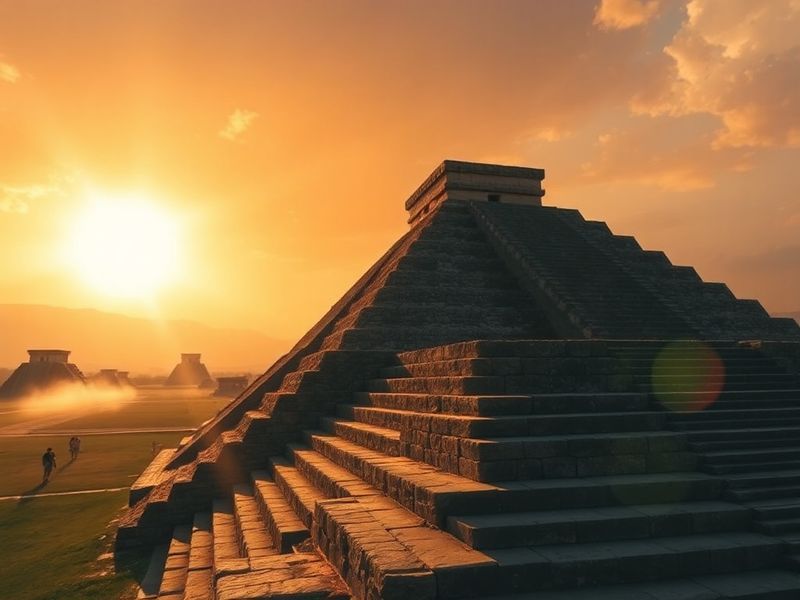
The most striking feature of Teotihuacan is its urban design, which adheres to a precise grid layout oriented along a north-south axis. This deliberate planning contrasts with the organic growth of other ancient cities, hinting at a highly organized society with advanced knowledge of astronomy and engineering. The city’s two most iconic structures—the Pyramid of the Sun and the Pyramid of the Moon—dominate the skyline and serve as focal points for the Avenue of the Dead, the main thoroughfare that runs through the site.
The Pyramid of the Sun, the third-largest pyramid in the world, stands at 246 feet tall and was constructed in a single phase around 200 CE. Unlike the stepped pyramids of Egypt, Teotihuacan’s pyramids were built in a talud-tablero style, featuring alternating sloping and vertical sections. The Pyramid of the Moon, though smaller, is equally impressive, with a base of 430 by 511 feet. Excavations beneath the pyramid have revealed a complex of tombs and offerings, suggesting it was a site of ritual significance.
Beyond these pyramids, Teotihuacan boasts the Temple of Quetzalcoatl, a feathered serpent deity later adopted by the Aztecs. The temple’s facade is adorned with intricate carvings of the feathered serpent and the rain god Tlaloc, reflecting the city’s religious syncretism. The discovery of a buried complex beneath the temple, containing the remains of over 200 sacrificial victims, has sparked debate about the city’s political and religious practices. Were these sacrifices part of a state-sponsored ritual to maintain cosmic order, or did they serve a different, perhaps more sinister, purpose?
The Multicultural Heart of Mesoamerica
One of the most fascinating aspects of Teotihuacan is its multicultural identity. Archaeological evidence suggests that the city was home to a diverse population, including migrants from the Maya lowlands, the Zapotec region of Oaxaca, and even as far as the Gulf Coast. This diversity is reflected in the city’s art, architecture, and religious practices, which blend elements from different Mesoamerican traditions.
For example, the Feathered Serpent Pyramid features iconography that combines Teotihuacan’s local deities with symbols from other cultures. Similarly, murals found in residential compounds depict scenes that are distinctly Maya or Zapotec in style, indicating that these groups maintained their cultural identities even within Teotihuacan’s cosmopolitan environment. This multiculturalism may have been a key factor in the city’s resilience and adaptability.
Yet, the city’s openness was not without tension. In the 5th century CE, evidence of violent conflict emerges in the archaeological record. Burned structures, mass graves, and signs of urban destruction point to a period of upheaval. Some scholars argue that this turmoil was the result of internal strife, possibly between different ethnic or social groups. Others suggest that external pressures, such as drought or invasion, played a role. Whatever the cause, these disturbances marked the beginning of Teotihuacan’s decline.
The Legacy of Teotihuacan
By 550 CE, Teotihuacan had entered a phase of decline, its population dwindling, and its monumental structures falling into disrepair. The causes of its collapse remain debated, but theories include environmental degradation, internal rebellion, and the rise of competing power centers in the Maya region. Despite its fall, Teotihuacan’s legacy endured. The Aztecs, who arrived centuries later, revered the city as a sacred site and incorporated its ruins into their own cosmology. Even today, Teotihuacan serves as a symbol of Mesoamerican civilization, inspiring both awe and curiosity.
Modern research continues to shed light on Teotihuacan’s mysteries. In recent years, archaeologists have used advanced technologies like LiDAR and isotopic analysis to uncover new insights about the city’s population, trade networks, and urban planning. For instance, LiDAR scans have revealed previously unknown structures beneath the jungle canopy, hinting at even greater complexity in Teotihuacan’s urban layout. Meanwhile, isotopic studies of human remains have traced the origins of Teotihuacan’s inhabitants, confirming the city’s role as a melting pot of Mesoamerican cultures.
For those interested in exploring further, Dave’s Locker travel section offers insights into visiting archaeological sites like Teotihuacan, while our analysis articles delve deeper into the cultural and historical significance of ancient civilizations.
Key Takeaways About Teotihuacan
- Urban Planning: Teotihuacan’s grid layout and monumental architecture reflect advanced engineering and astronomical knowledge.
- Multiculturalism: The city was a melting pot of Mesoamerican cultures, with influences from the Maya, Zapotec, and other groups.
- Trade and Economy: Control over obsidian and other resources allowed Teotihuacan to dominate regional trade networks.
- Mysteries and Debates: The city’s rulers, the causes of its decline, and the nature of its sacrifices remain subjects of ongoing research.
Visiting Teotihuacan Today
For travelers, Teotihuacan offers a glimpse into the past. The site is easily accessible from Mexico City, with guided tours available for those who want to learn about its history and significance. Visitors can climb the Pyramid of the Sun for panoramic views of the ancient city and the surrounding Valley of Mexico. The on-site museum houses artifacts, including pottery, tools, and murals, that provide further context about Teotihuacan’s culture and people.
However, tourism also poses challenges. The site’s popularity has led to concerns about preservation, with erosion and visitor foot traffic threatening the integrity of the pyramids. Efforts to mitigate these impacts include limiting access to certain areas and implementing sustainable tourism practices. As interest in Teotihuacan grows, balancing preservation with education will be crucial to ensuring that future generations can continue to explore its wonders.
Teotihuacan remains a symbol of Mesoamerican ingenuity and ambition. Its towering pyramids, diverse population, and enduring legacy invite us to reflect on the complexities of ancient urban life. As researchers uncover more secrets, the city’s story continues to evolve, reminding us that even the most enigmatic civilizations have much left to teach us.
—
METADATA
{
“title”: “Teotihuacan: Secrets of the Ancient Mesoamerican Metropolis”,
“metaDescription”: “Explore the rise, fall, and mysteries of Teotihuacan, one of Mesoamerica’s most influential ancient cities.”,
“categories”: [“Travel”, “History”],
“tags”: [“Teotihuacan”, “Mesoamerica”, “Ancient civilizations”, “Pyramids”, “Archaeology”],
“imageDescription”: “A wide-angle view of Teotihuacan’s Pyramid of the Sun and Pyramid of the Moon under a clear blue sky, with tourists walking the Avenue of the Dead. The scene captures the grandeur of the ancient city, with the surrounding landscape of arid hills and the distant silhouette of Mexico City.”
}
—END METADATA—
“`