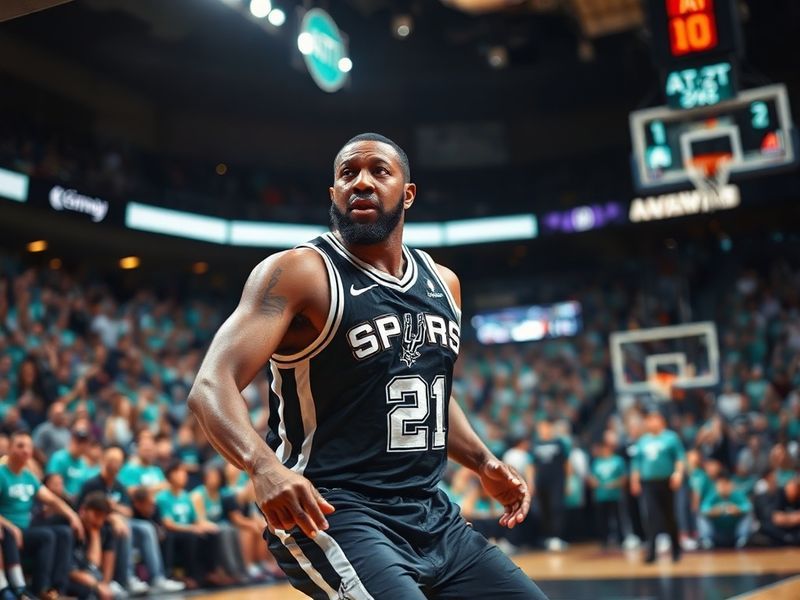
Tim Duncan wasn’t just a basketball player—he was an architect of excellence. Over two decades with the San Antonio Spurs, he transformed the game through unshakable fundamentals, tactical brilliance, and an almost alien level of consistency. While flashier stars dominated headlines, Duncan’s understated dominance reshaped how teams valued intelligence, discipline, and longevity in sports.
The Foundation of a Dynasty
Drafted first overall by the Spurs in 1997, Duncan arrived in San Antonio with a rare blend of size, skill, and composure. His college career at Wake Forest had already showcased his ability to dominate without theatrics, a trait that would define his NBA tenure. The Spurs, under Gregg Popovich’s emerging leadership, found their cornerstone. Duncan’s rookie season—15.9 points, 12.5 rebounds, and 2.5 blocks per game—hinted at what was to come.
The 1998-99 lockout-shortened season marked Duncan’s first championship. His two-way impact was undeniable: elite defense anchored by his shot-blocking and post presence, paired with a growing offensive game. That title set the tone for an era. The Spurs became synonymous with winning, not through luck or one-off superstars, but through a system built around Duncan’s reliability.
Five Pillars of Duncan’s Longevity
- Fundamental Mastery: Duncan’s bank shot, footwork, and defensive positioning were textbook-perfect. He rarely deviated from what worked, refining his craft year after year.
- Adaptability: As the league evolved, Duncan adjusted. He expanded his mid-range game, improved his passing, and even developed a reliable three-point shot in later years.
- Leadership by Example: Duncan’s work ethic spoke louder than any speech. Teammates often cited his quiet intensity as the standard they aspired to meet.
- Health Management: Rarely injured, Duncan prioritized recovery and longevity over short-term gains. His durability allowed him to play at an elite level into his late 30s.
- Chemistry with Popovich: Their relationship transcended typical coach-player dynamics. Popovich trusted Duncan to make in-game decisions, fostering a culture of mutual respect and accountability.
More Than Rings: The Broader Impact
Duncan’s success wasn’t just measured in titles—five in total, tied for the most by any player with the same team—but in how he redefined winning. Before the Spurs’ 2003 championship, teams often relied on isolation-heavy offenses and perimeter scoring. Duncan’s Spurs proved that a balanced, team-oriented approach could dominate. This philosophy influenced franchises like the Warriors and Spurs’ own later teams.
His defense, in particular, set a new benchmark. Duncan led the league in blocks three times and anchored defenses that ranked first in the NBA eight times. Modern analytics now quantify his impact through metrics like Defensive Win Shares, where he ranks first all-time. Duncan didn’t just stop opponents—he demoralized them.
The ripple effects extended beyond basketball. His career challenged the notion that stardom required charisma or marketability. Duncan’s humility and focus on substance over style resonated in an era where athletes often prioritized branding over fundamentals. He proved that greatness could coexist with obscurity, a counterculture message in the age of social media.
Legacy and Lessons
Duncan retired in 2016, leaving behind a legacy that transcends statistics. His 15 All-Star selections, two MVP awards, and 19 All-NBA First Team nods are impressive, but his true impact lies in the Spurs’ sustained excellence. From 1999 to 2016, San Antonio missed the playoffs only once—a feat no other team matched during that span.
For aspiring athletes, Duncan’s career offers a blueprint: prioritize fundamentals, embrace roles, and let results speak for themselves. His post-retirement life has been equally measured. He has avoided the spotlight, focusing on family and philanthropy, including support for education and youth sports programs.
The NBA’s current generation often cites Duncan as an inspiration. Players like LeBron James and Kawhi Leonard have acknowledged his influence, whether through his two-way dominance or his ability to elevate teammates. Even in an era of positionless basketball, Duncan’s versatility—playing power forward and center at an elite level—remains a benchmark.
Why Duncan’s Story Matters Today
In an age where sports narratives are often driven by drama and controversy, Duncan’s career stands as a testament to the power of quiet consistency. His success challenges the modern obsession with highlight-reel moments and viral moments. Instead, he embodies the value of process, preparation, and perseverance.
For fans of the game, Duncan’s era offers a reminder of what true greatness looks like. It’s not about flash or fame, but about the relentless pursuit of excellence, game after game, year after year. His legacy is a blueprint for those who believe in the power of fundamentals over hype.
As the NBA continues to evolve, Duncan’s influence persists. His principles—defense, teamwork, adaptability—remain cornerstones of winning basketball. The Spurs’ sustained success under his leadership is a case study in how to build a franchise the right way.
For those interested in the broader lessons of sports leadership, Duncan’s career is a masterclass. It’s a story of how one man’s commitment to excellence can redefine an entire organization and, by extension, an entire sport.
His retirement hasn’t dimmed his impact. Instead, it’s allowed his legacy to grow. Duncan’s name is now synonymous with greatness, not just in San Antonio, but across the basketball world.
For a deeper look at how Duncan’s era shaped modern basketball, explore our Sports and Analysis sections on Dave’s Locker.