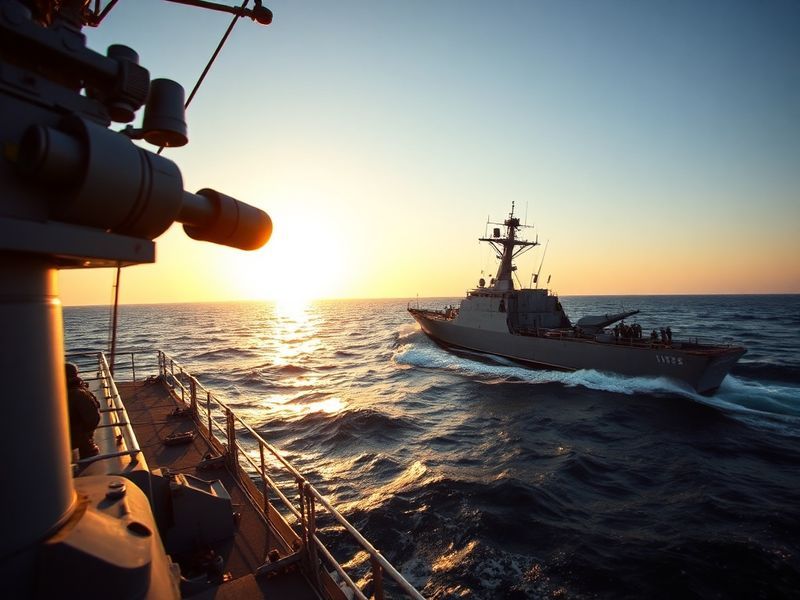
The U.S. Navy conducted a high-stakes interdiction operation in the Strait of Hormuz, seizing an Iranian-flagged vessel suspected of transporting advanced missile components and other restricted military technology. The operation, carried out by the guided-missile destroyer USS Carney, unfolded early Tuesday morning local time and marks one of the most direct confrontations between U.S. and Iranian naval forces in recent years.
According to a statement from U.S. Central Command (CENTCOM), the interdiction was executed in international waters and followed intelligence indicating the vessel, IRIS Behshad, was en route to Yemen in violation of U.N. Security Council resolutions. The ship, originally a commercial cargo vessel, has been linked to Iran’s Islamic Revolutionary Guard Corps (IRGC) and is believed to have been repurposed for military logistics.
Operation Details: How the Seizure Unfolded
The operation began after a multi-agency intelligence review confirmed the vessel’s illicit cargo. A team of U.S. Navy SEALs from Special Boat Team 20 conducted a fast-rope insertion from a MH-60S Seahawk helicopter operating from the USS Carney. The boarding team secured the ship without resistance and discovered multiple containers labeled as “agricultural equipment” that, upon inspection, contained precision-guided missile components and electronic warfare systems.
CENTCOM confirmed that the seized material included:
- Ballistic missile guidance systems
- Night-vision equipment
- Radar components compatible with surface-to-air missile systems
- Communication intercept devices
“This cargo was destined for Iranian-backed forces in Yemen and Syria,” said a Pentagon spokesperson. “The interception prevented the further destabilization of regional security.” The vessel and its crew are now being held at a U.S. naval facility in Bahrain for further investigation and evidence collection.
Regional Implications: Escalation in the Gulf
The seizure comes amid a sharp rise in maritime tensions in the Persian Gulf, where Iran has increasingly used civilian vessels—often disguised as commercial ships—to smuggle weapons to proxy groups. The Strait of Hormuz, through which roughly 20% of the world’s oil passes, remains a flashpoint. Earlier this year, Iran seized two commercial tankers in the region and temporarily held a U.S. Navy drone.
“This is not an isolated incident,” said Dr. Sanam Vakil, deputy director of the Middle East and North Africa program at Chatham House. “It reflects a broader Iranian strategy of plausible deniability—using commercial vessels to mask military transfers while avoiding direct confrontation.”
Regional analysts warn that such operations risk triggering unintended escalation. The IRGC has historically responded to perceived provocations with asymmetric tactics, including cyberattacks, drone strikes, and harassment of commercial shipping.
U.S. officials emphasized that the operation was conducted under international law and with the support of allied naval forces in the region, including the British Royal Navy’s HMS Lancaster, which provided overwatch during the boarding.
Diplomatic Fallout and International Reactions
Iranian officials quickly condemned the seizure as a “flagrant act of piracy” and summoned the Swiss ambassador—who represents U.S. interests in Tehran—to lodge a formal protest. The Iranian Foreign Ministry spokesperson stated, “The U.S. claims of legality are baseless. This is an act of state terrorism.”
Meanwhile, the European Union issued a cautious statement calling for “maximum restraint” and urging dialogue to prevent further escalation. NATO allies, including France and Germany, privately expressed support for the U.S. action, though some officials voiced concerns about the potential for broader conflict.
“While the seizure is legally defensible under maritime law,” said a senior EU diplomat, “it occurs at a time when diplomatic channels are already strained. We must avoid a cycle of retaliation.”
The United Nations is expected to review the incident in an emergency session of the Security Council, where the U.S. is likely to argue that the interdiction falls under Chapter VII authority due to the violation of arms embargo resolutions.
Broader Context: The Shadow War at Sea
This seizure is part of a decades-long shadow war in the Gulf, where naval forces operate in a gray zone between peace and conflict. Since 2019, there have been at least 15 confirmed incidents involving Iranian vessels intercepted by U.S. or allied forces, including the 2021 seizure of the oil tanker Grace 1 off Gibraltar and the 2022 capture of a drone ship in the Red Sea.
But the current operation is notable for its scale and the sophistication of the cargo. The seized missile components appear to be variants of the Fateh-110 and Zolfaghar systems, both used by Iranian-backed groups in Yemen. Intelligence suggests Iran has been modifying commercial vessels to evade detection, often repainting hulls and altering manifests in real time.
“This is a cat-and-mouse game,” said a retired U.S. Navy admiral. “Iran adapts faster than sanctions or interdiction efforts. We’re playing catch-up.”
The U.S. Navy has increased patrols in the region, deploying additional destroyers and surveillance aircraft. However, the operational tempo is straining resources, particularly as the service faces recruiting challenges and fleet readiness concerns.
For the Biden administration, the seizure presents both a challenge and an opportunity. It demonstrates a willingness to confront Iranian arms smuggling but risks provoking a response that could draw the U.S. deeper into regional conflict.
“The goal is deterrence,” said a senior defense official. “We want Iran to understand that the costs of these transfers are too high.”
Conclusion: What’s Next?
The immediate focus is on the investigation and legal disposition of the vessel and its cargo. The U.S. is coordinating with partners to ensure the seized material does not re-enter regional conflict zones. Meanwhile, Iran has signaled it may respond with increased naval patrols or further seizures of commercial vessels.
Analysts warn that without a diplomatic off-ramp, the risk of miscalculation remains high. The Strait of Hormuz is not just a chokepoint for oil—it’s a pressure cooker of geopolitical tension.
As the situation develops, one thing is clear: the U.S. Navy’s role in policing the world’s most critical maritime corridor has never been more complex—or more consequential.
Stay informed on global security developments by following updates on Dave’s Locker News and Analysis pages.