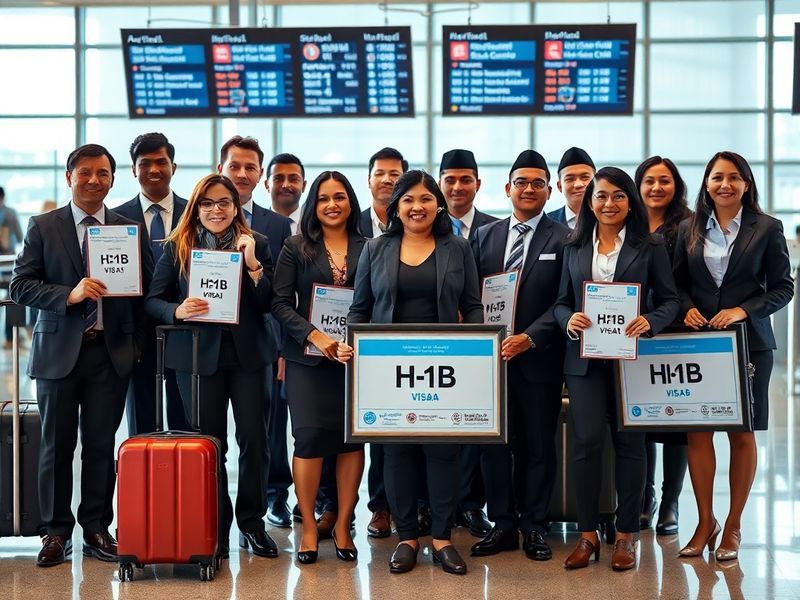
Understanding the H-1B Visa: A Global Talent Pipeline or Exploitative System?
“`html
The H-1B Visa: A Global Talent Pipeline or a Broken System?
The H-1B visa remains one of the most discussed and debated immigration pathways in the United States, drawing attention from tech workers, policymakers, and international professionals alike. Designed to bring highly skilled foreign nationals into the U.S. workforce temporarily, the program has evolved into a symbol of both opportunity and contention. Its impact stretches far beyond Silicon Valley, shaping industries, influencing global labor markets, and sparking cultural exchanges that ripple across continents.
But as demand for tech talent grows and political scrutiny intensifies, the H-1B visa program finds itself at a crossroads. Is it a vital mechanism for innovation and economic growth, or does it exploit foreign workers while undercutting domestic job markets? The answer, as with most complex systems, lies in the details.
The Origins and Purpose of the H-1B Visa
Introduced in 1990 as part of the Immigration Act, the H-1B visa was created to address a critical labor shortage in specialized fields such as science, engineering, and information technology. The program allows U.S. employers to sponsor foreign workers for up to six years, provided they hold at least a bachelor’s degree (or equivalent) in a relevant field. Unlike other visas, the H-1B is employer-specific, meaning the worker’s legal status is tied directly to their job.
At its core, the H-1B visa was meant to complement—not replace—the domestic workforce. The idea was simple: bring in top global talent to fill gaps where qualified Americans were scarce, thereby fostering innovation and economic expansion. In the early 2000s, as the tech boom accelerated, the program became a lifeline for Silicon Valley giants like Google, Amazon, and Microsoft, which relied heavily on H-1B workers to fuel rapid growth.
Yet even in its infancy, concerns emerged. Critics warned that the program could be misused, allowing companies to hire cheaper foreign labor instead of investing in American workers. These early debates would later intensify, as the H-1B became a flashpoint in broader conversations about immigration, outsourcing, and corporate accountability.
How the H-1B Visa Shapes Global Talent Flows
The H-1B visa doesn’t operate in a vacuum. It exists within a vast, interconnected network of global labor migration, where talent flows from countries like India, China, and Canada into the United States. Nowhere is this more visible than in the tech industry, where Indian nationals have dominated H-1B approvals for decades. In fiscal year 2023, Indian citizens received nearly 70% of all H-1B visas issued, with many working in software development, data science, and IT consulting.
This reliance on foreign talent reflects deeper trends in globalization. Countries such as India and China produce far more STEM graduates than the U.S., yet many graduates face limited career prospects at home due to economic constraints or bureaucratic hurdles. For these professionals, the H-1B offers a pathway to professional growth—and often, a stepping stone to permanent residency or citizenship.
But the visa’s influence extends beyond individual careers. It has reshaped entire industries. Take the case of technology, where H-1B workers have become indispensable to maintaining competitive advantage. Companies argue that without this pipeline, projects would stall, innovation would slow, and the U.S. would lose its edge in fields like artificial intelligence and cybersecurity. Critics, however, point to instances where H-1B workers are brought in to replace American employees, particularly during layoffs—a practice that has fueled outrage and legal challenges.
The cultural impact is equally significant. H-1B workers often arrive in the U.S. with families, bringing diverse perspectives that enrich communities. Cities like San Francisco, Seattle, and Austin have seen growing Indian, Chinese, and European expat communities, contributing to vibrant cultural scenes. Yet, the visa’s temporary nature can create a sense of impermanence, with many professionals living in a state of limbo, unsure whether they’ll be able to stay long-term.
The Lottery System: A Flawed but Necessary Mechanism
One of the most contentious aspects of the H-1B visa is its cap. The U.S. government limits the number of new H-1B visas issued each year to 85,000 (with an additional 20,000 for advanced degree holders from U.S. universities). Given the overwhelming demand—over 780,000 registrations were submitted in March 2024—only about 10% of applicants are selected. This lottery system has become a source of frustration for employers and employees alike.
For companies, the lottery introduces unpredictability. Startups and large corporations alike must prepare for the slim odds of securing visas for critical hires. The process begins with a registration period, where employers submit basic details about the proposed position and the candidate. If selected, the employer then files a full petition, subject to scrutiny by U.S. Citizenship and Immigration Services (USCIS).
For foreign workers, the lottery is a high-stakes gamble. Many invest thousands of dollars in legal fees, relocation costs, and lost wages while waiting for a decision that may never come. The uncertainty has led some to pursue alternative paths, such as the L-1 visa (for intracompany transfers) or the O-1 visa (for individuals with extraordinary ability). Others opt for countries like Canada or Germany, which offer more straightforward immigration pathways for skilled workers.
The lottery’s flaws are well-documented. It disproportionately benefits larger corporations with the resources to file multiple petitions, while smaller firms and startups often lose out. Additionally, the system does little to address regional labor shortages or align visa allocations with actual market needs. Reform proposals, such as prioritizing visas based on salary or industry demand, have been floated for years but remain stalled in Congress.
Ethics, Exploitation, and the Human Cost
Behind the policy debates and economic arguments are human stories—stories of ambition, sacrifice, and sometimes exploitation. For many H-1B workers, the visa represents a golden ticket: the chance to work at a prestigious company, earn a competitive salary, and build a future for their families. Yet the reality is often more complicated.
One of the most troubling issues is the prevalence of body shopping—a practice where staffing firms recruit H-1B workers and place them at third-party client sites, often at lower wages than direct hires. These workers may find themselves in precarious positions, with limited job security and few avenues for recourse. In some cases, they are laid off just before their H-1B status expires, forcing them to leave the country within weeks.
The ethical implications are stark. While the H-1B visa is not inherently exploitative, its structure creates opportunities for abuse. Employers hold significant power over workers’ legal status, which can lead to coercive situations. For example, some employees are threatened with deportation if they complain about poor working conditions or wage disparities. These issues have prompted lawsuits, congressional hearings, and calls for stricter oversight.
Cultural differences also play a role. Many H-1B workers come from countries where challenging authority is discouraged, making it harder to report mistreatment. Language barriers, unfamiliarity with U.S. labor laws, and fear of retaliation further compound the problem. Advocacy groups, such as the American Immigration Lawyers Association, have pushed for reforms to protect these workers, but progress has been slow.
The Future of the H-1B Visa: Reform or Replacement?
As the H-1B visa enters its fourth decade, its future is more uncertain than ever. The Biden administration has taken steps to address some of the program’s shortcomings, such as increasing scrutiny of H-1B-dependent employers and expanding premium processing for faster approvals. However, comprehensive reform remains elusive. Congress has proposed bills like the High-Skilled Integrity and Fairness Act, which aims to raise wages for H-1B workers and eliminate the lottery in favor of a merit-based system, but partisan divides have stalled progress.
Meanwhile, international competition for talent is heating up. Countries like Canada, Australia, and Germany have streamlined their immigration processes, offering faster pathways to permanent residency and citizenship. For tech workers, these alternatives are increasingly attractive. Canada’s Global Talent Stream, for example, promises work permits in as little as two weeks, compared to the months-long H-1B process.
The debate over the H-1B visa is fundamentally about values: Is the U.S. a nation that welcomes global talent and rewards ambition, or one that prioritizes protectionism and control? The answer will shape not only the tech industry but the country’s broader economic and cultural landscape. One thing is clear: the H-1B visa, for all its flaws, is unlikely to disappear anytime soon. What remains to be seen is whether it can evolve into a system that serves both employers and workers—or whether it will continue to be a source of frustration and division.
For now, the H-1B lottery rolls on, a symbol of both opportunity and inequity in the modern global economy.