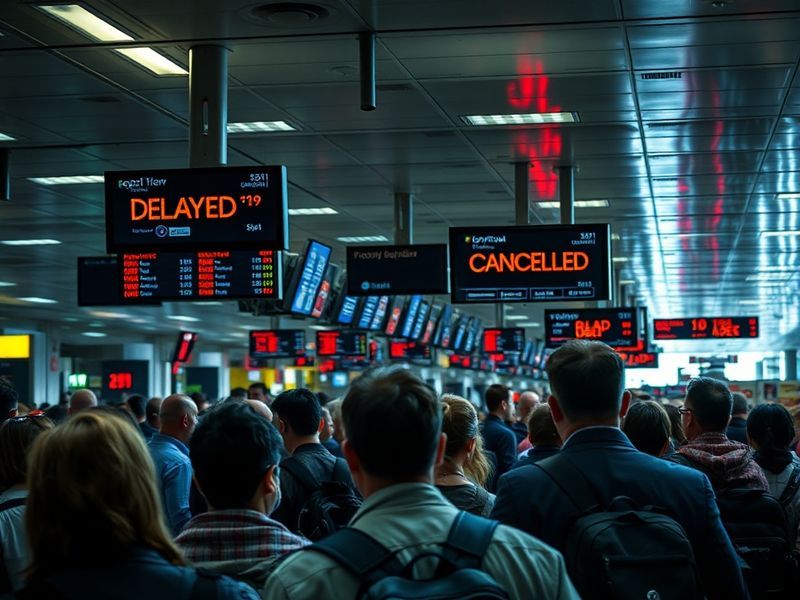
Why U.S. Flight Delays Are Rising and How They Affect Global Travel
“`html
U.S. Flight Delays and Cancellations: A Global Perspective on the Turbulence
The U.S. air travel system, one of the most complex and heavily trafficked in the world, faces persistent challenges with delays and cancellations. These disruptions ripple far beyond airport terminals, affecting travelers, airlines, and economies worldwide. From seasonal weather extremes to labor shortages and aging infrastructure, the causes are multifaceted. Understanding these patterns offers insight not just into aviation itself, but into broader issues of global connectivity, economic resilience, and cultural exchange.
The Scale of the Problem
In 2023, U.S. airlines canceled over 2% of all scheduled flights, according to the U.S. Department of Transportation. While this may seem small, it translates to tens of thousands of disrupted journeys. Delays are even more common, with nearly one in five flights arriving late. Such figures place the U.S. in the middle of the pack globally—not the worst, but far from ideal. Countries like Japan and South Korea boast delay rates under 1%, largely due to advanced infrastructure and disciplined air traffic systems.
What makes the U.S. situation unique is its sheer volume. The country’s airspace handles more than 45,000 flights daily. When disruptions occur, the ripple effects are exponential. A single delayed flight in Chicago can cascade into missed connections in Miami, Paris, or Dubai. This domino effect highlights how deeply interconnected global air travel has become.
Root Causes: Beyond the Weather
While severe storms and hurricanes often dominate headlines, they account for only a fraction of delays. Chronic issues such as air traffic control staffing shortages, outdated radar systems, and airline operational bottlenecks play a far larger role. The Federal Aviation Administration (FAA) has warned that controller staffing levels remain below optimal, especially during peak travel seasons.
Another factor is the concentration of air travel in a few major hubs. Airports like Atlanta’s Hartsfield-Jackson, Chicago O’Hare, and Los Angeles International handle millions of passengers annually. When operations hiccup at one, the entire network feels the strain. This concentration mirrors global patterns seen in London Heathrow, Beijing Daxing, and Dubai International—each a vital node in the world’s air traffic web.
Airlines themselves contribute to the problem through optimized scheduling that leaves little buffer for delays. Many carriers operate with tight turnaround times, minimizing ground time between flights. While efficient, this leaves little room for error when weather or mechanical issues arise.
Cultural and Economic Consequences
The impact of flight disruptions extends into culture and commerce. For international travelers, missed connections can mean lost business opportunities, ruined vacations, or cultural events missed. In Asia, where business travel is tightly linked to supply chains, even a few hours of delay can translate into millions in lost revenue. Similarly, in Europe, where budget airlines rely on strict schedules, delays can force passengers to rethink travel plans entirely.
On a societal level, frequent delays erode public trust in air travel. A 2023 survey by J.D. Power found that customer satisfaction with U.S. airlines dropped for the first time in years, citing delays and cancellations as primary concerns. This dissatisfaction isn’t confined to the U.S.—it reflects a global trend. As air travel becomes more accessible, expectations rise. Passengers now demand not just affordability, but reliability.
Solutions on the Horizon
Efforts are underway to mitigate these issues. The FAA’s NextGen modernization program aims to upgrade air traffic control technology, replacing decades-old systems with GPS-based navigation. This shift promises to increase efficiency and reduce delays by allowing more direct flight paths. Meanwhile, airlines are investing in better predictive analytics to anticipate and manage disruptions before they escalate.
Labor reforms are also critical. Air traffic controllers in the U.S. face high stress and burnout, especially during staffing shortages. Increasing training programs and improving working conditions could stabilize the workforce. Globally, countries like Canada and Australia have implemented similar reforms with positive results.
Yet technological and policy solutions alone may not suffice. The rise of remote work and digital communication has changed travel patterns. Business travel, once the backbone of airline revenue, has declined by nearly 20% since 2019. As leisure travel rebounds, airlines must adapt to a new reality—one where flexibility and customer service matter as much as schedules.
What Travelers Can Do
For passengers navigating this unpredictable landscape, preparation is key. Booking flights with longer layovers, choosing early-morning departures (which tend to be more reliable), and signing up for airline alerts can help manage expectations. Travel insurance, once a niche product, is now a mainstream necessity for international travelers.
It’s also worth noting that not all delays are created equal. Mechanical issues, for instance, often lead to longer disruptions than weather-related ones. Airlines prioritize safety over schedules, so while delays are frustrating, they’re rarely arbitrary.
The global air travel system remains one of humanity’s greatest logistical achievements. Yet its fragility reminds us that even the most advanced networks are subject to human, environmental, and economic forces. Delays and cancellations are not just inconveniences—they are symptoms of a system under pressure from all sides.
As we look to the future, the goal isn’t just to reduce delays, but to build a travel ecosystem that is resilient, equitable, and sustainable. That will require cooperation between governments, airlines, and passengers alike. Until then, the skies may remain a little bumpier than we’d like.
—