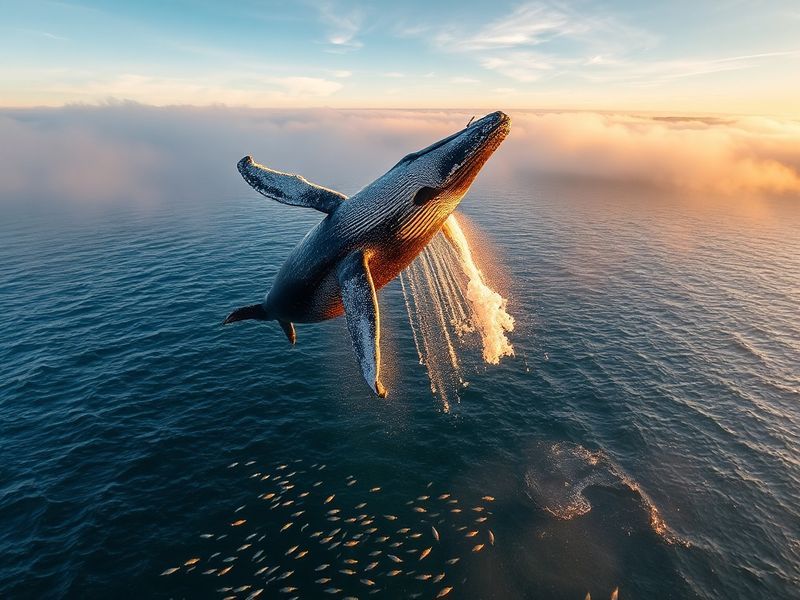
The humpback whale (Megaptera novaeangliae) is one of the most recognizable marine mammals, known for its acrobatic breaches, haunting songs, and distinctive body shape. These baleen whales can grow up to 52 feet in length and weigh up to 40 tons, making them a dominant presence in oceans worldwide. Despite their massive size, humpbacks are filter feeders, primarily consuming krill and small fish through baleen plates that filter water.
Their scientific name, Megaptera novaeangliae, translates to “big-winged New Englander,” a nod to their long pectoral fins—which can reach up to one-third of their body length—and their historical presence off the coast of New England. These fins are among the longest of any whale species and are used for complex maneuvers during feeding and social interactions.
The Life Cycle and Migration Patterns of Humpback Whales
Humpback whales undergo one of the longest migrations of any mammal, traveling up to 5,000 miles between feeding and breeding grounds. Their annual journey is a testament to their endurance and adaptability. These migrations follow a predictable pattern: during the summer months, humpbacks feed in cold, nutrient-rich waters near the poles, where they bulk up on krill and fish. As winter approaches, they migrate to warmer tropical or subtropical waters to mate, give birth, and nurse their calves.
The timing of these migrations varies by population. For example, humpbacks in the North Atlantic migrate between the Caribbean Sea and the Gulf of Maine or the coast of Iceland. In the North Pacific, some populations travel between Alaska and Hawaii, while others migrate between Mexico and the Bering Sea. These journeys are not solitary; humpbacks often travel in small groups or pairs, though larger aggregations may form in feeding areas.
Reproduction and Calf Development
Humpback whales reach sexual maturity between the ages of 4 and 10, depending on environmental conditions and food availability. Mating typically occurs in warm, shallow waters, where males compete for the attention of females through elaborate displays of breaching, tail slapping, and singing. These behaviors are not just for show; they play a crucial role in courtship and mate selection.
After a gestation period of about 11 months, females give birth to a single calf, which weighs around 1,500 pounds at birth. Calves are nursed for approximately one year, during which they gain about 100 pounds per day. The bond between mother and calf is strong, with the mother providing protection and guidance as the calf learns to navigate the ocean. Calves are weaned when they are about a year old, but they may stay with their mothers for an additional year before becoming fully independent.
Feeding Behavior: The Art of Bubble-Net Fishing
Humpback whales are skilled hunters, employing a variety of techniques to catch their prey. One of their most impressive strategies is bubble-net feeding, a cooperative hunting method that involves a group of whales working together to corral fish or krill into a tight ball. The whales release bubbles in a spiral pattern, creating a “net” that traps the prey. As the bubbles rise, the fish become disoriented and concentrate in the center, allowing the whales to swim upward with their mouths open to engulf the prey.
This method is not only efficient but also demonstrates the whales’ intelligence and social coordination. Bubble-net feeding is most commonly observed in the North Atlantic and North Pacific, where humpbacks feed on schools of herring or krill. Other feeding techniques include lunge feeding, where whales accelerate through a school of fish with their mouths open, and skim feeding, where they swim slowly near the surface with their mouths slightly open to catch small prey.
Diet and Prey Preferences
The diet of humpback whales varies by region and season. In the North Atlantic, they primarily feed on herring, capelin, sand lance, and krill. In the North Pacific, their diet may include anchovies, sardines, and krill. Humpbacks are opportunistic feeders, meaning they adapt their diet based on the availability of prey in their environment. This adaptability is crucial for their survival, especially in the face of climate change and shifting ocean conditions.
Humpbacks consume up to 3,000 pounds of food per day during the feeding season, storing energy in the form of blubber to sustain them during migration and breeding. Their feeding habits play a vital role in marine ecosystems, as they help regulate the populations of their prey and contribute to nutrient cycling through their waste.
Communication and Social Structure: The Language of Humpbacks
Humpback whales are renowned for their complex vocalizations, which are among the most elaborate in the animal kingdom. Males produce long, structured songs that can last for hours and are thought to play a role in mating displays. These songs consist of repeating sequences of moans, grunts, and high-pitched whistles, and they vary between populations. Interestingly, humpbacks in the same region sing similar songs, suggesting that these vocalizations are learned rather than innate.
In addition to their songs, humpbacks use a variety of non-vocal sounds for communication, including breaches, tail slaps, and pectoral fin slaps. These behaviors are often used in social interactions, such as courtship, aggression, or play. Humpbacks are also known to interact with other whale species, including orcas and blue whales, though these interactions are not always peaceful.
Social Bonds and Group Dynamics
Humpback whales are generally solitary or found in small groups, but they do form temporary associations during migration, feeding, or breeding. These associations are often fluid, with individuals joining and leaving groups frequently. However, strong social bonds can develop between mothers and calves, as well as between mating pairs. In some cases, humpbacks have been observed forming long-term friendships, particularly among females.
The social structure of humpback whales is complex and not fully understood. Researchers believe that their social behaviors are influenced by factors such as food availability, predation risk, and reproductive opportunities. For example, in areas with abundant food, humpbacks may form larger groups to take advantage of cooperative feeding strategies. In contrast, in breeding grounds, males may compete for access to females, leading to more aggressive interactions.
The Conservation Status and Threats to Humpback Whales
Humpback whales were once hunted to the brink of extinction by commercial whaling in the 19th and 20th centuries. By the 1960s, their populations had declined dramatically, with some estimates suggesting fewer than 1,000 individuals remained in the North Atlantic. However, thanks to international conservation efforts, including the 1986 moratorium on commercial whaling, humpback whale populations have rebounded significantly. Today, the global population is estimated to be over 100,000 individuals, and the species is listed as “Least Concern” on the IUCN Red List.
Despite this recovery, humpback whales still face numerous threats. One of the most significant is entanglement in fishing gear, which can lead to injury, drowning, or starvation. Ship strikes are another major concern, particularly in busy shipping lanes where humpbacks may collide with vessels, often with fatal results. Climate change is also impacting humpback whales by altering ocean temperatures and food availability, which can disrupt their migration patterns and feeding behaviors.
Conservation Efforts and Future Outlook
Efforts to protect humpback whales have included the establishment of marine protected areas, speed restrictions for ships in critical habitats, and regulations on fishing gear. Organizations such as the World Wildlife Fund and Ocean Conservancy have played key roles in advocating for these measures and raising public awareness about the importance of whale conservation.
Looking ahead, the future of humpback whales depends on continued conservation efforts and adaptive management strategies. Researchers are studying the impacts of climate change on humpback populations, as well as the effectiveness of current conservation measures. Public support for whale conservation is also crucial, as it drives funding and policy decisions that can help protect these magnificent creatures for generations to come.
Conclusion: Celebrating the Majesty of Humpback Whales
Humpback whales are a symbol of the ocean’s beauty and resilience. Their migrations, songs, and feeding behaviors are a testament to their intelligence and adaptability. While their populations have rebounded from the brink of extinction, they still face significant threats from human activities. By supporting conservation efforts and promoting sustainable practices, we can help ensure that humpback whales continue to thrive in the world’s oceans.
For those interested in learning more about humpback whales or getting involved in their conservation, there are numerous opportunities to observe these gentle giants in the wild. Whale-watching tours offer a chance to witness their acrobatics and hear their haunting songs, while educational programs provide insights into their biology and ecology. Whether through research, advocacy, or simply spreading awareness, everyone can play a role in protecting humpback whales and the marine ecosystems they call home.