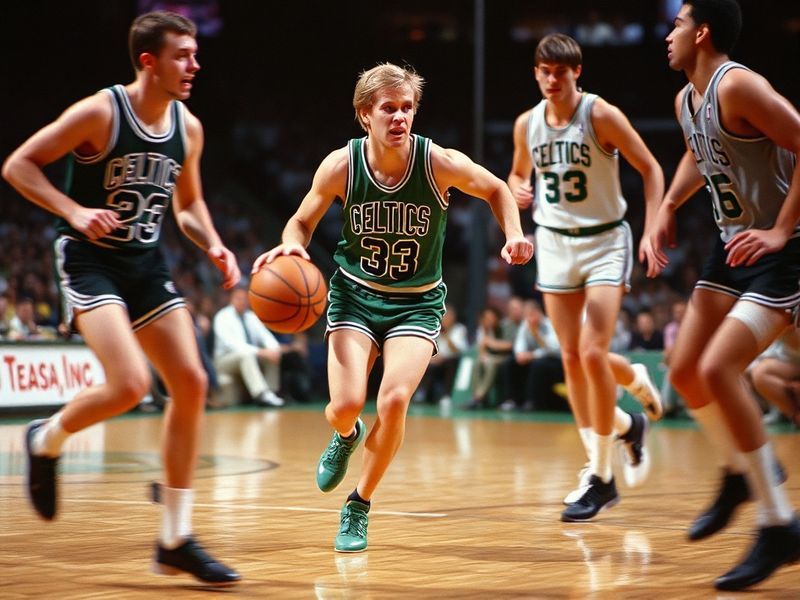
Few names in sports history carry the weight of Larry Bird. The Indiana native didn’t just play basketball—he elevated it to an art form, blending unmatched skill with an almost mythical competitive fire. Bird’s career, spanning the 1970s through the early 1990s, coincided with the NBA’s golden era, yet his impact stretched far beyond statistics and championships.
The Rise of a Basketball Icon
Born in West Baden Springs, Indiana, Bird grew up in modest circumstances. His father’s suicide when Larry was 18 left him with a profound sense of loss, which he later channeled into his basketball career. At Springs Valley High School, he became a local sensation, averaging 31 points, 21 rebounds, and 4 assists per game as a senior. His dominance earned him a scholarship to Indiana University, though he left after just a few weeks, overwhelmed by the size of the campus and the pressure.
Bird returned home and enrolled at Indiana State University, where he led the Sycamores to the 1979 NCAA Championship game. Though they fell short against Magic Johnson’s Michigan State Spartans, Bird’s performance—including 32 points and 13 rebounds in the final—cemented his reputation as a once-in-a-generation talent. The Boston Celtics selected him with the sixth overall pick in the 1978 NBA Draft, though he would remain in college for another season. When he finally joined the NBA in 1979, the league was forever changed.
Key Moments in Bird’s Early Career
- 1979 NBA Draft: Selected sixth overall by the Boston Celtics, a move that would redefine the franchise.
- 1979-80 NBA Rookie of the Year: Averaged 21.3 points, 10.4 rebounds, and 4.5 assists per game, proving his immediate impact.
- First All-Star appearance: Named to the 1980 All-Star team in his rookie season, signaling his arrival among the league’s elite.
- 1981 NBA Championship: Led the Celtics to victory over the Houston Rockets in six games, earning Finals MVP honors.
Playing Style and Legacy
Bird’s game was a masterclass in fundamentals and creativity. His shooting form—feet planted square to the basket, elbow tucked in—was textbook. Yet he wasn’t just a marksman; he was a floor general, a rebounder, and an elite passer. His ability to read defenses and exploit mismatches made him a nightmare for opponents. Bird’s rivalry with Magic Johnson transcended basketball, symbolizing the broader cultural shift in the NBA during the 1980s. Their battles in the 1984, 1985, and 1987 NBA Finals drew millions of viewers and helped popularize the league globally.
Bird’s impact extended beyond his on-court achievements. He brought a blue-collar work ethic to the game, embodying the values of his small-town upbringing. His trash-talking was legendary, but it was always in service of pushing his teammates to excel. Bird’s leadership style—demanding excellence without compromising his own standards—set a new benchmark for player accountability. Even in an era dominated by larger-than-life personalities, Bird stood out for his authenticity.
Injuries began to take their toll in the early 1990s, forcing Bird to retire after the 1992 season. His final game—a 110-102 loss to the Orlando Magic—was a poignant reminder of the physical toll the game had exacted. Yet, even in retirement, Bird’s influence endured. He transitioned seamlessly into coaching, leading the Indiana Pacers to the 1998 and 2000 NBA Finals, and later into executive roles. His front-office work with the Pacers further cemented his reputation as one of the sharpest minds in basketball.
Bird’s Broader Influence on the Game
Bird’s career coincided with the NBA’s transformation from a struggling league to a global powerhouse. His rivalry with Magic Johnson was pivotal in this evolution. The two players, representing the Celtics and Lakers respectively, became the faces of the NBA’s resurgence in the 1980s. Their 1984 Finals—a grueling seven-game series—drew record television ratings and introduced the NBA to a broader audience. Bird and Magic’s success paved the way for international stars like Michael Jordan, Shaquille O’Neal, and Kobe Bryant, proving that the league could thrive on skill, charisma, and star power.
Bird’s influence can also be seen in how modern players approach the game. His emphasis on fundamentals, teamwork, and preparation is now a cornerstone of player development programs across the league. Even players like Stephen Curry and Damian Lillard, who rely heavily on three-point shooting, owe a debt to Bird’s ability to stretch defenses and create space. His legacy is also evident in the way teams now prioritize versatility, with players expected to contribute in multiple facets of the game.
Bird’s Contributions Beyond Basketball
- Olympic Gold: Won a gold medal as a member of the 1992 “Dream Team,” the first time NBA players were allowed to compete in the Olympics.
- Coaching: Led the Indiana Pacers to two NBA Finals appearances as head coach (1998, 2000).
- Executive Role: Served as President of Basketball Operations for the Pacers from 2003 to 2012, helping the team reach the 2004 Eastern Conference Finals.
- Broadcasting: Worked as a color commentator for NBA games, offering insightful analysis rooted in his playing experience.
Bird’s Enduring Cultural Impact
Bird’s story is as much about perseverance as it is about talent. His journey from a small town in Indiana to the pinnacle of professional basketball is a testament to his work ethic and determination. Bird’s authenticity—his refusal to conform to the flashy image of the 1980s NBA—resonated with fans. He was the anti-Magic in some ways, representing the blue-collar ethos of the Midwest in contrast to the glitz of Los Angeles.
Bird’s cultural impact extends beyond basketball. His rivalry with Magic Johnson helped bridge racial divides in the 1980s, as their friendship became a symbol of unity in a divided America. Bird’s willingness to embrace the media, despite his introverted nature, also humanized athletes in an era when they were often seen as untouchable celebrities. His interviews, filled with dry humor and self-deprecation, endeared him to fans and journalists alike.
Even today, Bird remains a benchmark for excellence in basketball. His name is invoked in discussions about the greatest players of all time, often alongside legends like Jordan, Kareem Abdul-Jabbar, and LeBron James. Bird’s legacy is a reminder that greatness isn’t just about statistics or championships—it’s about the way a player changes the game itself.
As the NBA continues to evolve, with players prioritizing three-point shooting and analytics over traditional fundamentals, Bird’s career serves as a touchstone. His ability to dominate in an era before the three-point line was introduced, or before advanced metrics dominated decision-making, underscores the timelessness of his game. Bird didn’t just play basketball; he redefined what it meant to be a complete player.
Conclusion: Why Bird Still Matters
Larry Bird’s career is a study in contrasts: humility and competitiveness, introversion and charisma, small-town values and global fame. He was the kind of player who made those around him better, not just through his skill, but through his leadership and work ethic. Bird’s impact on the game is immeasurable, yet it’s often felt rather than quantified. He didn’t just play basketball; he elevated it.
For younger generations of players and fans, Bird’s legacy is a reminder that greatness comes from preparation, discipline, and an unwavering commitment to excellence. In an era where flash and highlight-reel plays often overshadow fundamentals, Bird’s career stands as a testament to the enduring power of the basics. His story is one of perseverance, authenticity, and an unrelenting pursuit of greatness—qualities that transcend sports.
As the NBA continues to grow and change, Larry Bird’s legacy remains a guiding light. He wasn’t just a player; he was a force of nature, a legend who redefined what it meant to be a basketball icon. His name will forever be synonymous with the golden era of the NBA, a reminder of a time when the game was as much about heart and hustle as it was about skill.
For those looking to understand the true essence of basketball, there’s no better place to start than with Larry Bird. His story is a blueprint for greatness, a lesson in leadership, and a testament to the power of authenticity. In a sport filled with larger-than-life personalities, Bird’s legacy is a reminder that greatness comes in many forms—and that the most enduring legacies are often the ones built on humility, hard work, and an unshakable belief in oneself.
Explore more about basketball legends and their impact on the game by visiting our Sports and Entertainment categories.