lyrid meteor shower tonight
“`html
Lyrid Meteor Shower Tonight: How to Watch the Celestial Show
The Lyrid meteor shower peaks tonight, offering skywatchers around the world a chance to witness one of the oldest recorded meteor showers. Known for its fast and bright meteors, this annual event has been observed for over 2,700 years, with its first recorded sighting dating back to ancient China in 687 BCE. Unlike some meteor showers that produce hundreds of meteors per hour, the Lyrids typically deliver a modest 10 to 20 meteors per hour at their peak, though occasional outbursts can surprise observers with up to 100 meteors in an hour.
The Lyrids originate from the debris trail of Comet Thatcher, a long-period comet that orbits the sun once every 415 years. As Earth passes through this debris field each April, particles collide with our atmosphere, creating streaks of light that we see as shooting stars. While the Lyrids may not be the most prolific meteor shower, their historical significance and reliability make them a favorite among amateur astronomers and casual stargazers alike.
The Best Times and Places to Watch
Tonight’s peak viewing window opens after midnight and extends until dawn, with optimal visibility expected between 2 AM and 4 AM local time. The Lyrids will be visible from both the Northern and Southern Hemispheres, though viewers in the Northern Hemisphere will have a clearer view due to the radiant point’s higher position in the sky. For the best experience, find a location far from city lights, where light pollution can obscure fainter meteors.
Astronomers recommend allowing at least 30 minutes for your eyes to adjust to the darkness. Bring a blanket or reclining chair to lie back comfortably, and avoid looking at your phone or other bright devices, as this can disrupt your night vision. The Lyrids’ radiant point is near the constellation Lyra, but meteors can appear anywhere in the sky, so there’s no need to focus on a specific area.
For those unable to escape urban areas, science centers and planetariums often host public viewing events with telescopes and expert guidance. Check local listings for observatories or astronomy clubs hosting gatherings tonight.
Cultural and Historical Significance
The Lyrids hold a special place in human history, with records of their sightings spanning multiple cultures and millennia. In ancient Chinese texts, the shower was described as “stars falling like rain,” a poetic phrase that captures the awe these celestial events inspired. Greek philosopher Aristotle also referenced the Lyrids, associating them with the death of Orpheus, the legendary musician whose lyre was placed in the sky as the constellation Lyra.
In Japan, the Lyrids were traditionally linked to the legend of the “Tanabata” festival, where the stars Vega and Altair, part of the Lyra and Aquila constellations, were said to meet once a year. While the festival celebrates a different astronomical event, the Lyrids’ appearance in April added to the cultural tapestry of spring sky-watching traditions.
Indigenous cultures in the Americas also observed the Lyrids, often incorporating them into oral traditions. Some Native American tribes saw the meteors as the spirits of ancestors returning to visit, while others interpreted them as omens or messages from the gods. These interpretations highlight how meteor showers have long been more than just astronomical phenomena—they’ve been woven into the fabric of human storytelling.
What to Expect: Science Behind the Lyrids
The Lyrid meteor shower is classified as a medium-strength shower, meaning it produces a steady number of meteors without the dramatic bursts seen in showers like the Perseids or Leonids. However, the Lyrids are known for their occasional “surprises.” About 25% of Lyrid meteors leave behind persistent trains—glowing trails of ionized gas that can linger for several seconds after the meteor has passed. These trains are caused by meteoroids traveling at high speeds (around 30 miles per second) and are a favorite sight for photographers.
The Lyrids also tend to produce brighter meteors than average, with some reaching fireball status. Fireballs are meteors that shine as brightly as Venus in the night sky, making them unmistakable even in areas with moderate light pollution. While fireballs are rare, their occurrence adds an element of unpredictability to the Lyrids, making each shower a unique experience.
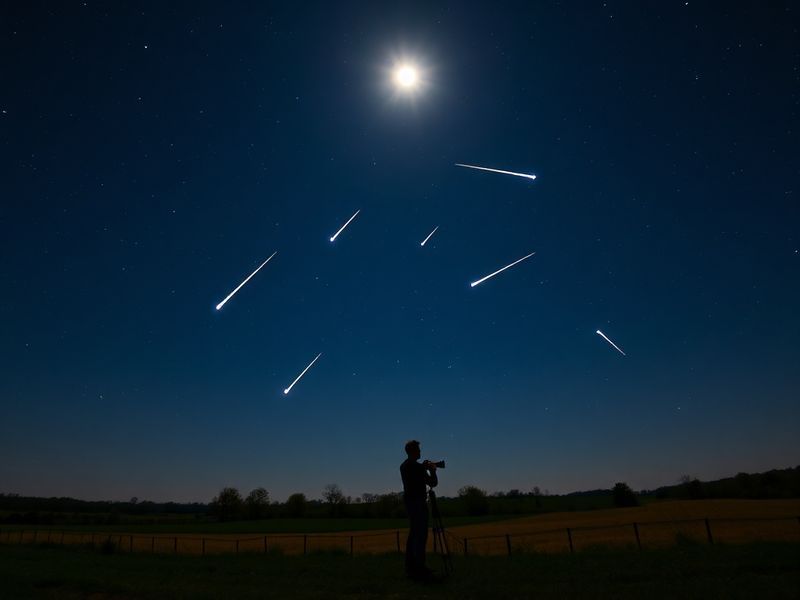
To maximize your chances of seeing a fireball or a meteor train, try watching after midnight when the radiant point is higher in the sky. The Lyrids are best observed with the naked eye, as binoculars or telescopes limit your field of view. If you’re using a camera to capture the event, a wide-angle lens and a tripod will help you capture long-exposure shots of the meteors streaking across the sky.
Photographing the Lyrids: Tips for Beginners
Capturing the Lyrid meteor shower requires some preparation, but the results can be stunning. Here’s a quick guide to get you started:
- Use a sturdy tripod: Since you’ll be taking long exposures, a tripod is essential to avoid blurry images. Even slight movements can ruin a shot.
- Set your camera to manual mode: Adjust the aperture to its widest setting (e.g., f/2.8 or lower) to allow as much light as possible into the lens.
- Use a wide-angle lens: A lens with a focal length of 14-24mm will capture a large portion of the sky, increasing your chances of catching a meteor.
- Set a high ISO: Start with ISO 1600 or 3200 and adjust based on the brightness of your surroundings. Higher ISO settings will make the image grainier but allow for shorter exposure times.
- Use a remote shutter or timer: This prevents camera shake when you press the shutter button. If you don’t have a remote, use your camera’s built-in timer.
- Take multiple shots: Set your camera to continuous shooting mode and take a series of 20-30 second exposures. Review each shot to ensure the framing and exposure are correct.
For those new to astrophotography, the Lyrids offer a great opportunity to practice. Even if you don’t capture a meteor, the long-exposure shots of the night sky can be breathtaking, especially when framed against a landscape or a familiar landmark.
Global Viewing Conditions and Weather Considerations
While the Lyrids are visible worldwide, weather and moonlight can significantly impact visibility. Tonight, the moon will be in its waxing gibbous phase, meaning it will be about 70% illuminated and may wash out fainter meteors. However, the moon will set around 3 AM in many locations, leaving a dark sky for the final hour before dawn—the optimal time for meteor watching.
Here’s a quick overview of viewing conditions in different regions:
- North America: Clear skies are expected across much of the western U.S. and Canada, while the eastern U.S. may contend with cloud cover. The Midwest and Great Lakes regions could see some breaks in the clouds.
- Europe: Northern Europe, including the UK and Scandinavia, will have cloudy conditions, while Southern Europe, including Spain and Italy, may offer clearer skies. Central Europe, including Germany and France, will have mixed conditions.
- Asia: Japan and South Korea are likely to have clear skies, while China and India may experience cloud cover. Southeast Asia, including Thailand and Vietnam, could see some breaks in the clouds.
- Australia and New Zealand: Southern Australia and New Zealand will have excellent viewing conditions, with clear skies expected across most regions.
- South America: Northern parts of South America, including Colombia and Venezuela, will have clear skies, while southern regions like Argentina and Chile may deal with cloud cover.
- Africa: Northern Africa, including Morocco and Egypt, will have clear skies, while central and southern regions may experience cloud cover.
For real-time updates on weather conditions and cloud cover, check resources like Time and Date or local meteorological services. Even if your location isn’t ideal, traveling a short distance to a darker area can dramatically improve your viewing experience.
Conclusion: A Timeless Experience
The Lyrid meteor shower is more than just a celestial event—it’s a connection to the past and a reminder of humanity’s enduring fascination with the night sky. Whether you’re an experienced astronomer or a first-time stargazer, tonight offers a chance to witness a phenomenon that has inspired awe for thousands of years. While the Lyrids may not be the most spectacular shower, their reliability and historical significance make them a must-see for anyone who looks up at the stars.
So, grab a blanket, find a dark spot, and give yourself time to enjoy the show. The Lyrids won’t produce a storm of meteors, but they offer something just as valuable: a quiet moment under the stars, a chance to reflect, and the thrill of seeing a fleeting streak of light across the sky. And who knows? You might just witness one of the Lyrids’ famous fireballs, a brilliant reminder of the universe’s beauty.
For those interested in learning more about meteor showers or other celestial events, explore our Science section for in-depth guides and updates on upcoming astronomical phenomena.
—METADATA—
{
“title”: “Lyrid Meteor Shower Tonight: Best Times and Viewing Tips”,
“metaDescription”: “The Lyrid meteor shower peaks tonight. Discover the best times to watch, global viewing conditions, and tips for photographing this historic celestial event.”,
“categories”: [“Science”, “Culture”],
“tags”: [“Lyrid meteor shower”, “stargazing tonight”, “Comet Thatcher”, “meteor shower viewing”, “Lyra constellation”],
“imageDescription”: “A wide-angle night sky photograph showing the Lyrid meteor shower with streaking meteors, the