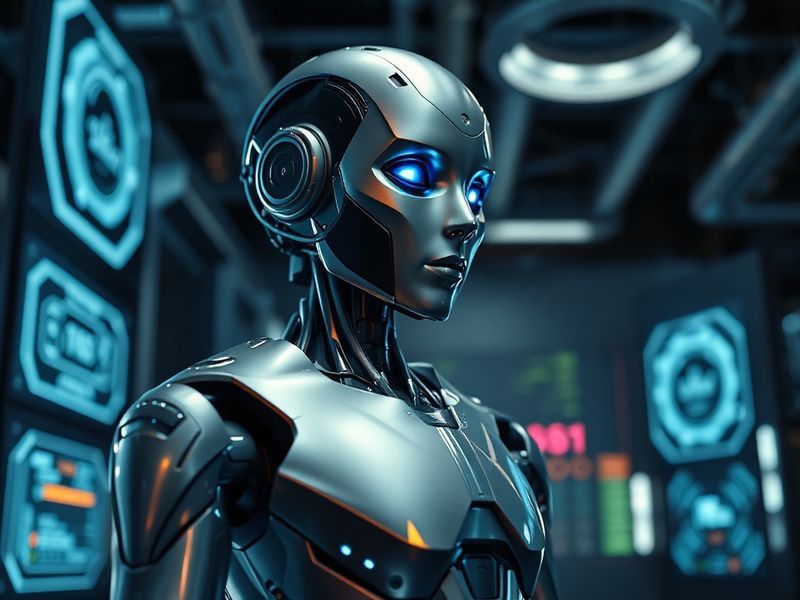
artificial intelligence
“`html
Artificial Intelligence: The Engine Reshaping Modern Life
Artificial intelligence has evolved from a distant sci-fi concept into a foundational technology that powers everything from smartphone autocorrect to autonomous delivery drones. Its integration into daily life often goes unnoticed, yet its influence is profound and accelerating. From healthcare diagnostics to financial forecasting, AI systems are not only augmenting human capabilities but also redefining what’s possible in efficiency, precision, and innovation.
While many associate AI with futuristic robots or Hollywood’s dystopian visions, the reality is more practical—and far more transformative. Today’s AI is built on decades of research in machine learning, neural networks, and data science. It thrives on data, learns from patterns, and continuously improves without human intervention. This shift from rule-based programming to adaptive, self-improving systems marks a quiet revolution in how technology interacts with the world.
The Evolution of AI: From Theory to Daily Reality
The journey of artificial intelligence began in the mid-20th century, when pioneers like Alan Turing and John McCarthy laid the groundwork for machines that could simulate human thought. Early AI systems relied on rigid rule sets and struggled with ambiguity—limitations that made them useful only in narrow, predictable domains. By the 1990s, however, advances in computing power and algorithmic design enabled breakthroughs such as IBM’s Deep Blue defeating chess champion Garry Kasparov in 1997.
The turning point came with the rise of deep learning in the 2010s. Powered by vast datasets and powerful GPUs, neural networks began to excel at tasks once thought uniquely human: recognizing faces in photos, transcribing speech, and even generating coherent text. Services like Google Translate, Siri, and Netflix recommendations are no longer novelties—they’re expected features of modern digital life. AI has moved from the lab to the living room, embedded in devices we use every day.
This evolution wasn’t just technical—it was cultural. As AI systems became more capable, public perception shifted from skepticism to cautious optimism, then to enthusiastic adoption. Today, AI is not just a tool for engineers; it’s a topic of dinner conversations, policy debates, and creative exploration. Its presence is so pervasive that many users interact with AI dozens of times daily without ever realizing it.
A Closer Look: How AI Learns and Adapts
At its core, artificial intelligence relies on algorithms that process data, identify patterns, and make predictions. Unlike traditional software, which follows explicit instructions, AI systems improve through exposure. They are trained on labeled datasets—images of cats and dogs, for instance—and gradually refine their ability to distinguish between them. Over time, they can generalize from these examples, identifying new instances with remarkable accuracy.
There are several key approaches to AI development:
- Supervised Learning: The AI is given input-output pairs and learns to map new inputs to correct outputs. Used in spam detection and medical imaging.
- Unsupervised Learning: The AI explores data without predefined labels, discovering hidden structures. Applied in customer segmentation and anomaly detection.
- Reinforcement Learning: The AI learns by trial and error, receiving rewards for correct actions. Powering robotics, game-playing AI like AlphaGo, and autonomous vehicles.
- Generative AI: Newer models like large language models (LLMs) and diffusion-based image generators create original content from learned patterns. Transforming creative industries and content production.
These systems are not perfect. They can inherit biases present in their training data, misinterpret context, or produce plausible but incorrect outputs—a phenomenon known as “hallucination” in LLMs. Ongoing research focuses on improving transparency, fairness, and reliability, ensuring AI serves diverse populations without reinforcing inequities.
Real-World Applications: Where AI Is Already Changing the Game
Artificial intelligence is no longer a futuristic promise—it’s a present-day reality transforming industries across the board. One of the most visible areas is healthcare, where AI assists in early disease detection, drug discovery, and personalized treatment planning. Hospitals use AI to analyze X-rays, MRIs, and pathology slides with speed and precision that rival—or sometimes exceed—human experts. Companies like PathAI and Zebra Medical Vision are pioneering platforms that reduce diagnostic errors and improve patient outcomes.
In finance, AI drives algorithmic trading, fraud detection, and credit scoring. Banks employ machine learning models to flag suspicious transactions in real time, adapting to new fraud patterns faster than rule-based systems ever could. Investment firms leverage predictive analytics to optimize portfolios and manage risk, while fintech startups use AI to expand access to credit for underserved populations.
The transportation sector is undergoing a quiet revolution thanks to AI. Self-driving car technology, led by companies like Waymo and Tesla, relies on deep learning models that process sensor data—lidar, radar, cameras—to navigate complex environments. While fully autonomous vehicles remain in testing phases, advanced driver-assistance systems (ADAS) are already mainstream, reducing accidents and improving traffic flow.
Even creative fields are not immune to AI’s influence. Musicians use AI to compose melodies, generate lyrics, or remix tracks. Visual artists employ tools like DALL-E and Midjourney to create original artwork from text prompts. While these developments spark debates about originality and authorship, they also democratize creativity, allowing non-experts to produce professional-quality content with minimal effort.
AI in Everyday Life: The Invisible Layer Beneath Our Screens
Many people interact with AI daily without recognizing it. Smartphone keyboards use predictive text powered by neural networks. Social media feeds are curated by recommendation algorithms that learn individual preferences. E-commerce platforms like Amazon and eBay use AI to suggest products, optimize pricing, and manage inventory. Navigation apps like Waze and Google Maps rely on real-time traffic prediction models to reroute drivers efficiently.
Voice assistants—Amazon’s Alexa, Apple’s Siri, Google Assistant—have become household staples, enabling hands-free control of smart devices, setting reminders, and answering trivia. These systems combine natural language processing (NLP) with speech recognition to understand and respond to human speech with increasing nuance. Their integration into smart speakers, cars, and appliances has made AI a constant companion in millions of homes.
Yet this ubiquity raises important questions. How much control should AI have over our decisions? Should an algorithm determine what news we see, what products we buy, or even who we date? The convenience of personalized AI comes with a trade-off: reduced privacy and the risk of echo chambers that reinforce existing beliefs.
Broader Implications: Power, Ethics, and the Future of Intelligence
The rapid advancement of AI has ignited global discussions about governance, ethics, and societal impact. Governments and international bodies are racing to establish frameworks that promote innovation while mitigating risks. The European Union’s Artificial Intelligence Act, for instance, proposes a risk-based regulatory system that bans certain uses of AI (like social scoring) and imposes strict requirements on high-risk applications (such as medical diagnostics).
Ethical concerns center on several key issues:
- Bias and Fairness: AI systems trained on biased data can perpetuate discrimination in hiring, lending, and law enforcement. Addressing this requires diverse training datasets and ongoing audits.
- Accountability: When an AI makes a harmful decision—such as a self-driving car causing an accident—who is responsible? The developer? The user? The vehicle’s owner?
- Job Displacement: Automation threatens certain professions, particularly in manufacturing, customer service, and data entry. Reskilling programs and policy interventions are critical to smooth transitions.
- Misinformation: Generative AI can produce deepfake videos, fake news articles, and synthetic voices indistinguishable from real people. This challenges trust in media and public discourse.
- Autonomy and Consent: AI systems often collect and analyze personal data without explicit consent. The balance between innovation and individual privacy remains unresolved.
Beyond ethics, AI is reshaping geopolitical dynamics. Nations that lead in AI development—such as the United States and China—are investing billions in research, infrastructure, and talent acquisition. AI is increasingly a matter of national security, with implications for cyber warfare, surveillance, and strategic decision-making. The global AI race has intensified competition not just in technology, but in ethics and values—raising the stakes for international cooperation.
The Human Element: Collaboration, Not Replacement
Despite concerns about AI replacing human jobs, most experts agree that AI’s greatest potential lies in collaboration. Rather than rendering humans obsolete, AI augments human capabilities—enabling doctors to diagnose diseases faster, engineers to design safer structures, and educators to personalize learning. The most successful organizations are those that integrate AI as a decision-support tool, empowering workers to focus on creativity, empathy, and complex judgment.
Consider the role of AI in education. Platforms like Khan Academy and Duolingo use adaptive learning algorithms to tailor lessons to individual students’ strengths and weaknesses. Teachers, rather than being replaced, gain insights into student progress and can intervene where needed. This synergy between human insight and machine efficiency is the future of work across sectors.
Conclusion: Navigating the AI-Powered Future
Artificial intelligence is not a distant dream—it is the engine of today’s digital transformation. From the mundane to the monumental, AI is reshaping how we live, work, and interact with the world. Its benefits are undeniable: faster diagnoses, smarter cities, more accessible education, and tools that unlock human potential. Yet its challenges demand proactive, thoughtful responses—ethical guidelines, transparent governance, and inclusive development practices.
The path forward requires more than technological innovation. It calls for a societal reckoning with what we value: privacy, fairness, accountability, and human dignity. As AI continues to evolve, so too must our frameworks for understanding it. The goal is not to halt progress, but to guide it—ensuring that artificial intelligence serves humanity, rather than the other way around.
One thing is certain: the AI revolution is not coming. It’s already here. The question is whether we will shape it—or be shaped by it.
Explore more about how AI intersects with technology and culture by visiting Technology and Science