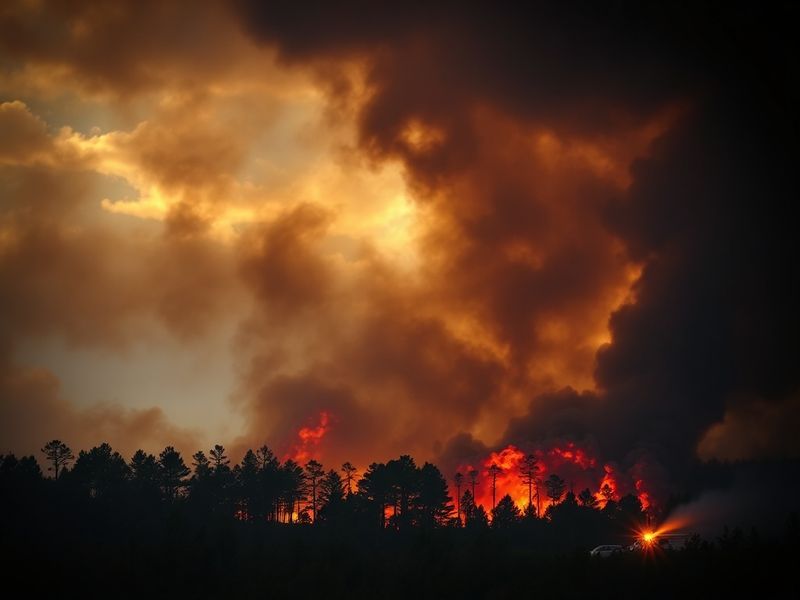
The Brantley County fire, which began on the evening of October 12, 2023, quickly escalated into one of the most challenging wildfire events in southeastern Georgia’s recent history. Originating near the Satilla River basin, the fire spread rapidly due to dry conditions and strong winds, threatening both rural communities and natural habitats. Firefighters from multiple agencies, including the Georgia Forestry Commission and local volunteer units, worked around the clock to contain the blaze, which ultimately scorched over 12,000 acres before containment was achieved.
The Immediate Response: A Race Against Time
Emergency responders were first alerted to the fire at approximately 6:45 PM on October 12, after reports of smoke near the intersection of Highway 82 and County Road 125. Within 90 minutes, a Level 3 wildfire alert was issued by the Georgia Forestry Commission, prompting a coordinated response involving over 300 personnel. The fire’s proximity to residential areas, including parts of Hoboken and Nahunta, forced mandatory evacuations for nearly 2,000 residents.
Evacuation efforts were complicated by limited visibility due to thick smoke, which reduced visibility on local roads to less than 50 feet at times. The Ware County Emergency Management Agency activated its emergency operations center, coordinating with Brantley County officials to establish multiple evacuation shelters. Residents were directed to the Hoboken Recreation Center and the Nahunta Gym, where Red Cross volunteers provided food, water, and temporary lodging.
Local schools in Brantley County, including Hoboken Elementary and Nahunta Primary, were closed for three consecutive days as a precaution. The Brantley County School District also canceled all extracurricular activities during that period, prioritizing student safety. Officials urged residents to remain indoors, close windows, and use air purifiers if available, as air quality levels reached “unhealthy” levels according to the Environmental Protection Agency’s Air Quality Index.
Challenges Faced by Firefighters
Firefighters encountered several obstacles that prolonged containment efforts. The terrain in the Satilla River basin is densely wooded with thick underbrush, making access difficult for heavy equipment. Additionally, the region had experienced below-average rainfall for six consecutive weeks, creating tinder-dry conditions that allowed the fire to spread at an alarming rate.
One of the most significant challenges was the fire’s erratic behavior. On October 14, embers carried by 25-mile-per-hour winds jumped containment lines, reigniting hotspots nearly a mile ahead of the fire front. Firefighters resorted to using aerial assets, including helicopters equipped with Bambi buckets, to drop water on advancing flames. The Georgia National Guard also deployed two Black Hawk helicopters to assist with reconnaissance and water drops.
Another complication arose from the fire’s impact on critical infrastructure. A major natural gas pipeline operated by Southern Company Gas runs through the affected area, and while the company reported no damage to the pipeline itself, the fire forced temporary shutdowns of two compressor stations. This disruption led to brief natural gas shortages in portions of Brantley and Ware counties, though service was restored within 48 hours.
Volunteer firefighters from neighboring counties played a crucial role in mitigating the crisis. Over 150 volunteers from the Camden County Fire Rescue and Glynn County Fire Department joined the effort, providing much-needed manpower for structure protection and evacuation support. Their contributions were recognized in a joint statement from Brantley County Commission Chair Jimmy Ricketson, who praised their dedication.
Long-Term Recovery and Environmental Impact
The aftermath of the Brantley County fire has raised concerns about long-term environmental and economic impacts. Ecologists from the University of Georgia’s Warnell School of Forestry and Natural Resources are monitoring the burn scar to assess damage to local ecosystems. The fire primarily affected longleaf pine forests, a critical habitat for the endangered red-cockaded woodpecker. Early surveys indicate that while the woodpecker population in the immediate burn area appears to have survived, the fire may have disrupted nesting sites that could take years to recover.
Agriculture, another key industry in Brantley County, has also suffered. Local pecan farmers reported losses of up to 30% in unharvested crops due to smoke damage and reduced sunlight during the fire’s peak. The pecan harvest, which typically concludes in late October, was delayed for nearly two weeks as farmers waited for smoke to clear. The Georgia Department of Agriculture has pledged financial assistance to affected growers, though the application process remains ongoing.
On a positive note, the fire’s impact on local wildlife has been less severe than initially feared. Wildlife officials from the Georgia Department of Natural Resources reported that most larger mammals, including deer and feral hogs, were able to flee the area before the fire became unmanageable. However, smaller species such as gopher tortoises, which move slowly and rely on burrows for shelter, faced higher mortality rates. Conservationists are now focusing on habitat restoration efforts to support these populations.
Community Resilience and Lessons Learned
The Brantley County fire has underscored both the vulnerabilities and strengths of rural communities in the face of natural disasters. In the weeks following the fire, residents came together to support one another through volunteer clean-up efforts and fundraising initiatives. The Brantley County Chamber of Commerce organized a “Rebuild Brantley” fundraiser, which raised over $50,000 in less than a month. These funds are earmarked for assisting displaced families and covering uninsured property damage.
Local officials have also emphasized the importance of proactive measures to prevent future wildfires. Brantley County Fire Chief Mike Smith noted that while wildfires are a natural part of the ecosystem in the southeastern United States, human activity often exacerbates their severity. He pointed to a recent increase in illegal campfires and discarded cigarettes as significant contributors to fire starts in the region. In response, the county has launched a public awareness campaign titled “One Spark, One Acre,” aimed at educating residents on fire safety and proper outdoor burning practices.
The fire has also prompted discussions about improving emergency response infrastructure. The Ware County Emergency Management Agency has requested additional funding to upgrade its communication systems, which were overwhelmed during the evacuation process. Currently, the agency relies on a mix of VHF radios and digital alert systems, but officials hope to implement a county-wide emergency notification app in the coming year.
For those looking to support ongoing recovery efforts, several local organizations are accepting donations. The Brantley County Disaster Relief Fund, managed by the United Way of Southeast Georgia, has been designated by the Federal Emergency Management Agency (FEMA) to distribute aid to affected residents. Donations can be made online at Dave’s Locker Community Disaster Relief.
As Brantley County continues to recover, the fire serves as a reminder of the unpredictable nature of wildfires and the importance of community preparedness. While the scars left by the fire may take years to fully heal, the resilience demonstrated by residents, firefighters, and volunteers offers a hopeful outlook for the future. For now, the focus remains on rebuilding, restoring, and ensuring that the lessons learned will help protect the community in the years to come.