self driving uber
“`html
Self-Driving Uber: The Road to Autonomous Ridesharing
Uber’s push into autonomous vehicle (AV) technology represents one of the most ambitious experiments in modern transportation. Since launching its first self-driving pilot in Pittsburgh in 2016, the ride-hailing giant has invested billions to redefine urban mobility. The goal isn’t just to replace drivers—it’s to reshape how people move through cities, reduce accidents, and unlock new economic models. Yet the path has been anything but smooth.
The Early Days: Testing and Trials
Uber’s self-driving program began under the leadership of Anthony Levandowski, a controversial engineer recruited from Google’s Waymo. Early tests in Pittsburgh used modified Volvo SUVs equipped with LiDAR, cameras, and AI software. In 2017, a self-driving Uber struck and killed a pedestrian in Tempe, Arizona, halting operations nationwide. The tragedy exposed the fragility of autonomous systems and forced Uber to rethink its approach.
After a temporary shutdown, Uber resumed testing with stricter safety protocols. Engineers refined algorithms to better detect pedestrians, cyclists, and unpredictable human behaviors. By 2019, the company relaunched in Pittsburgh and expanded to Toronto and San Francisco. Yet skepticism lingered. Could AI truly match the intuition of human drivers? Would passengers trust a car without a steering wheel?
Key Milestones in Uber’s AV Development
- 2016: First autonomous Uber rides in Pittsburgh with safety drivers.
- 2017: Expansion to Phoenix, San Francisco, and Toronto.
- 2018: Fatal crash in Tempe leads to temporary shutdown of AV program.
- 2019: Relaunch with enhanced safety measures and partnerships with Volvo and Toyota.
- 2020: Uber sells its AV unit to Aurora Innovation, shifting focus to software and partnerships.
The Business Case: Why Uber Wanted Self-Driving Cars
For Uber, autonomy wasn’t just a technological pursuit—it was a financial imperative. Driver wages consume up to 75% of ride-hailing revenue. Eliminating human drivers could slash costs, increase profit margins, and scale operations exponentially. Analysts projected that autonomous fleets could reduce ride prices by 30-50%, making Uber even more competitive against taxis and public transit.
Yet the math was never that simple. Developing AV technology required massive upfront investment. Uber spent over $1 billion on its self-driving unit before selling it. Meanwhile, competitors like Waymo and Cruise (GM’s AV division) raced ahead with more conservative, safety-first approaches. Uber’s aggressive timeline clashed with the harsh reality of real-world AI limitations.
In late 2020, Uber sold its Advanced Technologies Group to Aurora Innovation for $4 billion in stock, effectively exiting the hardware race. The move signaled a strategic pivot: Uber would focus on being a software platform for autonomous vehicles rather than building its own cars. This shift aligned with its core business—connecting riders with drivers (or soon, AV fleets operated by partners).
Broader Implications: Safety, Jobs, and Urban Life
The implications of autonomous ridesharing extend far beyond corporate balance sheets. Safety remains the most scrutinized issue. The National Highway Traffic Safety Administration (NHTSA) reports that human error contributes to 94% of crashes. If AVs can reduce that number, the societal benefit could be enormous. Yet the Tempe fatality proved that autonomous systems aren’t infallible. Trust in the technology hinges on proving it’s safer than human drivers—a standard that’s still unmet.
Job displacement is another concern. Uber and Lyft employ millions of drivers worldwide. A full shift to autonomy could displace these workers, exacerbating economic inequality. Uber has pledged to retrain drivers for other roles, such as vehicle maintenance or customer service, but the transition risks leaving many behind. Cities like San Francisco and Los Angeles, where ride-hailing is ubiquitous, could face social upheaval if thousands lose their livelihoods overnight.
On a broader scale, autonomous ride-hailing could redefine urban design. Fewer cars on the road might reduce congestion and emissions. Parking lots could be repurposed for housing or green spaces. Yet the rise of robotaxis might also encourage more car trips, negating some environmental gains. The net effect depends on how the technology is deployed—and whether cities regulate it effectively.
What’s Next for Self-Driving Uber?
- Partnerships Over Production: Uber’s focus is now on integrating AVs from partners like Waymo and Aurora into its platform.
- Regulatory Battles: States like California and Arizona are hotly contested arenas for AV testing and deployment.
- Public Acceptance: Surveys show mixed trust in self-driving cars, with safety and reliability as top concerns.
- Infrastructure Investments: Cities may need to upgrade roads, traffic signals, and digital networks to support AVs.
Conclusion: A Pivotal Moment for Mobility
Uber’s self-driving journey reflects both the promise and peril of autonomous technology. While the company no longer builds its own AVs, its role as a platform could make it the dominant force in autonomous ridesharing. The next decade will determine whether AVs live up to their potential—or remain a niche experiment. One thing is clear: the road to autonomous ride-hailing is far from over.
For now, human drivers remain essential to Uber’s operations. But as the technology matures, the balance will shift. Cities, regulators, and consumers must prepare for a future where the car drives itself—and the implications ripple through every aspect of urban life.
For more on the intersection of technology and transportation, visit our Technology and Automotive sections.
—
METADATA
{
“title”: “Self-Driving Uber: The Future of Autonomous Ridesharing”,
“metaDescription”: “Uber’s self-driving cars aim to revolutionize ridesharing but face safety, regulatory, and economic hurdles.”,
“categories”: [“Technology”, “Automotive”],
“tags”: [“autonomous vehicles”, “Uber self-driving”, “AV technology”, “ride-hailing future”, “urban mobility”],
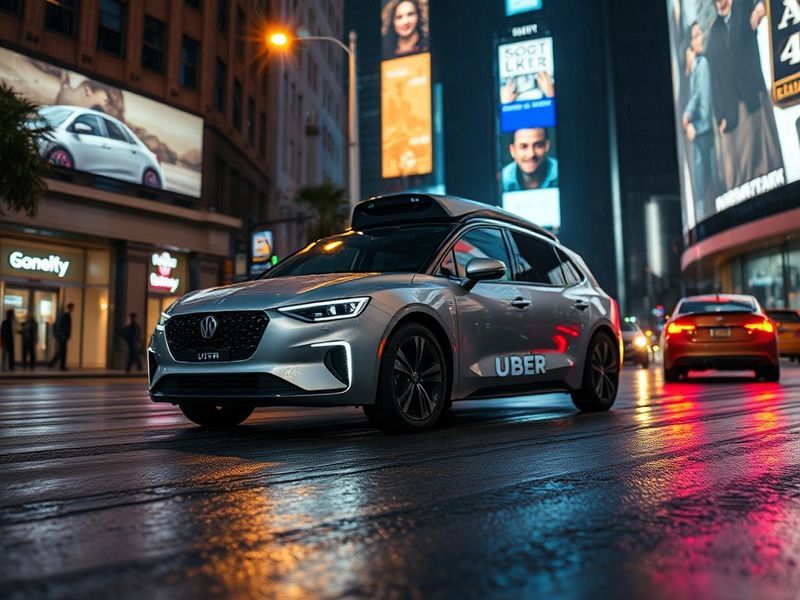
“imageDescription”: “A futuristic Uber self-driving car on a city street at dusk, with visible LiDAR sensors and a glowing interface, surrounded by blurred urban lights and pedestrians.”
}
—END METADATA—
“`