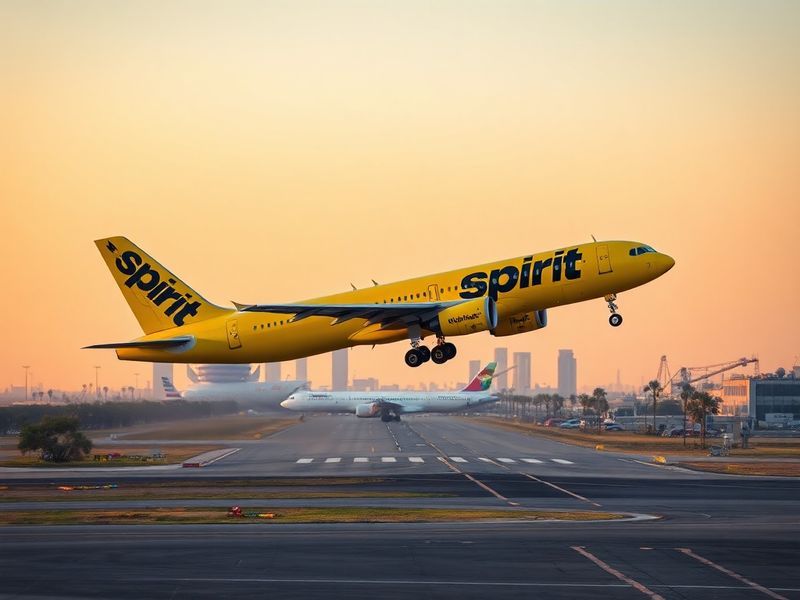
Spirit Airlines Stock: Low-Cost Model Faces Investor Scrutiny
“`html
Spirit Airlines Stock: A Low-Cost Carrier Under Pressure
Spirit Airlines has long been a darling of budget travelers, offering rock-bottom fares that made air travel accessible to millions. However, the airline’s stock performance tells a different story—one marked by volatility, operational challenges, and shifting investor sentiment. As the global aviation industry continues to recover from pandemic disruptions, Spirit’s stock remains a focal point for analysts and investors alike.
The carrier’s business model, built on ultra-low-cost operations, has both advantages and vulnerabilities. While it appeals to cost-conscious passengers, it also faces intense competition from other budget airlines and legacy carriers expanding into the low-cost market. This delicate balance has contributed to inconsistent financial results, leaving shareholders questioning the airline’s long-term trajectory.
The Business Model That Shaped Spirit’s Identity
Spirit Airlines was founded in 1980 as Charter One, a Detroit-based tour operator. By the late 1990s, it had pivoted to scheduled flights, adopting a no-frills approach that minimized operational costs. This strategy allowed Spirit to undercut competitors on ticket prices while still turning a profit through ancillary revenue—charging for everything from carry-on bags to seat selection.
The model proved successful in the U.S. domestic market, where it carved out a niche among budget-conscious travelers. However, as other airlines began adopting similar strategies, Spirit’s competitive edge started to erode. The airline’s reliance on ancillary fees also made it vulnerable to shifts in consumer behavior, particularly as travelers became more selective about where they spend their money.
Internationally, Spirit’s influence has been limited. While it has expanded into parts of Latin America and the Caribbean, its global footprint remains modest compared to giants like Delta or United. This regional focus has made Spirit more susceptible to domestic economic trends, such as fuel price fluctuations and changes in U.S. travel demand.
Stock Performance: A Rollercoaster Ride
Spirit Airlines’ stock (NASDAQ: SAVE) has experienced significant volatility over the past decade. After going public in 2011, the stock saw steady growth, peaking in 2018 at around $90 per share. However, a series of operational missteps, including frequent flight cancellations and customer service complaints, weighed heavily on investor confidence.
The COVID-19 pandemic delivered another blow, sending the stock plummeting to below $10 at its lowest point in 2020. While the airline rebounded as travel demand recovered, its stock has struggled to regain its pre-pandemic highs. As of mid-2024, Spirit’s stock hovers around $25-$30, reflecting ongoing concerns about its ability to sustain profitability.
Several key factors have influenced Spirit’s stock performance:
- Fuel Costs: Like all airlines, Spirit is highly sensitive to fuel price fluctuations. Sharp increases in jet fuel costs can squeeze profit margins, particularly for a low-cost carrier with thin margins.
- Competitive Pressure: The rise of ultra-low-cost carriers like Frontier Airlines and Allegiant Air has intensified competition, forcing Spirit to adjust its pricing strategies.
- Operational Challenges: Delays, cancellations, and labor shortages have repeatedly impacted Spirit’s reputation and financial performance.
- Mergers and Acquisitions: Spirit’s proposed merger with JetBlue, announced in 2022, was blocked by regulators, leaving shareholders uncertain about the airline’s future direction.
Global Context: How Spirit Compares to International Low-Cost Carriers
Spirit’s struggles are not unique in the global aviation industry. Low-cost carriers (LCCs) around the world have faced similar challenges, though some have fared better than others. For example, Europe’s Ryanair and EasyJet have maintained strong financial performance by focusing on efficiency and customer service. Meanwhile, Asian LCCs like AirAsia and Lion Air have benefited from robust regional travel demand.
The key difference lies in Spirit’s heavy reliance on the U.S. domestic market. While international LCCs often operate in regions with growing middle classes and increasing air travel demand, Spirit’s fortunes are tied to the economic health of the United States. This dependence makes it more vulnerable to domestic recessions or shifts in travel behavior.
Culturally, Spirit’s brand has also struggled to resonate globally. While it is well-known in the U.S., its reputation for nickel-and-diming passengers has made it less appealing in markets where travelers prioritize service and convenience. This perception has limited its ability to expand beyond its core U.S. customer base.
What’s Next for Spirit Airlines and Its Investors?
Looking ahead, Spirit Airlines faces a critical juncture. The airline must balance its low-cost model with improved operational reliability and customer satisfaction. Investors will be watching closely for signs of stabilization, such as consistent profitability, reduced flight cancellations, and a clear path to growth.
One potential avenue for improvement is expanding Spirit’s international presence. While the U.S. market remains its primary focus, targeted expansion into Latin America or the Caribbean could diversify its revenue streams. However, such moves require significant investment and careful execution to avoid repeating past mistakes.
For shareholders, Spirit’s stock remains a high-risk, high-reward proposition. The airline’s future will depend on its ability to adapt to changing market conditions, manage costs effectively, and rebuild trust with both customers and investors. Until then, Spirit Airlines’ stock will likely continue to reflect the challenges of operating in one of the world’s most competitive industries.
For those interested in broader trends in the aviation industry, check out our Travel section for more insights into how airlines are navigating a rapidly evolving landscape.