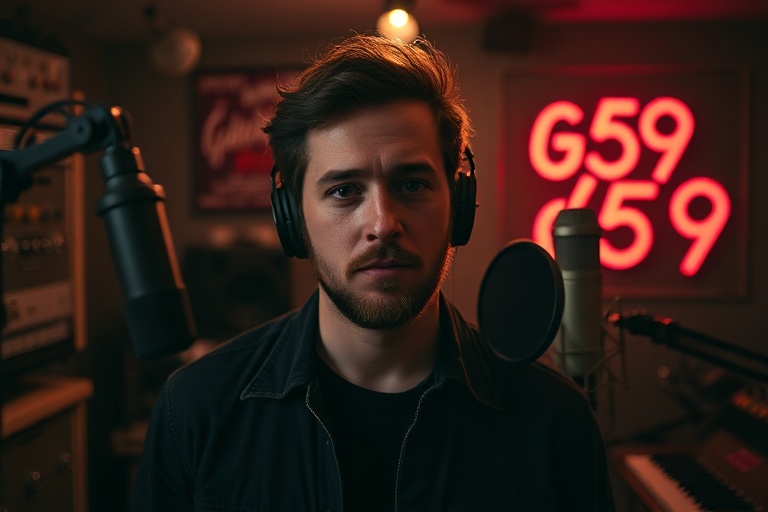
Krish Bhagat: How a 24-Year-Old Is Redefining Digital Art
Krish Bhagat has emerged as a dynamic force in contemporary creative industries, blending artistic vision with technical innovation. At just 24 years old, the Mumbai-born polymath has already made waves across digital art, music production, and interactive design. His work challenges conventional boundaries, merging traditional aesthetics with cutting-edge technology to create immersive experiences that captivate global audiences.
While still early in his career, Bhagat’s projects have garnered attention for their emotional depth and technical precision. From AI-assisted visual art to generative soundscapes, his portfolio reflects a restless curiosity and a commitment to pushing creative limits. This exploration examines the factors behind his rapid ascent and what his trajectory suggests about the future of interdisciplinary art.
Early Influences and Artistic Development
Bhagat’s creative journey began in his teenage years, when he first experimented with digital tools as a way to process complex emotions. Unlike many artists who follow a linear path, he resisted formal training in favor of self-directed learning, drawing inspiration from street art, electronic music, and experimental cinema. The absence of academic constraints allowed him to develop a distinct voice—one that values intuition as much as technical skill.
A pivotal moment came during the pandemic, when Bhagat began translating his inner landscapes into digital form. Using open-source software and custom scripts, he created a series of visual poems that combined hand-drawn elements with algorithmic motion. These early works, shared on social platforms, caught the attention of digital art curators and laid the foundation for his professional practice.
Key Turning Points in Bhagat’s Career
- 2020: Released first generative art collection on Foundation, selling out within hours.
- 2021: Collaborated with an indie game studio to design ambient soundscapes for a narrative adventure.
- 2022: Featured in Art Review Asia as part of a “New Voices” series highlighting South Asian creators.
- 2023: Launched Echo Chambers, an interactive installation blending AI and audience participation.
Signature Style and Creative Philosophy
Bhagat’s work is defined by a dialogue between control and chaos. He often begins with a conceptual framework—such as memory, identity, or ecological decay—but allows algorithms to introduce unpredictability. The result is art that feels both deeply personal and universally resonant. His use of real-time data—weather patterns, social media feeds, urban noise—further blurs the line between creator and audience, making each viewing experience unique.
He describes his process as “collaborative composition,” where human intention and machine interpretation coexist. “I’m not interested in art that simply illustrates an idea,” Bhagat said in a 2023 interview. “I want work that evolves, that responds, that invites the viewer to become part of the system.” This philosophy has led to collaborations with neuroscientists studying synesthesia and urban planners modeling pedestrian flows through sound.
Broader Implications for Creative Industries
The rise of creators like Bhagat signals a shift in how value is assigned in digital art. Traditionally, scarcity and originality were prized, but Bhagat leverages reproducibility and variability to create new forms of engagement. His NFT projects, for instance, don’t rely on static images but on evolving ecosystems that change based on external inputs. This challenges collectors to rethink ownership and authenticity in an age of infinite replication.
In music, his experiments with AI-driven composition are democratizing production. By releasing custom tools and tutorials, he empowers other artists to explore generative sound without deep technical expertise. This open-source ethos aligns with broader trends in the creator economy, where collaboration often outweighs competition.
Moreover, Bhagat’s work intersects with ethical debates about AI in art. While some critics argue that algorithmic creation diminishes human agency, Bhagat positions technology as an extension of creativity—not a replacement. “The machine doesn’t make the art,” he clarifies. “It helps me see connections I wouldn’t otherwise notice.” This nuanced view invites deeper discussion about the role of tools in artistic expression.
What’s Next for Krish Bhagat
With several high-profile commissions on the horizon, including a public art installation in Berlin and a VR collaboration with a Japanese studio, Bhagat is poised to expand his global footprint. He’s also developing a mentorship platform to support young artists in the Global South, aiming to bridge gaps in access to digital tools and networks.
Looking further ahead, he hints at exploring biophilic design—integrating living systems into digital interfaces—and neuroaesthetics, studying how art affects brain activity. If his past is any indication, the next phase of his career will continue to challenge expectations and redefine what it means to be a creator today.
Why Bhagat Matters
In an era dominated by algorithmic culture and attention economies, Krish Bhagat represents a counter-movement: one that prioritizes depth over virality, process over product, and collaboration over individualism. His work doesn’t just reflect the present; it actively reshapes the creative landscape for future generations.
As digital art evolves from novelty to mainstream medium, figures like Bhagat serve as both guides and provocateurs. They remind us that technology, when wielded thoughtfully, can amplify human expression rather than dilute it. And in doing so, they offer a hopeful vision of what art—and artists—can become.
Explore more about digital art and creative innovation on Entertainment and Technology at Dave’s Locker.