The Pantheon stands as one of humanity’s most enduring architectural achievements—a structure that has defied centuries while continuing to inspire awe. Completed around 126 AD under Emperor Hadrian, this ancient Roman temple has transitioned from a pagan worship site to a Christian church, a tourist magnet, and a subject of scholarly fascination. Its massive dome, unrivaled in size for over a millennium, remains a marvel of engineering and aesthetics.
Beyond its physical grandeur, the Pantheon embodies the Roman Empire’s ambition, ingenuity, and cultural synthesis. It reflects a society that borrowed from Greek aesthetics, Egyptian materials, and its own innovations to create something transcendent. Today, it serves as both a historical artifact and a living monument, challenging modern architects to reconsider what permanence means.
The Pantheon’s Architectural Innovations
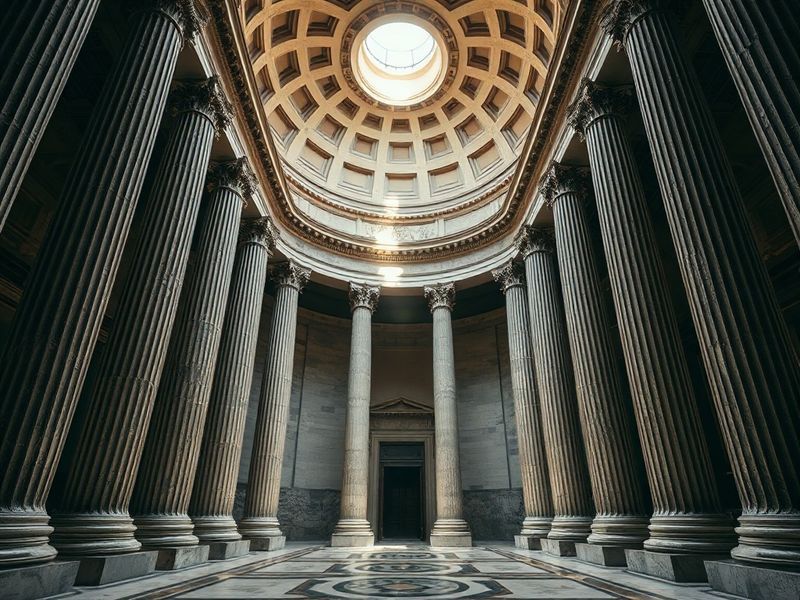
The Pantheon’s most striking feature is its unreinforced concrete dome, a feat of ancient engineering. At 43.3 meters (142 feet) in diameter, it remains the world’s largest unreinforced concrete dome—a record that stood unchallenged until the 20th century. The dome’s weight is cleverly distributed through a series of coffers (square recessed panels), reducing the overall mass while adding visual rhythm. The oculus at the dome’s apex, 8.7 meters wide, serves as both a structural relief and a symbolic connection to the heavens.
Materials were chosen with precision. Roman concrete, mixed with volcanic ash (pozzolana), was used for its durability. The lower walls, nearly six meters thick, incorporate alternating layers of brick and travertine, while the upper dome transitions to lighter pumice stone. The façade, a harmonious blend of Corinthian columns and triangular pediment, mimics the design of traditional Greek temples, reinforcing the Roman synthesis of Greek and Etruscan traditions.
Inside, the interplay of light and shadow heightens the structure’s drama. The oculus casts a moving spotlight on the interior, illuminating the marble floors and walls in shifting patterns throughout the day. This dynamic experience underscores the Pantheon’s dual role as both a temple and a celestial observatory—a reminder of Rome’s fascination with cosmic order.
From Pagan Temple to Christian Church: A Legacy of Adaptation
The Pantheon’s survival owes much to its reinvention. By the 7th century, as Rome’s pagan traditions waned, Pope Boniface IV consecrated the building as the Church of Santa Maria ad Martyres in 609 AD. This transition preserved the structure, albeit with modifications: pagan altars were replaced with Christian iconography, and the original bronze doors, though now slightly diminished, still guard the entrance.
This adaptability highlights a broader Roman principle: the empire’s ability to absorb and repurpose elements of conquered cultures. The Pantheon’s transformation mirrors Rome’s own evolution—from a martial power to a spiritual and cultural center. Its continued use as a church, now hosting the tombs of Renaissance figures like Raphael, further cements its role as a bridge between antiquity and modernity.
Today, the Pantheon operates as both a place of worship and a secular monument. The Italian government maintains it as a state property, balancing preservation with public access. This dual function raises questions about heritage management in an era where historical sites face commercial pressures and environmental threats.
Broader Implications: What the Pantheon Teaches Us
The Pantheon’s endurance offers lessons that extend beyond architecture. Its longevity challenges the modern obsession with disposable design, proving that structures built with intention and craftsmanship can outlast empires. The use of concrete, a material still central to construction today, underscores the importance of material science in longevity.
Culturally, the Pantheon exemplifies the power of synthesis. Rome didn’t invent the dome or the temple form, but it perfected them by integrating diverse influences. This model of cultural hybridization remains relevant in today’s globalized world, where hybrid identities and blended traditions shape societies.
The Pantheon also raises ethical questions about preservation. How much should a site be restored versus preserved in its aged state? The recent restoration of the interior marble, completed in 2023, sparked debates about authenticity and intervention. These discussions are vital as climate change and tourism threaten historic sites worldwide.
Key Takeaways: Why the Pantheon Still Matters
The Pantheon is more than a relic; it is a living testament to human creativity and adaptability. Below are its most enduring lessons:
- Engineering Brilliance: The dome’s construction remains unmatched in scale and durability, showcasing Roman innovation in concrete and structural design.
- Cultural Synthesis: The Pantheon blends Greek aesthetics, Egyptian materials, and Roman ambition, demonstrating the power of integration.
- Adaptive Reuse: Its transition from temple to church highlights the importance of flexibility in preserving heritage.
- Symbol of Permanence: Despite political and cultural upheavals, the Pantheon endures, challenging modern notions of impermanence.
- Contemporary Relevance: Its preservation debates force us to confront ethical questions about authenticity and intervention in historic sites.
For those interested in exploring similar architectural marvels, Dave’s Locker’s Travel section offers insights into other historic structures and their cultural contexts. Alternatively, the Analysis section delves into the broader implications of preserving our built heritage.
Conclusion: A Monument That Transcends Time
The Pantheon is a paradox—a building both ancient and modern, static yet dynamic, pagan and Christian. Its dome, still the largest unreinforced concrete dome in the world, defies the passage of time, while its interior light shifts with the sun’s trajectory, reminding visitors of the cosmos’s constancy. In an age of rapid obsolescence, the Pantheon stands as a quiet rebuke to the throwaway culture of the 21st century.
Its story is one of resilience, adaptation, and the unyielding human desire to create something lasting. Whether viewed as a marvel of engineering, a canvas of cultural history, or a philosophical meditation on time, the Pantheon endures as a symbol of what humanity can achieve when ambition is tempered by wisdom. As we continue to build and preserve, the lessons of the Pantheon remain as relevant as ever—reminding us that true greatness is not measured in fleeting trends, but in the timeless echoes of our creations.