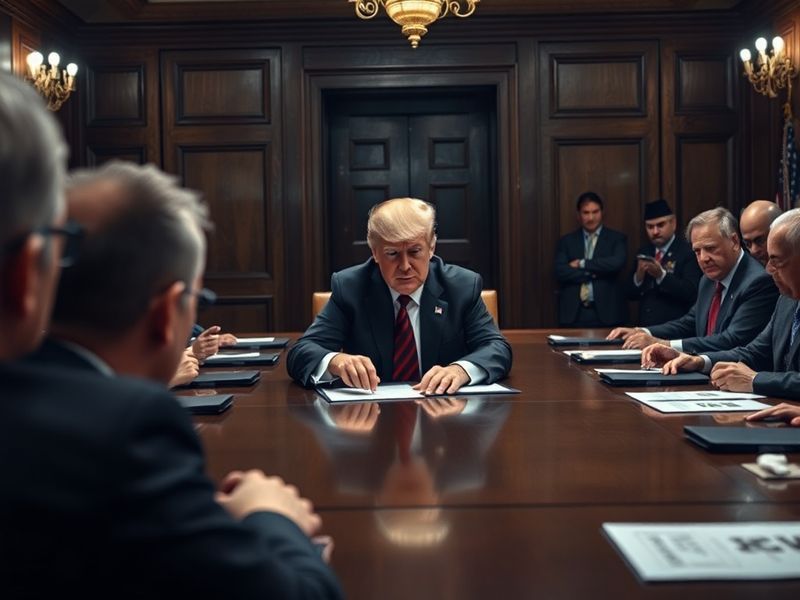
Trump’s 2024 Ceasefire Plans: A New Era in Global Diplomacy?
“`html
Understanding the 2024 Trump Ceasefire Proposals in the Middle East
The 2024 ceasefire proposals linked to Donald Trump have drawn international attention, not only for their geopolitical implications but also for their timing and the unique approach they represent. As the former U.S. president continues to shape global discourse through social media and public statements, his involvement in ceasefire negotiations—particularly in the Middle East—has sparked both cautious optimism and skepticism among analysts, diplomats, and citizens worldwide.
Trump’s ceasefire initiatives are not occurring in a vacuum. They follow years of escalating conflict in regions like Gaza, Ukraine, and the South China Sea, where traditional diplomatic channels have struggled to yield lasting resolutions. His proposals, often delivered via Truth Social or through intermediaries, reflect a blend of transactional diplomacy and high-profile mediation—an approach consistent with his presidency’s broader foreign policy style. This style prioritized direct negotiation, personal relationships with world leaders, and a willingness to bypass conventional diplomatic protocols.
The Origins of Trump’s Ceasefire Diplomacy
Trump’s engagement in ceasefire talks can be traced back to his post-presidency influence, where he positioned himself as a dealmaker capable of resolving intractable conflicts. Unlike traditional diplomats, Trump leveraged his celebrity status and media savvy to insert himself into high-stakes negotiations. In 2023, for example, he publicly called for a ceasefire in Gaza, urging both Israeli and Palestinian leaders to accept a temporary halt to hostilities. His statements were amplified by conservative media outlets and supporters, creating a parallel track to official U.S. and UN efforts.
The 2024 proposals expanded on this strategy, with Trump hinting at a “Trump Peace Plan” that would involve economic incentives, security guarantees, and possibly even U.S. troop deployments as part of a broader stabilization effort. While details remain scarce, the framing of these proposals aligns with Trump’s long-standing belief in leveraging American power—military, economic, and diplomatic—to secure favorable outcomes.
Global Reactions: Support, Skepticism, and Geopolitical Tensions
The international response to Trump’s ceasefire proposals has been mixed. In Israel, some officials have expressed openness to discussions facilitated by Trump, citing his administration’s strong pro-Israel stance during his presidency. Others, however, remain wary of his unpredictable negotiating style and the potential for abrupt policy shifts. Meanwhile, Palestinian leaders and their allies have criticized Trump’s proposals as insufficient, arguing that they lack concrete commitments to Palestinian statehood or an end to occupation.
Across Europe and Asia, reactions have varied. European Union diplomats have largely dismissed Trump’s efforts as unserious, preferring to rely on established multilateral frameworks. In contrast, leaders in some Middle Eastern countries—such as Saudi Arabia and the UAE—have shown cautious interest, viewing Trump’s involvement as a potential counterbalance to Iranian influence in the region.
In Ukraine, Trump’s calls for a ceasefire have reignited debates about U.S. involvement in the war. While some Ukrainian officials have welcomed any diplomatic effort to end the conflict, others fear that Trump’s proposals could pressure Ukraine into accepting unfavorable terms, particularly if they involve territorial concessions. The Kremlin, meanwhile, has remained silent on Trump’s ceasefire calls, though Russian state media has occasionally highlighted his statements as evidence of growing U.S. disunity.
A Closer Look at the Proposed Framework
While Trump has not released a formal ceasefire document, leaked details and media reports suggest a framework that includes several key components:
- Humanitarian pauses: Temporary halts to hostilities to allow for aid delivery and civilian evacuations.
- Economic incentives: Promises of U.S.-led investment and reconstruction funding for war-torn regions, contingent on compliance with ceasefire terms.
- Security guarantees: Commitments from the U.S. to provide military or intelligence support to enforce the ceasefire and deter violations.
- Political concessions: Vague references to future negotiations on core issues such as borders, refugees, or sovereignty—though specifics are notably absent.
Critics argue that this framework lacks the depth and specificity required for a sustainable peace. They point out that previous ceasefire agreements—such as those brokered by the UN or regional powers—often collapsed due to lack of enforcement mechanisms or unresolved underlying grievances. Trump’s proposals, they contend, risk repeating these failures by prioritizing short-term stability over long-term reconciliation.
Proponents, however, see potential in Trump’s unorthodox approach. They highlight his ability to bring together unlikely allies, such as during the Abraham Accords, where he brokered normalization agreements between Israel and several Arab states. Skeptics counter that those agreements were largely symbolic and did not address the Palestinian issue, raising questions about whether Trump’s ceasefire proposals would fare any better.
The Role of Social Media and Public Perception
One of the most distinctive aspects of Trump’s ceasefire diplomacy is his use of social media to shape the narrative. Platforms like Truth Social and X (formerly Twitter) allow him to bypass traditional media gatekeepers and communicate directly with global audiences. His posts often frame ceasefire proposals in simple, emotionally charged language—appealing to his base while also attempting to sway undecided observers.
This digital-first approach has both advantages and drawbacks. On one hand, it keeps the issue in the public eye and pressures other leaders to respond. On the other, it risks oversimplifying complex conflicts and undermining the nuanced work of professional diplomats. The viral nature of his statements also makes it difficult to control the narrative, as misinterpretations or distortions can spread rapidly.
Public perception of Trump’s ceasefire efforts is deeply polarized. Supporters view him as a bold leader willing to challenge the status quo, while opponents see him as a destabilizing force whose interventions often prioritize personal or political gain over genuine peacebuilding. This divide is particularly pronounced in the United States, where Trump’s political future remains a dominant issue in the 2024 election cycle.
What’s Next for Trump’s Ceasefire Initiatives?
The future of Trump’s ceasefire proposals remains uncertain. While they have generated headlines and diplomatic chatter, there is little evidence to suggest that they will lead to tangible breakthroughs in the near term. The most likely scenario is that they will continue to serve as a backdrop to ongoing negotiations, influencing the tone and terms of discussions without fundamentally altering the dynamics on the ground.
For Trump, the ceasefire proposals also serve a domestic political purpose. By positioning himself as a global peacemaker, he reinforces his image as a leader capable of handling complex international challenges—a narrative that could resonate with voters in November. Whether this strategy will translate into electoral success remains to be seen, but it underscores the interconnected nature of domestic and foreign policy in the Trump era.
Internationally, the proposals highlight the growing fragmentation of global diplomacy. As traditional alliances weaken and new power centers emerge, leaders like Trump are increasingly turning to unconventional methods to achieve their goals. Whether these methods will yield lasting results remains an open question, but they are undeniably reshaping the way the world engages with conflict resolution.
One thing is clear: the era of purely state-driven diplomacy is evolving. In its place, a hybrid model is emerging—one that blends traditional negotiation with celebrity diplomacy, social media, and transactional incentives. Trump’s ceasefire proposals are a case study in this new landscape, offering both opportunities and challenges for the future of global peace.