The use of the firing squad as a method of execution remains one of the most debated forms of capital punishment in modern history. Though increasingly rare, it persists in certain jurisdictions, raising ethical, legal, and practical questions about state-sanctioned killing. This form of execution, rooted in military tradition, has evolved into a symbol of both justice and brutality, depending on one’s perspective.
Its continued presence in legal systems today reflects deep divisions over the nature of punishment, the role of pain in retribution, and the legitimacy of methods that do not prioritize speed or clinical precision. To understand its significance, we must examine its origins, its modern applications, and the arguments that keep it alive—or seek to abolish it.
The Origins and Evolution of the Firing Squad
The firing squad traces its lineage to early military codes where execution served as a public demonstration of authority and deterrence. In ancient Rome, desertion or treason could result in death by decimation, a brutal practice where one in ten soldiers was executed by fellow troops. While not a formal firing squad, the concept of peer involvement in state killing laid early groundwork for the method’s psychological and symbolic weight.
By the Middle Ages, firing squads emerged in European armies as a more humane alternative to beheading or hanging—methods that could be slow, imprecise, or degrading. The introduction of firearms made shooting a practical choice. In 18th-century Prussia, King Frederick the Great formalized the firing squad for military crimes, codifying its use within legal structures. This military origin would later influence civilian legal systems, particularly in nations with strong military traditions.
As civilian capital punishment evolved, some jurisdictions adopted the firing squad as a method of execution, often in response to public demand for a “dignified” or “honorable” death. Utah became the first U.S. state to authorize firing squad execution in 1977, following a national moratorium on the death penalty. This decision reflected a belief that shooting was less cruel than electrocution or lethal injection—at least in principle.
Where the Firing Squad Is Still Used Today
Despite global trends toward abolition or reform of the death penalty, the firing squad remains legally authorized in a handful of places. As of 2024, it is an active method in the following jurisdictions:
- United States: Utah, Mississippi, and Oklahoma retain firing squad as an option if lethal injection is unavailable or unconstitutional. Utah has not carried out an execution by firing squad since 2010, but the method remains on the books.
- Indonesia: The military justice system allows firing squad execution for severe crimes, including treason and terrorism. Civilian use is not authorized, but the method persists within military law.
- Peru: The military code permits firing squad execution for desertion during wartime, though actual use has not occurred in decades.
- Yemen: Government forces have used firing squads in conflict zones, particularly during periods of civil unrest.
These examples highlight that the firing squad is no longer a mainstream form of civilian execution, but it survives in contexts where military authority intersects with justice. Its presence often signals a deliberate choice to preserve historical continuity or to offer an alternative when other methods are contested.
Controversy and Ethical Debate
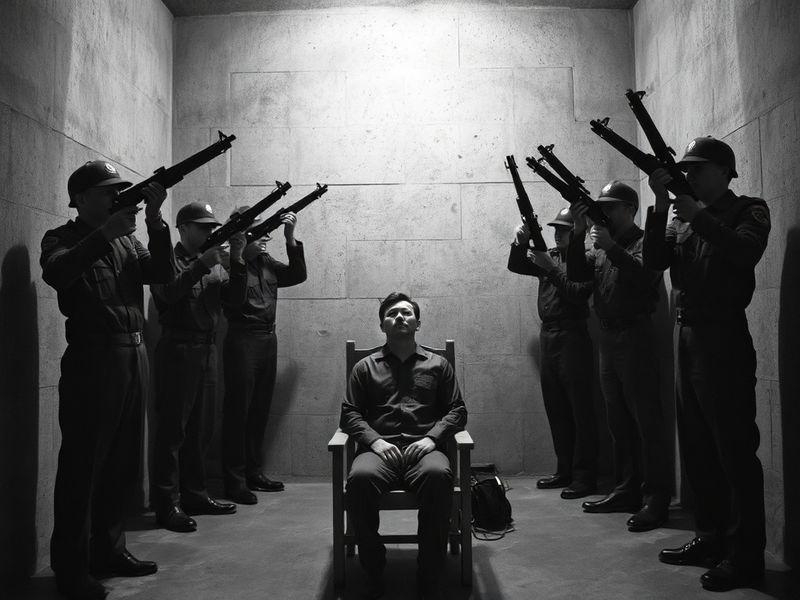
The firing squad is uniquely polarizing because it combines elements of ritual, responsibility, and physical suffering. Unlike lethal injection, which is meant to be painless and clinical, the firing squad involves multiple shooters, deliberate targeting, and the possibility of a prolonged death. This raises serious ethical concerns about the state’s role in inflicting pain, even as part of punishment.
One of the most cited arguments in favor of the firing squad is its perceived reliability. Unlike lethal injection, which has been plagued by botched executions due to poor training or faulty drug protocols, shooting is mechanically simple. A well-trained squad can ensure a quick and irreversible death. Proponents also argue that it is more transparent—there’s no pretense of medicalization or hidden process.
Opponents counter that transparency is not the same as humanity. The involvement of multiple shooters—often volunteers from the military or prison staff—can create psychological trauma for participants. The condemned person’s awareness of being targeted by a group adds a layer of psychological torment. Moreover, the risk of a misfire or non-fatal shot introduces the possibility of a botched execution, contradicting claims of reliability.
Legal challenges have emerged in the U.S., where inmates have argued that firing squad execution constitutes “cruel and unusual punishment” under the Eighth Amendment. Courts have generally upheld the method, however, on the grounds that it is not inherently more cruel than other forms of execution when properly administered. This legal acceptance contrasts sharply with public opinion polls, which often show majority opposition to the practice.
The Future of the Firing Squad
The long-term viability of the firing squad appears limited. Global abolition of the death penalty is accelerating, with 144 countries having abolished it in law or practice as of 2024. Even in nations where it remains legal, its use is increasingly symbolic rather than functional. The last civilian firing squad execution in the U.S. occurred in 2010, and no state has actively trained squads in years.
Yet symbolic retention matters. In Utah, for example, the firing squad remains a legally viable option, not because the state intends to use it, but because it preserves a connection to frontier justice and military tradition. This reflects a broader pattern: the firing squad endures not as a practical tool, but as a cultural artifact—one that embodies ideas of honor, finality, and state power.
As lethal injection continues to face supply chain disruptions and legal challenges, some lawmakers may revisit older methods like firing squads. But such moves are likely to provoke intense backlash from human rights organizations, medical ethicists, and the public. The firing squad may remain in legal codes, but its use is increasingly anachronistic—a relic of a time when execution was both ritual and deterrence.
Ultimately, the firing squad forces society to confront uncomfortable questions: What does justice look like when it involves violence? Is there a method of execution that is truly humane? And when a society keeps a brutal practice on the books, even if rarely used, what does that say about its values?
These questions have no easy answers, but they demand attention as long as the firing squad remains part of our legal and moral landscape.
For deeper analysis on capital punishment and its alternatives, visit our News section and explore Analysis archives.