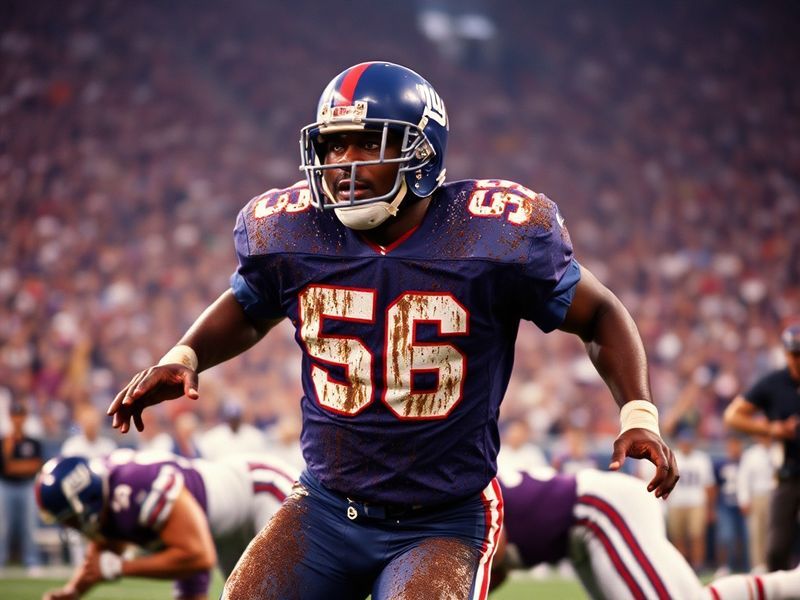
Few names in professional football carry the weight and respect of Lawrence Taylor. Drafted second overall by the New York Giants in 1981, Taylor didn’t just enter the NFL—he redefined defensive play and left an indelible mark on the league. His blend of speed, power, and relentless aggression made him a nightmare for quarterbacks and a cornerstone of one of the most dominant defensive units in NFL history.
Taylor’s influence extended beyond statistics and highlight reels. He changed how teams drafted, coached, and even how offensive linemen approached their jobs. More than three decades after his final snap, his legacy continues to shape defensive strategies across the league, proving that true greatness transcends eras.
The Early Years: From North Carolina to NFL Stardom
Born on February 4, 1959, in Williamsburg, Virginia, Lawrence Taylor grew up in a household that valued discipline and hard work. His father, a Marine, instilled in him a competitive spirit that would later define his playing style. Taylor’s athletic talents emerged early, excelling in football, basketball, and track at Lafayette High School in Williamsburg.
He continued his career at the University of North Carolina, where he played linebacker and defensive end. Though not an immediate standout, Taylor’s physical gifts—speed off the edge, raw strength, and instinctive playmaking—caught the attention of scouts. By his senior year, he had earned All-American honors and set the stage for his leap to the NFL.
When the Giants selected him with the second pick in the 1981 NFL Draft, few anticipated the seismic impact he would have. Taylor joined a Giants defense that was solid but unspectacular. Within two seasons, he would transform it into a force that struck fear into opposing offenses and became the backbone of a franchise on the rise.
Redefining Defensive Play: Taylor’s Playing Style and Legacy
Lawrence Taylor didn’t just play defense—he redefined it. At 6’3” and 237 pounds, he possessed the rare combination of speed, strength, and football IQ that allowed him to dominate from the edge. Unlike traditional linebackers who reacted to plays, Taylor anticipated them, using his explosive first step to disrupt plays before they developed.
His signature move—the outside rush—terrorized quarterbacks. Taylor didn’t rely solely on power; he used leverage, technique, and sheer athleticism to beat blockers. This approach forced offensive coordinators to design entire game plans around neutralizing him, a testament to his influence.
Taylor’s impact was immediate and historic. In his rookie season, he recorded 9.5 sacks, earned All-Rookie honors, and helped the Giants reach the playoffs for the first time in eight years. By his second season, he won both the NFL Defensive Player of the Year and MVP awards—a feat unmatched before or since. His 20.5 sacks in 1983 remain a rookie record and a benchmark for defensive excellence.
His career numbers tell only part of the story. Taylor finished with 1,088 tackles, 132.5 sacks, and nine interceptions returned for touchdowns. But his true value lay in what he prevented: sacks didn’t just tally up; they disrupted drives, altered play-calling, and shifted momentum. Quarterbacks avoided throwing toward his side of the field, changing the geometry of offensive attack.
Key Contributions to the New York Giants
- Three Super Bowl appearances: Including victories in Super Bowls XXI and XXV, cementing his place in Giants lore.
- Two Defensive Player of the Year awards: In 1986 and 1987, showcasing his sustained dominance.
- 1986 NFL MVP: The first and only defensive player to win the award, a reflection of his transformative presence.
- Super Bowl XXI MVP: Recorded 1.5 sacks, five tackles, and a forced fumble in the Giants’ 39–20 win over the Broncos.
- Revolutionized the edge rusher role: Inspired a generation of pass rushers and changed how defenses were constructed.
Beyond the Field: Taylor’s Influence on the NFL and Pop Culture
Taylor’s impact wasn’t confined to the football field. His charisma, intensity, and larger-than-life persona made him a cultural icon in the 1980s. He appeared in films, commercials, and even music videos, bridging the gap between sports and entertainment. His rivalry with Joe Montana and Dan Marino elevated the NFL’s profile, turning games into national events.
Off the field, Taylor’s life mirrored the highs and lows of his era. His battles with substance abuse became public and painful, serving as a cautionary tale about the pressures of fame and the consequences of unchecked ambition. Despite personal struggles, he remained a respected figure, later becoming an advocate for recovery and second chances.
Taylor’s legacy also reshaped NFL strategy. Before him, edge rushers were often afterthoughts in drafts. After him, teams prioritized speed and athleticism off the edge, leading to the rise of the modern pass rusher. Players like Derrick Thomas, Kevin Greene, and later, Michael Strahan, all cited Taylor as their inspiration.
Even today, NFL draft analysts and front offices use Taylor as the benchmark for elite edge defenders. The Lawrence Taylor Trophy, awarded annually to the nation’s top high school football player, ensures his name endures in the fabric of the game.
Why Lawrence Taylor Still Matters Today
In an era where analytics and scheme often dictate success, Taylor’s career stands as a reminder of the power of individual dominance. His ability to single-handedly alter offensive game plans offers a counterpoint to modern systems-driven football. He proved that one transcendent player can change the outcome of a game—and in some cases, an entire franchise’s trajectory.
His story also highlights the fragility of athletic greatness. Taylor’s career was shortened by injuries and off-field challenges, serving as a reminder that even the greatest talents are human. Yet, his resilience in recovery and his later work as a commentator and mentor underscore a legacy that goes beyond sacks and Super Bowls.
For young athletes, Taylor represents the pinnacle of defensive excellence. His combination of physicality, instinct, and work ethic remains a blueprint for aspiring linebackers and edge rushers. In a league increasingly focused on speed and versatility, Taylor’s blueprint—built on relentless effort and unmatched intensity—remains timeless.
As the NFL evolves, Taylor’s influence persists. Modern players like Von Miller and T.J. Watt carry on his tradition of edge dominance, but none have matched his combination of impact and cultural footprint. He didn’t just play the game—he defined an era and left the sport better than he found it.
Lawrence Taylor wasn’t just a football player. He was a force of nature, a disruptor, and a legend whose shadow still looms large over the NFL. Decades after his final game, his name remains synonymous with greatness, fear, and transformation.
And that’s why, more than 40 years after he first stepped onto a field as a professional, Lawrence Taylor still matters.
Further Reading
To explore more about NFL legends and their lasting impact, visit our Sports and Analysis sections on Dave’s Locker.