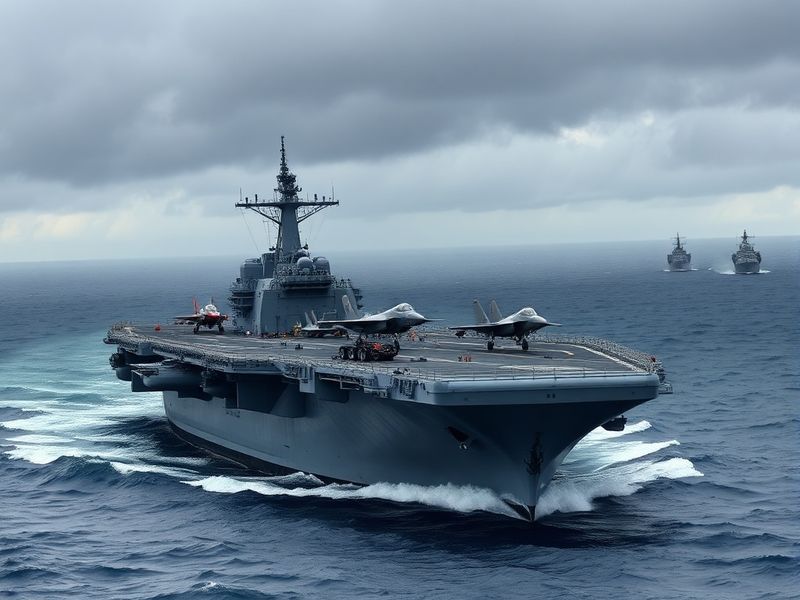
The Royal Navy’s HMS Prince of Wales has once again taken center stage in Britain’s maritime strategy, deploying to key global regions this spring. As the second Queen Elizabeth-class aircraft carrier, its movements are closely watched by defense analysts, allied navies, and geopolitical observers alike. This deployment comes at a time of heightened tensions in the South China Sea and persistent security concerns in the Middle East, making the carrier’s presence both symbolic and strategically significant.
The Carrier’s Mission and Strategic Context
Commissioned in 2019, HMS Prince of Wales is designed to project power across vast distances while supporting allied operations. Unlike traditional warships, it serves as a mobile airbase capable of launching F-35B Lightning II stealth fighters, Merlin helicopters, and a range of unmanned systems. The current deployment follows a pattern of periodic exercises and shows of force, but this iteration stands out due to its timing and declared objectives.
British defense officials have cited three primary goals for the deployment:
- Enhancing regional deterrence in the Indo-Pacific, particularly in response to China’s growing naval assertiveness.
- Reinforcing NATO commitments in the Mediterranean and North Atlantic amid Russia’s continued aggression in Ukraine.
- Conducting joint exercises with allied navies to improve interoperability and readiness.
These objectives reflect a broader shift in UK defense policy toward a more expeditionary and globally deployable force. After years of budget constraints and operational focus on smaller vessels, the Royal Navy is now prioritizing high-end capabilities that can operate far from home waters. HMS Prince of Wales embodies this ambition, serving as both a warship and a diplomatic tool.
Route and Operational Highlights
The carrier’s journey began with a ceremonial departure from HMNB Portsmouth in early March, followed by a transit through the Mediterranean. Unlike its predecessor, HMS Queen Elizabeth, which conducted a high-profile deployment to the Indo-Pacific in 2021, Prince of Wales is taking a different route. Instead of a full circumnavigation, it will focus on two critical theaters: the Mediterranean and the South China Sea.
Key stops and exercises include:
- NATO’s Neptune Strike 24 in the Mediterranean, involving more than 20 allied ships and aircraft. This exercise tests the carrier’s ability to integrate with NATO’s integrated air and missile defense system.
- Bilateral drills with Japan and Australia in the Philippine Sea, signaling closer ties with regional partners amid shared concerns over Chinese maritime claims.
- Port visits in Japan and South Korea, designed to strengthen defense relationships and showcase the UK’s commitment to a “tilt to the Indo-Pacific.”
The operational tempo is intense. The carrier’s air wing of 12 F-35Bs will conduct daily sorties, while Merlin helicopters perform anti-submarine and early warning roles. Electronic warfare suites and cyber defense systems are also being tested under realistic conditions. This deployment is not just a show of force—it’s a proving ground for the carrier’s systems and crew.
Broader Implications for UK Defense and Global Security
The deployment of HMS Prince of Wales arrives at a pivotal moment. For the United Kingdom, it signals a break from the post-Brexit inward focus and a return to a more muscular foreign policy. The 2023 Integrated Review Refresh explicitly identified the carrier as a key asset in countering systemic competitors like China and Russia. By deploying to the Indo-Pacific, the UK is asserting itself as a Pacific power—not just a European one.
But the implications extend beyond symbolism. The Royal Navy’s ability to sustain long-range carrier operations remains unproven. HMS Prince of Wales has faced mechanical issues in the past, including a propulsion problem during sea trials in 2022. While these have been addressed, they underscore the challenges of operating such a complex platform at extended range. Sustainment at sea, crew fatigue, and equipment reliability are real concerns.
For allied nations, the deployment is a welcome sign of commitment. Japan, in particular, has welcomed the UK’s involvement in regional exercises. After years of relying on US carrier presence, Tokyo sees British participation as a force multiplier. Similarly, Australia’s participation in joint drills reinforces the AUKUS pact’s maritime dimension.
Yet, China has responded with predictable criticism. State media has accused the UK of “stoking tensions” and “playing a destabilizing role.” While such rhetoric is expected, it highlights the sensitivity of naval operations in contested waters. The South China Sea remains a flashpoint, and any miscalculation could escalate tensions. HMS Prince of Wales will need to navigate carefully, balancing deterrence with diplomacy.
What Comes Next for the Carrier and the Royal Navy
The deployment of HMS Prince of Wales is more than a military exercise—it’s a statement. It signals Britain’s intent to remain a top-tier naval power despite economic headwinds and competing domestic priorities. But success depends on more than just showing up. The carrier must demonstrate operational excellence, maintain high readiness, and deliver tangible security benefits to its allies.
Looking ahead, three factors will determine the long-term impact of this deployment:
- Sustainment and maintenance: Can the Royal Navy keep the carrier operational over months at sea without major breakdowns?
- Allied integration: Will the carrier’s systems and procedures align seamlessly with US, Japanese, and Australian forces?
- Strategic follow-through: Will the UK commit to regular deployments, or will this be a one-off demonstration?
For now, the Royal Navy is watching closely. The carrier’s performance will shape future defense spending, shipbuilding plans, and international partnerships. If successful, HMS Prince of Wales could become the cornerstone of a reinvigorated British naval presence. If not, it may prompt a reassessment of the UK’s carrier ambitions.
One thing is certain: in an era of renewed great power competition, the seas remain the ultimate stage for diplomacy and deterrence. HMS Prince of Wales is not just a ship—it’s a statement of intent on the global stage.
For more on naval strategy and defense analysis, visit our Analysis and News sections.