The Birth of a Wrestling Legend
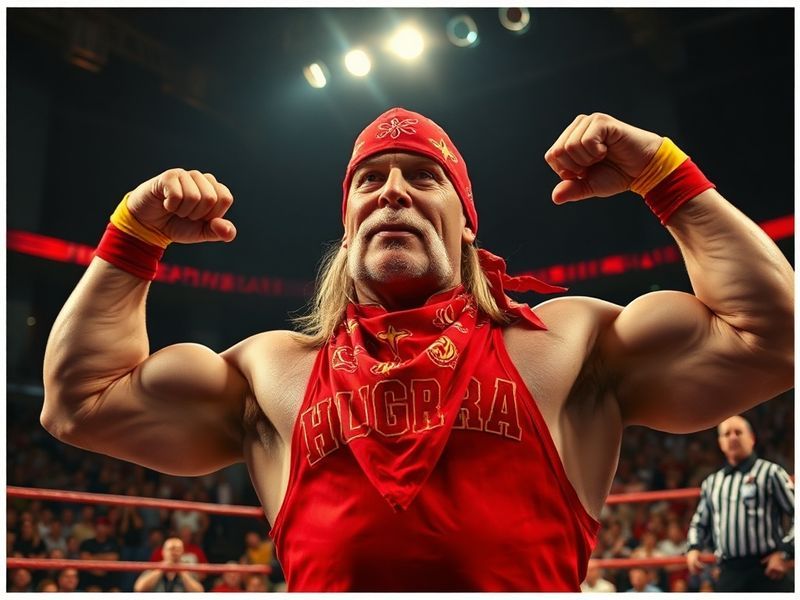
Terry Bollea, known worldwide as Hulk Hogan, emerged in the early 1980s as the face of professional wrestling. With his bleached-blond mustache, red-and-yellow bandana, and larger-than-life personality, Hogan transformed the sport into a spectacle that transcended athletic competition. His character was built on exaggerated strength, unshakable confidence, and an almost mythical persona that resonated with audiences across North America and beyond.
Hogan’s rise coincided with the dawn of cable television, which allowed wrestling to reach living rooms in ways previously unimaginable. The World Wrestling Federation (WWF, now WWE) capitalized on this by promoting Hogan as its top star. His 1984 victory over “The Nature Boy” Ric Flair at WrestleMania I cemented his status as the industry’s premier attraction and set the stage for wrestling’s first major boom.
A Character That Transcended Sport
What made Hogan unique was not just his in-ring ability but his ability to embody the ideals of perseverance and heroism. His famous promos—delivered with a mix of gravelly sincerity and over-the-top bravado—made him relatable despite his superhuman persona. Lines like “Whatcha gonna do, brother?” became cultural catchphrases, spoken in playgrounds and boardrooms alike.
Hogan’s influence extended beyond wrestling. He starred in films like No Holds Barred and Mr. Nanny, appeared on television shows such as Thunder in Paradise, and even ventured into music with the novelty song “Hulk Hogan’s Rock ‘n’ Wrestling Theme Song.” His crossover appeal helped wrestling shed its regional carnival image and enter the mainstream.
The Golden Era of WrestleMania
WrestleMania, introduced in 1985, became the flagship event of the WWF, and Hogan was its central figure. The inaugural event featured Hogan teaming with actor Mr. T against “Rowdy” Roddy Piper and Paul Orndorff in a match that drew over one million viewers via closed-circuit television. This was not just a sporting event; it was a pop culture phenomenon that blended sports, entertainment, and spectacle.
Hogan’s WrestleMania moments are etched in wrestling history. His victory over André the Giant at WrestleMania III in 1987 remains one of the most iconic moments in sports entertainment. The image of Hogan bodyslamming a 520-pound giant in front of 93,000 fans at the Pontiac Silverdome is immortalized in wrestling lore. It wasn’t just a wrestling match; it was a David-and-Goliath narrative played out on a global stage.
- WrestleMania III (1987): Hogan vs. André the Giant – A match that drew over 93,000 fans and became a defining moment for the WWF.
- WrestleMania V (1989): Hogan vs. “Macho Man” Randy Savage – A title match that headlined the event and showcased Hogan’s dominance.
- WrestleMania IX (1993): Hogan’s heel turn and quick title victory – A controversial moment that reshaped his legacy.
The Era of Hulkamania and Its Global Impact
Hogan’s “Hulkamania” was more than a gimmick; it was a cultural movement. The phrase “Hulkamania is running wild” became synonymous with his brand of wrestling, which emphasized family values, patriotism, and physical dominance. This resonated particularly well in the United States during the 1980s, a time of economic recovery and renewed national pride.
Hogan’s appeal was not limited to America. Wrestling promoters in Japan, Europe, and Australia adopted his character, often tailoring it to local tastes. In Japan, for instance, Hogan’s larger-than-life persona fit perfectly with the country’s love for strong, charismatic heroes in sports entertainment. His tours in Japan drew massive crowds, further solidifying his global reach.
In Europe, Hogan’s WWF shows became a staple of ITV’s wrestling coverage in the UK, introducing a new generation to the sport. His matches were broadcast in countries where professional wrestling had previously been a niche interest, helping to lay the groundwork for the international expansion of WWE in the decades to come.
Beyond the Ring: Hogan’s Cultural Legacy
Hogan’s influence extended into politics and social commentary. His 2005 appearance at WrestleMania 21, where he “passed the torch” to John Cena, symbolized the generational shift in wrestling. Cena, like Hogan, became the new face of a sport evolving with the times.
Hogan’s personal life, particularly his struggles with racism and his eventual public reckoning with past offensive remarks, added layers to his legacy. His 2015 apology video, addressing his use of racial slurs in private conversations, sparked widespread debate. While some fans forgave him, others saw it as a betrayal of the values he once represented. This moment highlighted the complexities of Hogan’s public persona—a hero to many, flawed to others.
Hogan’s Enduring Influence on Wrestling and Pop Culture
Today, Hogan remains a polarizing yet undeniable figure in wrestling history. His impact on the industry is undeniable. The “Hulkster” paved the way for future wrestling superstars like The Rock, Stone Cold Steve Austin, and Roman Reigns, who have all cited Hogan as an inspiration. His larger-than-life persona set the template for how wrestlers could become global celebrities.
Hogan’s presence can still be felt in modern wrestling. WWE continues to reference him in storylines, documentaries, and even video games. His character’s DNA is present in every muscular, charismatic hero who steps into the ring, from Goldberg to Braun Strowman. Hogan’s legacy is not just in the championships he won but in the doors he opened for an entire industry.
Beyond wrestling, Hogan’s influence is evident in the way sports entertainment is marketed today. The blend of athleticism, drama, and showmanship that Hogan perfected is now a global industry worth billions. His ability to connect with audiences on a personal level, despite his exaggerated persona, remains a benchmark for entertainers in any field.
Hogan’s story is one of triumph, controversy, and reinvention. He was not just a wrestler; he was a cultural icon who helped shape the landscape of sports entertainment. Whether admired or criticized, his impact is undeniable and continues to be felt more than four decades after his rise to fame.