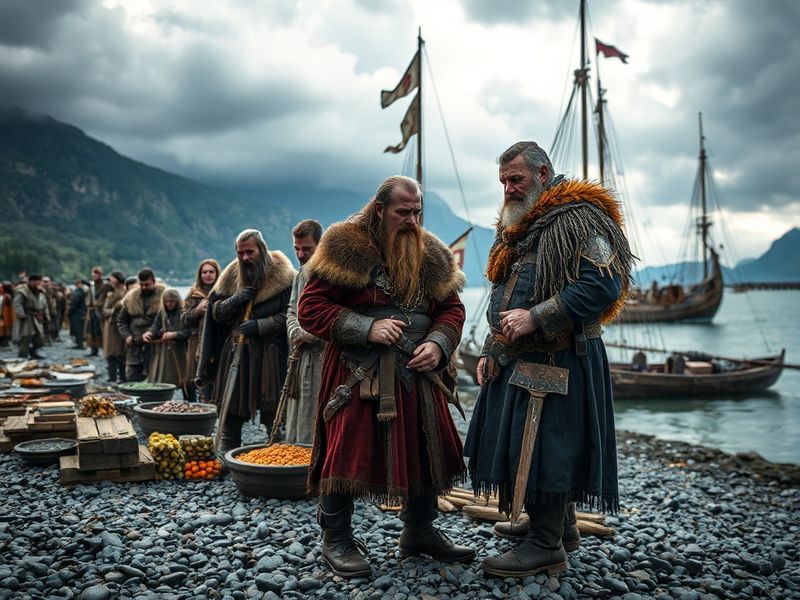
The Viking Age (793–1066 AD) is often remembered for its raids and conquests, but trade was just as vital to Norse society. While warriors struck fear across Europe, merchants crisscrossed the continent and beyond, exchanging goods that fueled Viking expansion. These traders weren’t just opportunists—they were sophisticated operators who built networks stretching from the Middle East to North America. Their commerce shaped economies, influenced politics, and even altered cultural landscapes in the lands they touched.
The Viking Trade Network: Routes and Hubs
Viking traders operated along well-established routes that connected Scandinavia to the wider medieval world. The most famous of these was the trading route that linked the Baltic Sea to the Black Sea via Russia’s river systems. This “East Way” allowed Norse merchants to reach Constantinople, where they sold furs, amber, and slaves in exchange for silver, silk, and spices. Meanwhile, the “West Way” connected the North Sea to the Atlantic, linking Scandinavia to Ireland, England, and even Iceland and Greenland.
Key trading hubs emerged where these routes intersected. Hedeby in modern-day Denmark became one of Europe’s most important ports, boasting a population of up to 2,000 people by the 10th century. Birka in Sweden and Kaupang in Norway served similar roles, acting as bustling marketplaces where goods from across the known world converged. Archaeologists have uncovered artifacts in these sites—such as Arab coins in Swedish graves—that prove the vast reach of Viking commerce.
- Hedeby (Denmark): A major Baltic port with a diverse population, including Frisians, Slavs, and Arabs.
- Birka (Sweden): A fortified trading center with evidence of glass production and ironwork.
- Kaupang (Norway): One of the earliest urban settlements in Norway, specializing in iron and soapstone goods.
- Novgorod (Russia): A critical stop on the Volga trade route, where Norse traders dealt with Byzantine merchants.
Commodities That Defined Viking Trade
Viking traders dealt in a surprisingly diverse range of goods, from everyday necessities to luxury items. On the export side, Scandinavians traded furs from Arctic foxes and sable, amber harvested from the Baltic coast, and walrus ivory carved into intricate objects. Slaves, captured during raids or purchased from local markets, were another grim but valuable commodity, sold in exchange for silver dirhams or European coinage.
The Vikings’ most prized imports, however, were metals. Silver was particularly sought after, as it was used to mint coins in Scandinavia and beyond. Arab dirhams, English pennies, and Frankish denars have all been found in Viking hoards, suggesting a complex monetary system. Other luxury goods included silk from Byzantium, glassware from the Rhineland, and spices like pepper and cinnamon from the Middle East. Even mundane items like soapstone pots and whetstones were traded in bulk, indicating a demand for practical goods.
- Exports:
- Furs (fox, mink, sable)
- Amber (Baltic “gold”)
- Walrus ivory
- Slaves (traded for silver)
- Iron and soapstone goods
- Imports:
- Silver coins (Arab, English, Frankish)
- Silk and spices (from Byzantium)
- Glassware and pottery
- Weapons and armors (Frankish swords)
- Wine and salt
The Role of Trade in Viking Society
Trade wasn’t just an economic activity for the Vikings—it was a social and political force. The wealth generated from commerce allowed chieftains and kings to consolidate power, funding the construction of ships and armies. In return for their loyalty, warriors and farmers received a share of the profits, creating a hierarchy that rewarded both martial skill and mercantile acumen. This system helped turn petty warlords into regional powers, like the legendary Ragnar Lothbrok, who was said to have amassed wealth through both raiding and trade.
Women also played a significant role in Viking trade. While men dominated long-distance commerce, women managed local markets and household economies. Widows and unmarried women often inherited trading goods, allowing them to operate independently in the marketplace. The Oseberg ship burial in Norway, for example, contained a wealth of imported textiles and jewelry, suggesting that elite women were active participants in the trade network.
“The Viking economy was a hybrid of raiding and trading, where the line between merchant and warrior was often blurred. Success in one often led to success in the other.” — Neil Oliver, archaeologist and historian
The Decline of Viking Trade: Causes and Consequences
By the 11th century, Viking trade began to decline, a shift driven by several key factors. The Christianization of Scandinavia reduced the demand for pagan religious artifacts and altered trade dynamics with Christian Europe. The rise of centralized kingdoms in Norway, Sweden, and Denmark also centralized trade under royal control, marginalizing independent merchants. Additionally, the stabilization of European economies reduced the need for Norse middlemen, as local production increased.
Yet the legacy of Viking trade endured. The silver dirhams and coins they brought back to Scandinavia were melted down and reused, influencing the region’s monetary systems for centuries. The trade routes they established became the foundation for later medieval commerce, and the cultural exchanges they facilitated—such as the adoption of Arabic numerals or Frankish shipbuilding techniques—left a lasting mark. Even the Viking sagas, which often glorify warriors, contain detailed accounts of merchants and their adventures, proving that trade was as much a part of Norse identity as battle.
Today, the remnants of Viking trade can be seen in museum collections and archaeological sites across Europe. From the hoards of silver in Sweden to the runic inscriptions on soapstone weights, these artifacts tell the story of a society that thrived not just on the edge of a sword, but on the strength of its markets.
Conclusion
The Viking Age was far more than a series of raids and battles—it was an era of economic ambition and innovation. Behind the image of berserkers and longships lay a network of traders who connected the known world, shaping the fortunes of Scandinavia and beyond. Their legacy reminds us that even the most feared civilizations were shaped by commerce as much as conflict. As we uncover more about their trade routes and markets, we gain a richer understanding of the Vikings not just as warriors, but as builders of an early global economy.