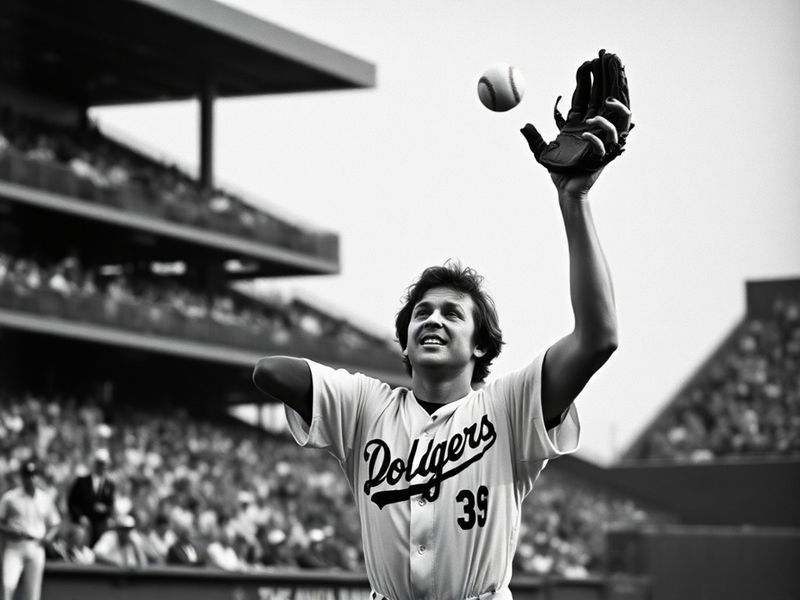
Rick Monday’s name resonates through baseball history not just for his 19-year career in the major leagues, but for a single, defining moment that transcended sports. A three-time All-Star, Monday played for the Kansas City Athletics, Los Angeles Dodgers, and Oakland Athletics from 1966 to 1984. Yet, his legacy is most vividly tied to a 1976 act of courage that unfolded in the middle of a game in Los Angeles. His story remains a testament to principle over popularity, a rare blend of athletic excellence and moral clarity.
Born John Rickey Monday Jr. on November 20, 1945, in Batesville, Arkansas, he grew up in Southern California and became a standout athlete at Long Beach State University. Drafted by the Kansas City Athletics in 1965, he quickly rose through the minors and debuted in the majors the following year. By 1968, he was a regular in the outfield, known for his steady glove, clutch hitting, and disciplined approach at the plate. Over his career, he batted .264 with 241 home runs and 775 RBIs, earning the respect of teammates and opponents alike.
The Day Rick Monday Saved an American Flag
On April 25, 1976, during a game between the Los Angeles Dodgers and the Chicago Cubs at Dodger Stadium, Monday was playing center field for the Dodgers. In the fourth inning, two protesters ran onto the field from the outfield stands. One of them, William Thomas, grabbed an American flag from a young Boy Scout who had brought it to wave during the national anthem. As the crowd gasped, Thomas and his companion proceeded to douse the flag with a lighter fluid-like substance, preparing to set it ablaze.
Without hesitation, Monday sprinted across the outfield, scooped up the flag, and handed it to Dodgers first baseman Steve Garvey. The crowd erupted in applause—some in approval, others in relief. The protesters were quickly subdued by security. Monday later stated, “If you’re going to burn the flag, don’t do it in front of me. I’ve been to too many veterans’ hospitals and seen too many broken bodies to sit idle while somebody’s trying to make a mockery of our country and our flag.”
The moment was captured on live television and broadcast nationwide. Monday’s actions sparked both praise and debate. Some saw it as a natural response to defend a national symbol. Others criticized him for inserting himself into a political statement. But Monday never wavered. He emphasized that his concern was not politics, but respect for the flag as a symbol of freedom and service.
From Baseball Star to Symbol of Patriotism
While Monday’s career statistics are impressive, it’s this singular act that cemented his place in history. He wasn’t the most flamboyant player, nor did he chase headlines. He was a professional—quietly consistent, respected in clubhouses, and known for his leadership. After leaving the Dodgers in 1981, he played two more seasons with the Oakland Athletics, winning a World Series ring in 1981 as a part-time player.
Yet, it was the flag incident that defined his public persona. He received thousands of letters, many from veterans thanking him for his courage. The U.S. flag he saved now resides in the Baseball Hall of Fame in Cooperstown. The Boy Scout who owned the flag, 11-year-old Jeff Hall, later said Monday’s action gave him chills—and a lifelong sense of pride.
Monday himself downplayed the heroism of the moment. “I didn’t do anything special,” he told reporters years later. “I just reacted. It wasn’t about me. It was about what that flag stands for.” His humility only strengthened the respect he earned across generations.
A Life Beyond the Diamond
After retiring from baseball in 1984, Monday transitioned into broadcasting. He became a beloved color commentator for the Chicago Cubs on WGN Radio, a role he held for 15 years. His voice became synonymous with Cubs baseball, known for his insightful analysis and steady, unpretentious delivery. Fans appreciated his authenticity—he didn’t embellish, didn’t grandstand. He simply loved the game.
In 1995, he was inducted into the Kansas City Royals Hall of Fame, honoring his contributions to the Royals during their early years (he played for them from 1972 to 1976). Though he never played for the Dodgers during his prime, his legacy in Los Angeles remained unshaken by that defining 1976 moment.
Monday also became active in veterans’ causes. He frequently visited military hospitals and participated in events honoring those who served. His respect for the flag was deeply personal—rooted in family. His father served in World War II, and Monday himself was a Marine Corps Reserve veteran, having served from 1967 to 1973.
Lessons from a Quiet Hero
Rick Monday’s story offers more than a footnote in baseball history. It’s a reminder that principles often matter more than popularity. In an era where athletes are often expected to stay silent on social issues, Monday’s choice to act—without hesitation and without seeking praise—stands out. It wasn’t a political statement. It was a human one.
His life reflects the values of integrity, service, and quiet leadership—qualities that resonate far beyond the baseball diamond. For many, Monday represents what it means to stand for something greater than oneself.
As he once said, “The flag isn’t about politics. It’s about people. It’s about freedom. It’s about the chance to stand up and do what’s right, even when it’s hard.”
That philosophy defined his career on and off the field. And it’s why, decades later, Rick Monday is remembered not just as a great ballplayer, but as a man who chose courage when it mattered most.
To learn more about baseball history and legends, visit our Sports category on Dave’s Locker. For deeper analysis of sports figures who made a difference, explore our Analysis section.