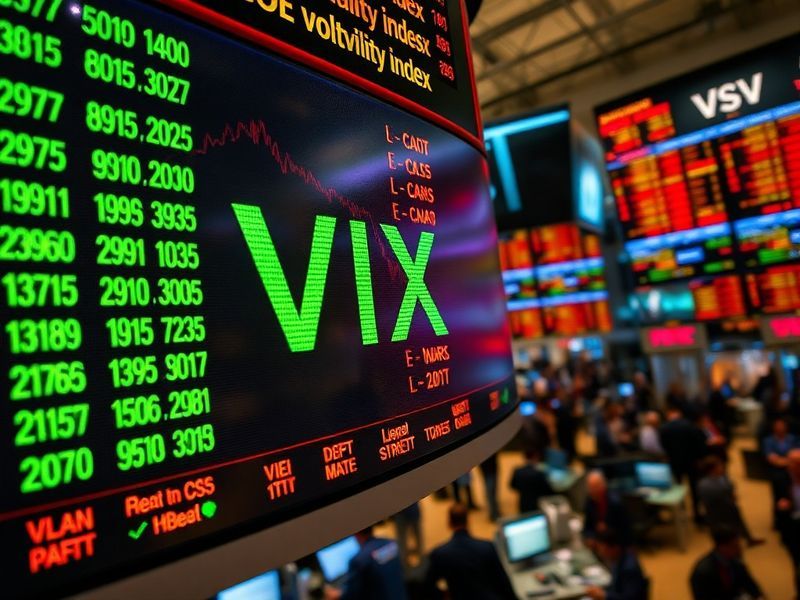
Cboe Volatility Index (VIX) Explained: How Traders Use the Fear Gauge
“`html
The Cboe Volatility Index: A Global Barometer of Market Fear and Opportunity
The Cboe Volatility Index, commonly known as the VIX, has become one of the most closely monitored indicators in global financial markets. Often referred to as the “fear gauge,” the VIX measures market expectations of near-term volatility based on S&P 500 index options. It reflects investor sentiment and risk appetite, making it a vital tool for traders, policymakers, and economists worldwide.
Unlike traditional stock indices that track price movements, the VIX quantifies the market’s anticipation of volatility over the next 30 days. When investor anxiety rises, the VIX tends to climb, signaling potential turbulence ahead. Conversely, a low VIX suggests confidence and stability. This unique role has cemented the VIX’s place in financial media and investment strategies across continents.
The Origins and Evolution of the VIX
The VIX was introduced by the Chicago Board Options Exchange (Cboe) in 1993. It was the first benchmark index to measure expected volatility directly from market data rather than historical price swings. The index was developed in collaboration with financial economists, including Robert Whaley, who helped design a methodology that remains influential today.
Initially, the VIX relied on S&P 100 index options. However, in 2003, Cboe transitioned to using S&P 500 options, broadening its relevance and accuracy. This change aligned the VIX with the most widely followed U.S. equity benchmark, increasing its global credibility. Over the years, the index has inspired similar volatility measures in other markets, such as the VXN for the Nasdaq-100 and the VXD for the Dow Jones Industrial Average.
The VIX’s evolution also includes the launch of VIX futures in 2004 and VIX options in 2006. These derivatives allow traders to hedge against volatility or speculate on future market conditions, further embedding the VIX into the fabric of global derivatives trading. Today, the VIX is not just a sentiment indicator—it’s a tradable asset class with deep liquidity and a market of its own.
How the VIX Works: A Technical Breakdown
The VIX is calculated using a weighted blend of prices for a range of S&P 500 put and call options. Specifically, it uses out-of-the-money options and weights them to reflect the market’s expectation of volatility over the next 30 days. The calculation involves a sophisticated formula that accounts for option premiums and time decay, producing a single number that represents implied volatility.
For example, if the VIX is trading at 20, it suggests the market expects the S&P 500 to move up or down by about 20% annualized over the next month. This does not mean the index will swing by 20% in 30 days, but rather that options traders are pricing in that level of volatility in their contracts. The VIX is annualized to provide a standardized measure, making it easier to compare across different timeframes.
One of the VIX’s most notable features is its tendency to spike during periods of market stress. During the 2008 financial crisis, the VIX reached an all-time high of 80.86. Similarly, in March 2020, at the onset of the COVID-19 pandemic, the VIX surged to 82.69. These spikes often precede or coincide with sharp market downturns, making the VIX a leading indicator of systemic risk.
- Key inputs: S&P 500 index options (puts and calls)
- Weighting: Out-of-the-money options, emphasizing near-term contracts
- Output: Annualized implied volatility percentage
- Trading tools: VIX futures, options, and exchange-traded products (ETPs)
The VIX in Global Markets: A Cross-Cultural Lens
While the VIX is rooted in U.S. equities, its influence extends far beyond American borders. Global investors and traders watch the VIX as a proxy for risk appetite, even in non-U.S. markets. During periods of geopolitical tension or economic uncertainty, the VIX often rises in tandem with volatility in European, Asian, and emerging market equities.
In Europe, for instance, the Euro Stoxx 50 Volatility Index (VSTOXX) serves a similar purpose, but the VIX remains the benchmark for global sentiment. Traders in Tokyo and London frequently reference the VIX when making decisions about currency movements, commodity prices, and cross-asset allocations. The VIX’s universality makes it a common language in trading rooms from New York to Singapore.
Culturally, the VIX has also permeated financial media and public discourse. It is frequently cited in news reports during market turmoil, often accompanied by dramatic headlines. This visibility has made the VIX a symbol of both market fragility and resilience. For retail investors, the VIX can be a confusing concept—why would anyone want to measure fear? Yet, its role in derivatives markets underscores its importance in modern finance.
Moreover, the VIX has inspired cultural references in art, film, and literature. It appears in movies like The Big Short, where it is used to illustrate the absurdity of pre-2008 market complacency. In music and literature, the VIX is sometimes invoked metaphorically to describe societal anxiety or unpredictability. This cultural footprint speaks to the VIX’s status as more than just a financial tool—it is a symbol of the interconnectedness of markets and human emotion.
Practical Applications and Misconceptions
For traders, the VIX is a versatile instrument. It can be used to hedge equity portfolios, speculate on volatility, or diversify risk. For example, investors worried about a market downturn might purchase VIX call options or VIX futures as a form of insurance. Conversely, those expecting calm markets might sell VIX-related products to generate income from low volatility environments.
However, the VIX is often misunderstood. One common misconception is that a rising VIX always signals an impending crash. While the VIX does tend to rise during downturns, it can also reflect temporary spikes in uncertainty, such as during earnings season or geopolitical events. Additionally, the VIX is mean-reverting, meaning it tends to return to its long-term average over time. This characteristic makes it a challenging but potentially rewarding trade for experienced investors.
Another point of confusion is the difference between the VIX and realized volatility. The VIX measures expected volatility based on options prices, while realized volatility tracks the actual price swings of the S&P 500. The two can diverge significantly, especially during periods of extreme sentiment or liquidity constraints. Traders must understand this distinction to avoid misinterpreting the VIX’s signals.
For those looking to incorporate the VIX into their strategies, it’s essential to start with a clear understanding of its mechanics and limitations. The Finance section of Dave’s Locker offers in-depth guides on derivatives trading, risk management, and market analysis that can help demystify the VIX and its applications.
Looking Ahead: The Future of the VIX
The VIX continues to evolve as markets change. With the rise of algorithmic trading and artificial intelligence, new methods for calculating and interpreting volatility are emerging. Some innovators are exploring machine learning models to predict VIX movements with greater accuracy, while others are developing volatility-based ETFs and structured products for retail investors.
Additionally, the VIX’s role in environmental, social, and governance (ESG) investing is growing. As sustainability becomes a priority for global markets, volatility indices are being adapted to reflect ESG-related risks. This shift could lead to new volatility benchmarks that incorporate climate change, social unrest, or corporate governance factors.
Despite these advancements, the VIX’s core function remains unchanged: to quantify market fear and opportunity. In an era of rapid technological change and geopolitical uncertainty, the VIX stands as a timeless tool for navigating volatility. Whether you’re a seasoned trader or a curious observer, understanding the VIX is key to grasping the pulse of global finance.
The next time you hear the VIX mentioned in the news, remember that it’s not just a number—it’s a reflection of collective human behavior, economic forces, and the ever-present dance between risk and reward.