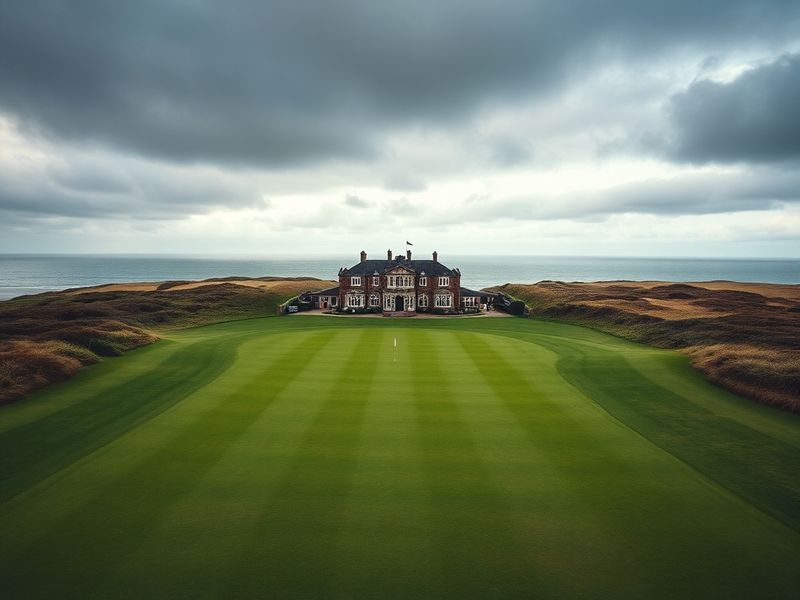
Royal Lytham & St Annes: Golf’s Historic Coastal Challenge
“`html
Royal Lytham & St Annes: A Golfing Jewel with Global Prestige
Golf’s most hallowed venues share a common trait: they transcend sport to become cultural landmarks. Among these, Royal Lytham & St Annes stands out not just for its championship pedigree but for its enduring role as a custodian of golf’s traditions. Located on England’s northwest coast, this Open Championship venue has hosted the world’s best players for over a century, while quietly shaping the social fabric of the game.
The course’s history is inseparable from the evolution of professional golf. Founded in 1886 as the Lytham St Annes Golf Club, it was granted the “Royal” prefix in 1926, a mark of its growing influence. Unlike many early courses carved into inland heathlands, Royal Lytham & St Annes embraced its coastal setting, where the Irish Sea’s salty breeze and undulating dunes create a natural hazard unlike any other. This geography has forced generations of golfers to adapt, blending power with precision in a way few inland courses demand.
The Open Championship and the Test of Lytham
Royal Lytham & St Annes has been a cornerstone of The Open since 1926, when it first welcomed the world’s elite. The course’s layout—short on paper but brutal in reality—has produced some of golf’s most dramatic moments. The 1961 Open saw Arnold Palmer defy a final-round deficit with a legendary display of shot-making. In 1974, Gary Player claimed victory in torrential rain, his resilience emblematic of the Open’s punishing conditions. More recently, in 2012, Ernie Els overcame a four-stroke deficit to win his fourth major, proving that Lytham’s challenges are as much mental as physical.
The Open’s rotation policy means Royal Lytham & St Annes hosts the championship roughly every 12 years. Each return brings fresh narratives. In 2001, David Duval’s victory marked the end of an era for the long-hitting American, while in 2012, Els’ triumph underscored the course’s ability to reward patience over power. These moments aren’t just footnotes in golf history; they reflect the sport’s global expansion, where European venues like Lytham became as pivotal as the traditional American strongholds.
Why the Course Stands Apart
Royal Lytham & St Annes is often described as a “classic” course, but its design defies simple categorization. The front nine is deceptive in its gentleness, luring players into a false sense of security before the back nine unveils its true character. The par-3 15th, “Short Hole,” is a mere 119 yards but demands a precise tee shot over a deep bunker. The par-4 17th, “The Road Hole,” is a brutal 453-yard challenge where the green is angled away from play, and an out-of-bounds road lurks left. These holes are not just obstacles; they are tests of a player’s ability to manage risk and reward.
The course’s bunkering is another distinguishing feature. Unlike the flashy, penal sand traps of modern designs, Lytham’s bunkers are natural and subtle, often blending into the landscape. This subtlety forces players to read the terrain, a skill that separates the good from the great. The wind, too, is a constant adversary. Off the Irish Sea, it can shift direction mid-swing, turning a straightforward shot into a gamble. These elements combine to create a course that feels timeless, as if it has always been there and always will be.
Golf’s Cultural Role: More Than Just a Tournament
Royal Lytham & St Annes is more than a venue for The Open; it is a cultural touchstone for golf. The club’s embrace of its local community reflects a broader shift in the sport, where tradition and accessibility coexist. Unlike some elite clubs that guard their exclusivity, Lytham has maintained a relatively open membership policy, allowing amateur golfers to experience its hallowed fairways. This inclusivity has endeared it to players worldwide, from weekend hackers to future champions honing their skills on its links.
The club’s annual events, such as the Women’s British Open and the Senior Open Championship, further cement its role as a global stage for golf. These tournaments highlight the sport’s diversity, showcasing players from different backgrounds and eras. The Senior Open, in particular, has become a highlight of the veteran circuit, where legends like Bernhard Langer and Tom Watson continue to defy age and expectations. Such events remind fans that golf’s appeal transcends generations.
A Global Stage for Golf’s Evolution
From a global perspective, Royal Lytham & St Annes represents the enduring appeal of traditional golf courses in an era dominated by modern, resort-style layouts. While venues like Pine Valley or Augusta National are revered, they are also inaccessible to most players. Lytham, by contrast, offers a rare blend of world-class challenge and relative openness. Its annual club competitions attract over 1,000 entries, a testament to its role as a living, breathing part of the golfing community.
The course’s influence extends beyond competition. The club’s junior golf programs have nurtured talent from the northwest of England, proving that great golf can thrive outside the usual hotspots of Florida or California. These initiatives reflect a broader trend in golf, where clubs are redefining their roles as community hubs rather than elite enclaves. In this way, Royal Lytham & St Annes is not just preserving golf’s past; it is helping shape its future.
Visiting Royal Lytham & St Annes: A Pilgrimage for Golfers
For golfers planning a pilgrimage to Lytham, the experience begins long before stepping onto the first tee. The town of Lytham St Annes itself is a charming seaside retreat, with Victorian architecture, independent shops, and a relaxed pace of life. The contrast between the town’s tranquility and the intensity of the golf course is part of its allure. Many visitors stay in local B&Bs or golf hotels, where the warm hospitality mirrors the club’s ethos.
Playing the course is a rite of passage. The booking process is competitive, with member and visitor tee times released months in advance. Green fees reflect the venue’s prestige, but for many, the cost is secondary to the opportunity to walk in the footsteps of legends. The club’s pro shop offers a curated selection of golf memorabilia, from Open Championship programs to signed photographs of past champions. These items are more than souvenirs; they are tangible connections to golf’s history.
Beyond the course, the surrounding area offers additional attractions. The Ribble Estuary, a short drive away, is a haven for birdwatchers, while the Lake District’s rugged beauty is within reach for those seeking a post-round adventure. Golfers who combine a trip to Lytham with a visit to nearby sports events or cultural sites often find that the experience enriches their understanding of the region’s character.
Preserving the Legacy
Royal Lytham & St Annes faces the same challenges as other historic courses: balancing tradition with modernization. Recent updates to the course, such as the restoration of bunkers and the introduction of new drainage systems, aim to preserve its challenge while ensuring it remains playable in changing weather conditions. The club’s commitment to sustainability is evident in its management of the dunes and coastal areas, where native grasses are protected to maintain the course’s natural beauty.
Looking ahead, Royal Lytham & St Annes will continue to play a pivotal role in golf. Its next Open Championship in 2025 promises to draw global attention, but the club’s true legacy lies in its ability to inspire. Whether through the stories of past champions, the dedication of its members, or the awe of first-time visitors, Lytham reminds us that golf is more than a sport—it is a tradition, a community, and a test of character.
For those who have walked its fairways, Royal Lytham & St Annes is more than a course; it is a place of pilgrimage. For those yet to visit, it remains an invitation—to test one’s skills, to embrace the wind and the waves, and to become part of golf’s enduring story.