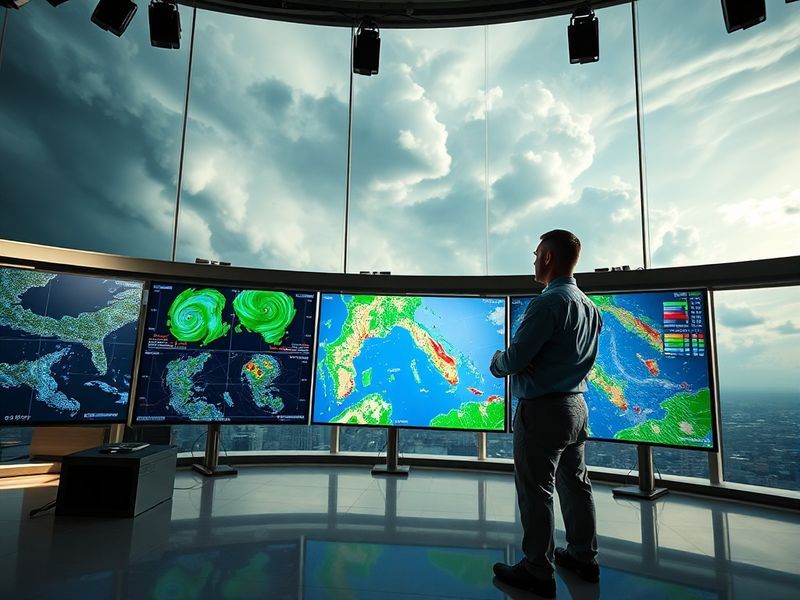
Weather Forecasting: Science, Technology, and Everyday Impact
Weather forecasting has evolved from ancient observations of natural signs to a sophisticated science driven by satellites, supercomputers, and artificial intelligence. Today, meteorologists use a combination of physics, data science, and real-time monitoring to predict conditions with remarkable accuracy. The stakes are high—accurate forecasts save lives, protect infrastructure, and guide economic decisions from agriculture to aviation.
The National Weather Service in the United States, for example, issues over 1.5 million forecasts and 50,000 warnings annually. These predictions rely on a global network of weather stations, ocean buoys, weather balloons, and geostationary satellites that scan the atmosphere every few minutes. Without this infrastructure, early warning systems for hurricanes, tornadoes, and flash floods would be far less reliable.
The Science Behind Predictions
At its core, weather forecasting is rooted in fluid dynamics and thermodynamics. The atmosphere behaves like a giant heat engine, redistributing energy from the equator toward the poles. Meteorologists model this system using the Navier-Stokes equations, which describe how air moves and changes pressure. These equations are solved numerically on supercomputers that perform trillions of calculations per second.
One of the biggest challenges is chaos theory—the idea that tiny errors in initial measurements can lead to vastly different outcomes over time. This is why forecasts beyond 10 days become increasingly uncertain. Ensemble forecasting helps mitigate this by running multiple simulations with slightly varied starting conditions. The European Centre for Medium-Range Weather Forecasts (ECMWF) is renowned for its ensemble models, which often outperform deterministic models in long-range predictions.
Data assimilation is another critical component. Meteorologists blend real-time observations with model forecasts to create the most accurate starting point possible. For instance, when a weather balloon rises through the atmosphere, its temperature, humidity, and wind readings are fed into models within hours. This continuous feedback loop improves accuracy, especially for severe weather events.
Technology Driving Innovation
The past decade has seen a technological revolution in weather prediction. High-resolution models now operate at scales as fine as 1 kilometer, allowing forecasters to pinpoint thunderstorms, snow bands, and even individual hailstorms. The GOES-16 and GOES-17 satellites, launched by NOAA, provide images of the continental U.S. every 30 seconds, compared to the 15-minute intervals of older satellites. This rapid refresh rate helps meteorologists track fast-developing storms in real time.
Artificial intelligence is also making inroads. Machine learning algorithms can now correct biases in numerical models, downscale global forecasts to local levels, and even predict fog formation more accurately than traditional methods. For example, researchers at Penn State developed an AI model that improves summer temperature forecasts by 25% in some regions. These tools are particularly valuable in developing countries, where dense weather station networks are scarce.
Another breakthrough is the use of phased-array radar, which scans the sky electronically rather than mechanically. Unlike traditional Doppler radar, phased-array systems can track multiple weather phenomena simultaneously without losing time between sweeps. The U.S. is gradually deploying these radars, with the first operational system installed in Oklahoma in 2023. This technology could cut tornado warning lead times from 14 minutes to over 30 minutes in the future.
From Farmers to Pilots: Who Relies on Forecasts?
Weather forecasting isn’t just about telling us whether to carry an umbrella. It’s a lifeline for industries where conditions can mean the difference between profit and loss. Farmers, for instance, rely on seasonal outlooks to decide when to plant and harvest crops. A misplaced frost warning in California’s Central Valley could cost almond growers millions, while an accurate hurricane forecast in Florida allows citrus farmers to protect groves with temporary covers.
Aviation is another sector deeply dependent on precision forecasts. Airlines use turbulence forecasts to reroute flights and avoid costly diversions. The World Meteorological Organization estimates that turbulence costs airlines up to $500 million annually in injuries, delays, and aircraft damage. Modern flight planning systems integrate real-time weather data with aircraft performance models to optimize fuel consumption and passenger safety.
Energy companies also depend on forecasts to balance supply and demand. Wind farms need accurate wind speed predictions to schedule maintenance and predict output. Solar farms rely on cloud cover forecasts to estimate energy generation. Even traditional power plants use temperature and humidity data to anticipate demand spikes during heatwaves or cold snaps. In 2021, ERCOT, the Texas grid operator, faced massive blackouts after underestimating demand during a winter storm—partly due to flawed temperature forecasts.
- Farming: Seasonal forecasts guide planting, irrigation, and harvesting schedules.
- Aviation: Turbulence and storm predictions ensure safe, efficient flight paths.
- Energy: Wind and solar output forecasts optimize renewable energy integration.
- Maritime: Wave height and storm warnings protect shipping and offshore operations.
- Public Health: Heat advisories and air quality alerts reduce weather-related illnesses.
The Limits and Ethical Questions
Despite advances, forecasting still faces fundamental limits. The chaotic nature of the atmosphere means that beyond two weeks, predictions are largely guesswork. Even short-term forecasts can fail spectacularly—consider the 2013 European floods, where models underestimated rainfall by up to 30%, leading to catastrophic flooding in Germany and the Czech Republic. Climate change is exacerbating these challenges by intensifying weather patterns and making historical data less reliable for future projections.
There are ethical questions, too. Should governments issue evacuations based on uncertain hurricane tracks? How much do inaccurate forecasts cost businesses and individuals? The 2019 “Snowmageddon” forecast in Washington, D.C., predicted 12–18 inches of snow, but only 3–6 inches materialized. While some residents stocked up on supplies unnecessarily, others criticized the overhyped warning as eroding trust in future alerts. This dilemma highlights the tension between caution and accuracy.
Another concern is the digital divide in weather access. In wealthier nations, high-speed internet and smartphones deliver real-time alerts to millions. But in rural Africa or Pacific island nations, communities often rely on radio broadcasts or text messages delivered days late. Organizations like the WMO’s Global Framework for Climate Services work to bridge this gap by providing localized forecasts to vulnerable populations.
What’s Next for Weather Forecasting?
The future of weather forecasting lies in three key areas: higher resolution, better data, and deeper integration with other sciences. Next-generation geostationary satellites like GOES-T will provide even sharper images, while polar-orbiting satellites like JPSS-2 will deliver more atmospheric profiles. These improvements will allow forecasters to predict flash floods and wildfire behavior with greater precision.
Quantum computing may eventually revolutionize weather modeling by solving complex equations in minutes that currently take hours. IBM and The Weather Company are already experimenting with quantum algorithms to improve hurricane intensity forecasts. Meanwhile, citizen science initiatives like CoCoRaHS enlist volunteers to report rainfall, snowfall, and hail, filling gaps in official data networks.
Perhaps most importantly, meteorology is merging with climate science. While weather forecasting deals with day-to-day conditions, climate modeling looks decades ahead. Increasingly, forecasters are using climate projections to inform long-range outlooks. For example, a strong El Niño event can tilt the odds toward wetter winters in California or milder winters in the northern U.S., giving forecasters an edge in seasonal predictions.
As technology advances, the goal isn’t just to predict the weather—it’s to live safely within it. Whether it’s a farmer deciding when to plow, a pilot rerouting around turbulence, or a city preparing for a heatwave, accurate forecasts are the invisible infrastructure that keeps modern society running. The next decade will likely bring even more precise tools, but the challenge remains: turning data into decisions that save lives and livelihoods.
The science of weather forecasting has come a long way since the days of reading animal behavior or cloud shapes. Today, it’s a fusion of physics, computer science, and teamwork across continents. Yet, at its heart, it remains a human endeavor—one that balances cold, hard data with the urgent need to protect communities from nature’s unpredictability.