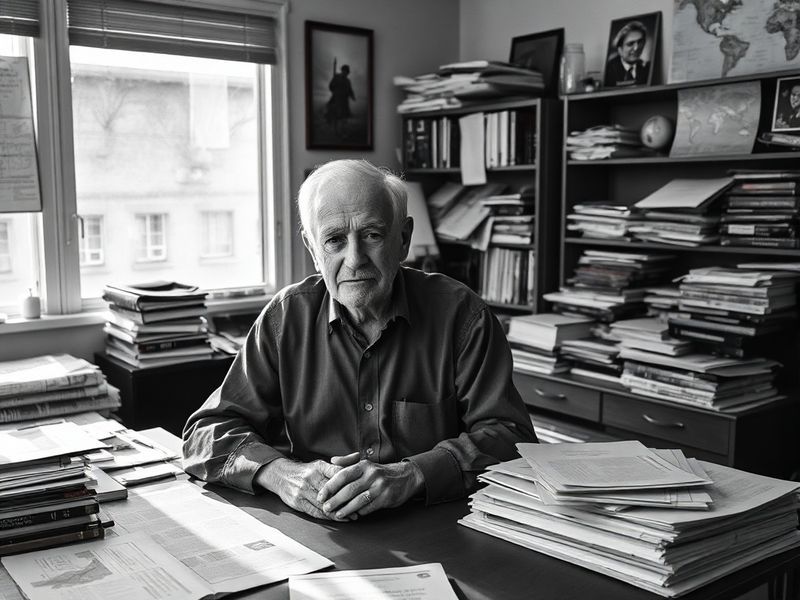
Michael Glantz: The Man Who Made Environmental Risks Impossible to Ignore
Michael Glantz has spent half a century sounding alarms about environmental threats long before they became front-page news. Few researchers have matched his foresight into how climate anomalies could trigger global crises. His early warnings about El Niño’s far-reaching consequences, for instance, transformed a poorly understood weather pattern into a critical metric for disaster preparedness worldwide. Glantz didn’t just study environmental science; he taught the world to anticipate its ripple effects—on food supplies, migration flows, and geopolitical stability.
Born in 1939, Glantz began his career at the National Center for Atmospheric Research (NCAR) in the 1970s, a time when climate change was still a fringe concern. His work on drought prediction in Africa and Asia laid the groundwork for today’s seasonal forecasting systems. These systems now help governments allocate emergency aid before famines take hold. While many scientists focused narrowly on atmospheric data, Glantz connected the dots between climate variables and human outcomes. His approach was radical for its era: treating environmental phenomena not as isolated events, but as catalysts for cascading societal challenges.
The El Niño Effect: From Scientific Curiosity to Global Priority
Glantz’s most influential contribution came in the 1980s and 1990s with his research on El Niño-Southern Oscillation (ENSO). At the time, El Niño was considered a regional curiosity—a warm ocean current off Peru with limited global impact. Glantz’s 1996 book, Currents of Change: El Niño’s Impact on Climate and Society, changed that perception permanently. He demonstrated how El Niño events disrupted monsoon patterns in India, sparked wildfires in Indonesia, and even influenced the outcome of civil conflicts in sub-Saharan Africa.
- 1982-83 El Niño: Glantz’s warnings helped avert famine in southern Africa by prompting early food aid distributions.
- 1997-98 El Niño: His forecasts enabled governments in Southeast Asia to prepare for catastrophic droughts and fires.
- Peruvian fisheries: His research explained how El Niño decimated anchovy populations, devastating local economies dependent on fishing.
These insights didn’t just fill library shelves—they saved lives. By framing El Niño as a socioeconomic disruptor rather than a meteorological oddity, Glantz pushed climate science into the realm of policymaking. His work proved that environmental data could—and should—guide disaster response strategies. Today, agencies like the World Food Programme and UNICEF rely on ENSO forecasts that trace their lineage directly to Glantz’s early models.
Beyond Climate: A Holistic View of Environmental Security
Glantz’s research expanded far beyond El Niño. He became a leading voice in what’s now called “environmental security”—the study of how ecological degradation fuels conflicts, mass migration, and state fragility. In books like Climate Affairs (2003) and Water, Peace, and War (2006), he argued that water scarcity and extreme weather would become primary drivers of geopolitical tension in the 21st century.
Consider his analysis of the Nile River Basin. Glantz warned decades ago that Ethiopia’s Grand Renaissance Dam could spark tensions with downstream nations like Egypt and Sudan. His prescient commentary in the 2010s highlighted how climate-induced droughts would exacerbate these disputes. While some dismissed his concerns as alarmist, recent diplomatic crises over Nile water rights have validated his predictions. His work underscores a crucial truth: environmental stress doesn’t just harm ecosystems—it destabilizes nations.
Glantz also pioneered the concept of “climate affairs,” an interdisciplinary framework combining science, policy, and sociology. This approach has been adopted by institutions like the Woodrow Wilson International Center for Scholars and the Stockholm Environment Institute. His emphasis on bridging academic silos anticipated today’s calls for integrated climate solutions.
The Educator Who Trained a Generation of Climate Leaders
While Glantz’s research reshaped environmental policy, his teaching shaped the minds of future leaders. As a professor at the University of Colorado Boulder and a senior scientist at NCAR, he mentored hundreds of students who now occupy key roles in climate science and international relations. His teaching style was unorthodox: he forced students to confront uncomfortable questions. “What does it mean to predict famine?” he’d ask. “How do you measure human suffering in degrees of temperature?”
Many of his former students credit Glantz with instilling a sense of urgency about climate action. One protégé, Dr. Pablo Suarez of the Red Cross Red Crescent Climate Centre, recalls Glantz’s mantra: “Knowledge without action is just noise.” This philosophy extended beyond academia. Glantz frequently collaborated with journalists, NGOs, and government agencies to translate complex climate data into actionable insights. His 2013 report for the United Nations Office for Disaster Risk Reduction provided a blueprint for integrating climate forecasts into humanitarian response plans.
Glantz’s educational legacy isn’t just academic. He popularized climate science through accessible writing and public lectures. His 2001 book Drought Follows the Plow remains a seminal text for understanding how agricultural expansion can trigger environmental collapse. By making climate science relatable, he ensured that policymakers and the public alike could grasp the stakes of inaction.
Legacy and Lessons for the Climate Era
Now in his eighth decade, Glantz shows no signs of slowing down. At 84, he continues to publish and advise on climate risk assessment. His most recent work examines how artificial intelligence could improve early warning systems for extreme weather. Yet his greatest contribution may be his insistence on connecting climate science to human realities. In an era where climate data often feels abstract, Glantz reminds us that behind every degree of warming is a story of displacement, scarcity, or conflict.
Glantz’s career offers several enduring lessons. First, foresight requires interdisciplinary thinking. Second, science must serve society—not just curiosity. Third, environmental risks demand proactive solutions, not reactive damage control. As climate change accelerates, his work serves as both a warning and a roadmap. The question isn’t whether we’ll face these challenges, but whether we’ll heed the warnings in time.
For those seeking to understand how today’s climate crises took shape, Glantz’s body of work is essential reading. His ideas didn’t just predict the future—they forced us to confront it. And in doing so, he changed how the world prepares for what’s coming.