The Panama Canal stands as one of the most critical infrastructure projects of the 20th century, revolutionizing maritime trade by connecting the Atlantic and Pacific Oceans. Completed in 1914 after a decade of construction and over 20,000 lives lost, the canal eliminated the need for ships to navigate the treacherous Cape Horn route around South America. Today, it remains a vital artery for international commerce, handling approximately 3-4% of global maritime trade annually.
Its strategic location in Central America has made the canal a focal point for geopolitical maneuvering, economic competition, and environmental scrutiny. Recent challenges, including drought and rising demand, have put pressure on its operational capacity, raising questions about its future role in global shipping.
The Canal’s Historical Significance and Construction
The idea of a canal through the Isthmus of Panama dates back to the 16th century, but it wasn’t until the late 19th century that serious efforts began. French engineer Ferdinand de Lesseps, famed for the Suez Canal, led an initial attempt in 1881. However, the project was plagued by disease, financial mismanagement, and engineering difficulties, leading to its abandonment in 1894.
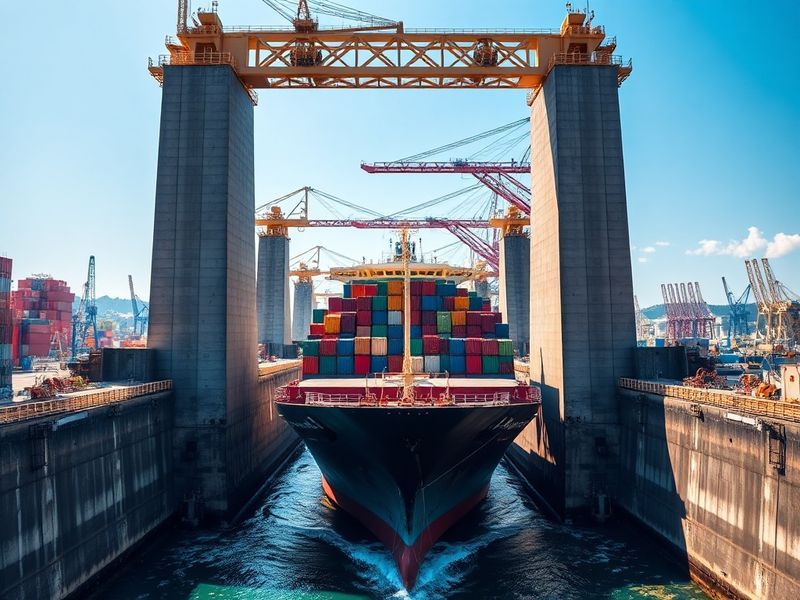
The United States took over the project in 1904, implementing advanced engineering techniques and prioritizing worker safety—though still at a devastating human cost. The project introduced the lock system, which allowed ships to be raised and lowered through a series of chambers, overcoming the 26-meter elevation difference between the oceans. The canal’s completion in 1914 was a triumph of early 20th-century engineering and a testament to perseverance.
A Maritime Shortcut with Global Impact
Before the canal, ships traveling from New York to San Francisco had to sail around Cape Horn, a journey of approximately 13,000 nautical miles. The canal reduced this distance to roughly 5,200 nautical miles, saving time, fuel, and operational costs. This efficiency boosted trade between the Americas, Europe, and Asia, fostering economic growth in regions directly connected by the waterway.
The canal’s influence extends beyond trade. During World War II, it played a crucial role in military logistics, enabling rapid deployment of troops and supplies across the globe. Its strategic importance has made it a focal point in international diplomacy, particularly during periods of heightened geopolitical tension.
How the Canal Operates Today: Challenges and Innovations
The Panama Canal Authority (ACP), a quasi-autonomous government agency, oversees the canal’s operations. Ships pay tolls based on size, type, and cargo, generating billions in revenue annually. The most common vessels are container ships, followed by tankers and bulk carriers. The canal operates 24/7, with traffic managed through a sophisticated scheduling system to prevent bottlenecks.
However, the canal faces growing challenges. One of the most pressing is water scarcity. The lock system relies on vast amounts of freshwater from Gatun Lake, which is fed by rainfall. Droughts, exacerbated by climate change, have reduced water levels, forcing the ACP to implement restrictions on ship transits. In 2023, the canal imposed draft restrictions, limiting the size of vessels that could pass, which disrupted supply chains and increased shipping costs.
Adapting to Modern Demands: The Neopanamax Expansion
To accommodate larger vessels, the ACP completed a $5.25 billion expansion in 2016, adding a third lane of locks. This Neopanamax project allowed the canal to handle ships up to 14,000 TEUs (twenty-foot equivalent units), nearly triple the capacity of the original locks. The expansion positioned the canal to compete with the Suez Canal for traffic between Asia and the U.S. East Coast.
Yet, even with these upgrades, the canal must contend with evolving global trade patterns. The rise of mega-container ships and the shift toward East-West trade routes have intensified competition. Meanwhile, alternative routes, such as the Northwest Passage in the Arctic, pose long-term challenges to the canal’s dominance.
Environmental and Geopolitical Concerns
The Panama Canal’s operations are not without environmental consequences. The freshwater used in the locks is drawn from Gatun Lake, a critical ecosystem that supports biodiversity. Lower water levels have raised concerns about the lake’s long-term health and the impact on local wildlife. The ACP has invested in conservation efforts, including reforestation projects and water recycling initiatives, but the sustainability of these measures remains under scrutiny.
Geopolitically, the canal’s control has shifted over time. Originally a U.S. territory under the Hay-Bunau-Varilla Treaty, the canal zone was returned to Panama in 1999 under the Torrijos-Carter Treaties. This transfer marked a significant moment in Panama’s sovereignty but also introduced new challenges in managing the canal’s operations and security.
The Canal in the Context of U.S.-China Trade Tensions
The canal has become a pawn in broader geopolitical rivalries, particularly between the U.S. and China. As the world’s two largest economies engage in a trade war, the canal’s role in facilitating commerce between Asia and the Americas has made it a strategic asset. The U.S. has emphasized the canal’s importance in maintaining supply chain resilience, while China has invested in infrastructure projects in Panama, including a proposed deep-water port.
These dynamics highlight the canal’s dual role as both an economic lifeline and a geopolitical tool. The ACP must navigate these pressures carefully to ensure the canal remains neutral and accessible to all nations.
Looking Ahead: The Future of the Panama Canal
The Panama Canal’s future hinges on its ability to adapt to changing conditions. Climate change poses the most immediate threat, with droughts and extreme weather events becoming more frequent. The ACP is exploring long-term solutions, such as building new reservoirs or investing in desalination technology, though these options are costly and complex.
Another critical factor is the evolution of global trade. The growth of e-commerce and the demand for faster shipping times may shift traffic patterns, favoring routes that offer more direct connections. The canal must also contend with competition from alternative shipping lanes, such as the Suez Canal and the Arctic routes opening due to melting ice.
Investing in Resilience and Innovation
The ACP is not standing idle. In addition to conservation efforts, the authority is exploring technological innovations to improve efficiency. These include AI-driven traffic management systems to optimize transit times and reduce fuel consumption. The canal is also investing in digital infrastructure to streamline toll payments and customs procedures, aligning with the broader trend of smart trade facilitation.
For Panama, the canal remains a cornerstone of economic growth. It contributes roughly 6% to the country’s GDP and supports over 9,000 jobs directly, with thousands more in related industries. The revenue generated funds social programs, infrastructure projects, and environmental initiatives, underscoring the canal’s role as a national asset.
As the world grapples with supply chain disruptions, climate change, and geopolitical tensions, the Panama Canal’s resilience will be tested. Its ability to innovate and adapt will determine whether it retains its status as the world’s most vital maritime shortcut or faces obsolescence in the face of emerging challenges.
One thing is certain: the Panama Canal’s story is far from over. As long as global trade relies on efficient, sustainable pathways, this engineering marvel will remain at the heart of international commerce.
Key Takeaways
- The Panama Canal is a critical global trade route, handling 3-4% of maritime traffic annually.
- Climate change and droughts threaten its operations, forcing the ACP to implement restrictions.
- The Neopanamax expansion in 2016 doubled the canal’s capacity but introduced new challenges.
- The canal’s geopolitical significance has grown amid U.S.-China trade tensions.
- Innovation and sustainability will be key to the canal’s future.
For those interested in exploring more about global trade and infrastructure, visit our Trending and News categories for further reading.