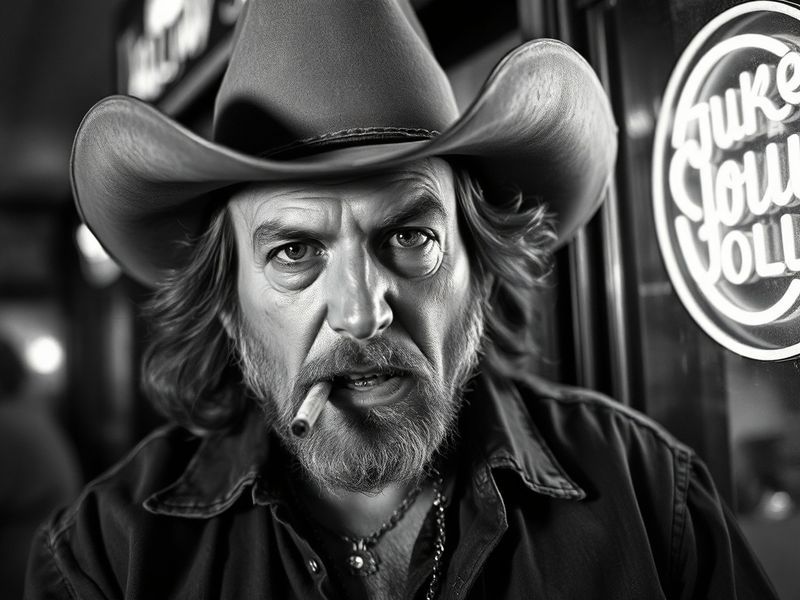
David Allan Coe remains one of country music’s most enigmatic and polarizing figures. A man who lived as he sang—raw, unfiltered, and defiant—Coe carved a path through the industry that few dared to follow. His music blurred the lines between country, outlaw, and rock, creating a sound that was uniquely his own. Decades after his initial rise to fame, Coe’s influence endures, challenging listeners to confront the gritty realities of life beyond Nashville’s polished veneer.
The Rise of an Outlaw Icon
Born in 1939 in Akron, Ohio, Coe’s early life was marked by instability and hardship. He spent much of his youth in and out of reform schools, a period that later became the foundation of his songwriting. By the 1970s, Coe had relocated to Nashville, where he quickly became associated with the outlaw country movement alongside artists like Willie Nelson and Waylon Jennings. His 1975 album Texas Moon and subsequent releases like The Mysterious Rhinestone Cowboy (1977) showcased his knack for blending honky-tonk grit with rebellious storytelling.
Coe’s breakthrough came with the 1977 single “Longhaired Redneck,” a song that proudly embraced his outsider status. Unlike the slick, crossover-friendly country acts of the era, Coe’s music reveled in its roughness. His lyrics didn’t just tell stories—they screamed them, often drawing from his own experiences in prison, on the road, and in the shadows of society. This authenticity resonated with a growing audience tired of the industry’s sanitized offerings.
Key Milestones in Coe’s Career
- 1975: Releases Texas Moon, his first major-label album, introducing his outlaw persona to a wider audience.
- 1977: “Longhaired Redneck” becomes a hit, solidifying his place in the outlaw country movement.
- 1980s: Collaborates with artists like Johnny Cash and Waylon Jennings, further cementing his influence in country music.
- 1991: “If That Ain’t Country” becomes a surprise hit, proving his staying power in an evolving musical landscape.
- 2000s–Present: Continues touring and recording, maintaining a cult following despite shifting industry trends.
The Outlaw Persona: Myth vs. Reality
Coe’s public image was as carefully constructed as it was controversial. He cultivated a persona that was equal parts outlaw, philosopher, and provocateur. Songs like “The Ride” (1983) painted him as a drifter, a man on the run from both the law and the expectations of Nashville. Yet behind the myth was a man who had spent years in prison, fought addiction, and navigated the complexities of fame on his own terms.
Unlike many of his contemporaries, Coe didn’t shy away from taboo subjects. His music tackled topics like prison life (“Prison Poem”), infidelity (“She’s Got Everything”), and even the darker sides of the music industry (“Nigger Fucker,” a song that sparked significant backlash). This fearlessness set him apart but also limited his commercial appeal. While other outlaw artists found mainstream success, Coe remained an acquired taste—a testament to his refusal to compromise.
Coe’s relationship with the media was equally contentious. He embraced controversy, often courting it to maintain his rebellious image. Whether it was his run-ins with the law, his unapologetic lyrics, or his unorthodox marketing tactics (he once sold his songs door-to-door), Coe thrived in the gray areas where others played it safe. This defiance wasn’t just for show; it was a core part of his artistic identity.
Legacy and Influence on Modern Country Music
David Allan Coe’s impact on country music extends far beyond his own discography. He was a bridge between the traditional honky-tonk sound and the raw, unfiltered outlaw movement of the 1970s and 1980s. Artists like Hank Williams Jr., Merle Haggard, and later Sturgill Simpson and Zach Bryan have cited Coe as an influence, drawn to his willingness to push boundaries and his refusal to conform.
In an era where country music is often homogenized for mass appeal, Coe’s legacy serves as a reminder of the genre’s roots. His music wasn’t just entertainment; it was a mirror held up to the struggles, flaws, and triumphs of real people. While modern country often prioritizes radio-friendly polish, Coe’s work stands as a challenge to artists today: to write honestly, live authentically, and never apologize for who you are.
Coe’s influence is also evident in the way he blurred genre lines. His fusion of country, rock, and even punk elements anticipated the genre-blending that would define later movements like Americana and alt-country. Artists such as Jason Isbell and Tyler Childers owe a debt to Coe’s fearless approach to storytelling and musical experimentation.
The Man Behind the Myth
To understand David Allan Coe’s music, it’s essential to look beyond the outlaw persona and acknowledge the man himself. Coe was a complex figure—brilliant, flawed, and unapologetically himself. His life was a series of contradictions: a man who wrote songs about redemption yet struggled with his own demons, a performer who commanded stages with a presence that belied his quiet, introspective side.
Coe’s later years were marked by both triumph and tragedy. He continued to tour well into his seventies, playing to loyal fans who appreciated his unvarnished honesty. Yet he also faced health issues and the loss of close friends in the music industry. Despite these challenges, he remained a vital force in country music, proving that authenticity is timeless.
In interviews, Coe often spoke about the importance of truth in art. “If you’re going to write a song,” he once said, “write it like you mean it. If you’re going to sing it, sing it like you feel it.” This philosophy defined his career and continues to inspire musicians today. Coe wasn’t just a country singer; he was a storyteller who dared to live the stories he told.
Why Coe’s Music Still Matters
David Allan Coe’s music endures because it refuses to be ignored. In an industry that often prioritizes commercial success over substance, Coe’s work stands as a testament to the power of raw, unfiltered art. His songs are not just relics of a bygone era; they are living, breathing reminders of the importance of authenticity in music.
For new listeners, Coe’s music can be a revelation—an introduction to a world where country music isn’t just about twang and nostalgia but about life’s harsh realities and unfiltered emotions. For longtime fans, his music remains a comfort and a challenge, a reminder of a time when country music was as diverse and unpredictable as the people who made it.
As the country music landscape continues to evolve, David Allan Coe’s legacy serves as both a foundation and a challenge. He proved that great art doesn’t require approval, that authenticity can be its own reward, and that the most powerful music often comes from the margins. In a genre that has too often been sanitized for mass consumption, Coe’s work is a defiant act of preservation—a reminder of what country music can and should be.
For those willing to listen, David Allan Coe’s music is more than just a sound. It’s a lesson in courage, a celebration of imperfection, and a testament to the power of living—and creating—on your own terms.
Explore more about outlaw country and rebellious artists on Dave’s Locker Music section or dive into deeper artist profiles on Entertainment.