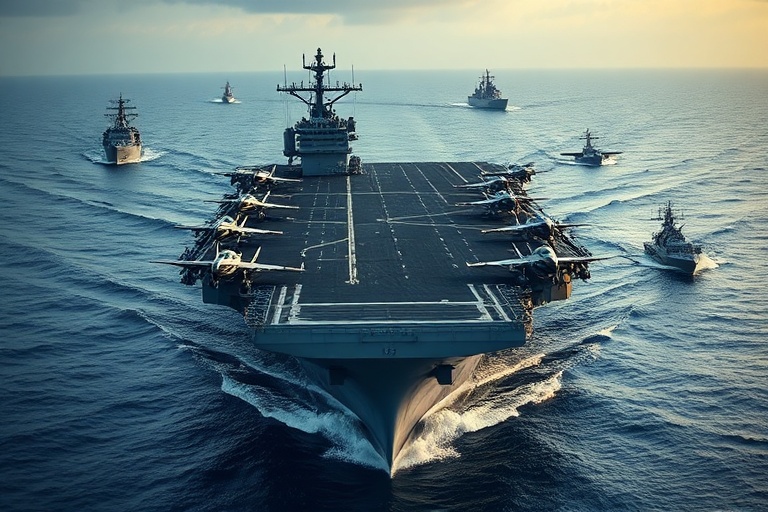
The carrier strike group (CSG) represents one of the most formidable and versatile instruments of military power in the modern era. Comprising an aircraft carrier at its heart, flanked by a sophisticated screen of destroyers, cruisers, submarines, and support vessels, these formations are designed to project force across vast distances while maintaining operational flexibility. Their presence alone often serves as a deterrent, while their actual deployment can reshape geopolitical dynamics in hours.
Unlike historical battleships or cruiser-centered task forces, the CSG is built around air power—specifically, the embarked air wing of 60 to 75 fixed-wing and rotary-wing aircraft. This includes F/A-18E/F Super Hornets, EA-18G Growlers for electronic warfare, E-2D Hawkeye early warning aircraft, and increasingly, the F-35C Lightning II. The integration of fifth-generation stealth fighters has elevated the CSG’s combat effectiveness, enabling it to operate in contested environments where older platforms would struggle.
The Anatomy of a Carrier Strike Group
A modern CSG is not a static formation but a highly adaptable operational unit. Its composition varies by nation and mission, but the U.S. Navy’s Nimitz- and Ford-class CSGs serve as the global standard. At its core is the aircraft carrier, typically displacing over 100,000 tons and capable of speeds exceeding 30 knots. Surrounding the carrier is a protective “screen” designed to detect, track, and neutralize threats before they reach the carrier.
The escort typically includes:
- One Ticonderoga-class guided-missile cruiser: Equipped with the Aegis combat system and capable of ballistic missile defense, air surveillance, and land attack using Tomahawk cruise missiles.
- Two to four Arleigh Burke-class guided-missile destroyers: These provide anti-submarine, anti-air, and anti-surface warfare capabilities, often armed with SM-6 missiles and the SeaRAM close-in weapon system.
- One to two nuclear-powered attack submarines (SSN): These operate in advance of the CSG, conducting intelligence gathering, mine countermeasures, and interdiction missions.
- One supply ship (T-AOE or T-AKE class): Ensures extended operational reach through underway replenishment of fuel, munitions, and provisions.
- Various support vessels and aircraft: Including early warning helicopters (MH-60R), airborne command and control, and logistics drones.
The result is a self-sustaining, rapidly deployable task force capable of operating independently for up to 90 days without returning to port. This endurance and reach make the CSG indispensable in scenarios ranging from humanitarian assistance to high-intensity combat.
Operational Roles and Strategic Flexibility
Carrier strike groups are often described as “100,000-ton diplomacy.” Their deployment signals intent, capability, and resolve without a single shot being fired. During the 2020 tensions in the South China Sea, the USS Theodore Roosevelt CSG conducted sustained operations in the region, asserting freedom of navigation while deterring coercive actions by Beijing.
Beyond deterrence, CSGs fulfill multiple roles:
- Power Projection: The embarked air wing can deliver precision strikes up to 500 nautical miles inland using a mix of GPS-guided bombs, standoff missiles, and stealth aircraft. This capability allows a president to respond to crises without placing boots on the ground.
- Sea Control: By dominating the air and subsurface domains, the CSG ensures that maritime trade routes remain open—a cornerstone of the global economy. Disruptions in these areas can trigger cascading effects on supply chains and energy markets.
- Deterrence and Crisis Response: The mere presence of a CSG can prevent escalation. For instance, during the 2014 Russian annexation of Crimea, the USS George H.W. Bush CSG was deployed to the eastern Mediterranean as a stabilizing force.
- Humanitarian Assistance and Disaster Relief: Following the 2011 Tōhoku earthquake and tsunami, the USS Ronald Reagan CSG delivered critical supplies, conducted medical evacuations, and supported search-and-rescue operations.
The adaptability of the CSG was further demonstrated during the COVID-19 pandemic. In 2020, the USS Nimitz CSG conducted dual-carrier operations in the Philippine Sea with the USS Ronald Reagan CSG, showcasing the ability to surge combat power rapidly in response to emerging threats.
Technological Evolution and Future Challenges
The CSG is not a static system—it evolves with advances in sensing, propulsion, and networking. The introduction of the Ford-class carriers, beginning with USS Gerald R. Ford (CVN-78), marks a generational leap. The Ford features electromagnetic aircraft launch systems (EMALS), advanced arresting gear, and a new dual-band radar system that improves target tracking and reduces manpower requirements.
Yet, modernization brings new challenges. Hypersonic missiles, cyber threats, and electronic warfare pose existential risks to traditional CSG architectures. The U.S. Navy’s Distributed Maritime Operations (DMO) concept seeks to address this by dispersing the CSG’s escorts and aircraft across a wider battlespace, using networked sensors and unmanned systems to maintain situational awareness.
Another innovation is the integration of unmanned aerial vehicles (UAVs) and optionally manned platforms such as the MQ-25 Stingray. These systems extend the CSG’s reach, conduct aerial refueling, and perform intelligence, surveillance, and reconnaissance (ISR) without risking pilots. The MQ-25, in particular, is expected to double the strike range of the F-35C by enabling it to refuel mid-air without diverting from combat.
However, the rise of anti-access/area-denial (A2/AD) systems—such as China’s DF-21D “carrier killer” ballistic missiles—demands a rethink of how CSGs operate. The Navy is investing in long-range strike weapons like the Hypersonic Air-Launched Offensive Anti-Surface (HAASM) and developing the Next-Generation Air Dominance (NGAD) fighter to ensure air superiority in contested zones.
Global Perspectives: Who Else Operates Carrier Strike Groups?
While the U.S. Navy operates 11 active carrier strike groups—the largest fleet in the world—it is not alone. The United Kingdom’s Royal Navy has revitalized its carrier capability with the commissioning of HMS Queen Elizabeth in 2017 and HMS Prince of Wales in 2019. These 65,000-ton vessels embark a mix of F-35B Lightning IIs and Merlin helicopters, forming a light carrier strike group optimized for expeditionary operations.
France operates the Charles de Gaulle, a nuclear-powered carrier that serves as the flagship of its naval air arm. It regularly deploys to the Mediterranean and Indian Ocean, supporting counter-terrorism and maritime security missions. India’s INS Vikramaditya and the future INS Vikrant represent growing indigenous carrier capabilities, while China’s Type 003 Fujian, launched in 2022, signals Beijing’s ambition to field a blue-water navy with multiple CSG-capable carriers by 2035.
Even smaller nations are exploring carrier-capable platforms. Japan’s Izumo-class “helicopter destroyers” are being retrofitted to operate F-35Bs, effectively transforming them into light aircraft carriers. South Korea is also developing a light carrier, the CVX, slated for the 2030s.
This global diffusion of carrier technology is reshaping naval power structures. It is no longer the exclusive domain of superpowers, but a strategic option for middle powers seeking to project influence beyond their shores.
Conclusion: The Carrier Strike Group in the 21st Century
The carrier strike group remains the ultimate symbol of naval power, blending lethality, endurance, and adaptability. In an era of great-power competition, it serves as both a shield and a sword—deterring aggression while enabling decisive action when necessary. Technological innovation continues to extend its reach and resilience, but so too do the threats it faces.
As nations like China and Russia field increasingly sophisticated anti-ship systems, the CSG must evolve from a concentrated formation into a distributed network of sensors, shooters, and support nodes. The future may see smaller, more agile carrier platforms paired with unmanned systems and hypersonic weapons, enabling rapid strikes without the vulnerability of a single large hull.
Yet, for all the advances in drones and cyber warfare, the aircraft carrier—and by extension, the carrier strike group—retains a unique psychological and operational value. It is a visible, tangible assertion of sovereignty and strength. In an uncertain world, the CSG stands ready: a floating city of steel, firepower, and resolve.
To learn more about how naval power shapes global security, visit our News section. For deeper analysis on military technology, explore our Analysis category.