Donald Campbell was more than a speed record breaker; he was a symbol of post-war British ambition, technical ingenuity, and the relentless pursuit of perfection. Born in 1921 to Sir Malcolm Campbell—himself a legendary land and water speed record holder—Donald inherited a family obsession with velocity and innovation. Where his father set records on four wheels and two, Donald would push the boundaries of both land and water, ultimately becoming the only person to simultaneously hold world land and water speed records.
His story unfolds across continents, from the salt flats of Utah to the lakes of England and Africa, and reflects a global fascination with speed, engineering, and human daring. Campbell’s life and death in 1967 during a world-record attempt on Coniston Water remain a defining moment in motorsport and maritime history. Decades later, his legacy endures not just in record books, but in the hearts of speed enthusiasts and engineers worldwide.
The Rise of a Speed Pioneer
Donald Campbell’s early years were shaped by his father’s shadow and the roar of engines. Malcolm Campbell set nine land speed records and four water speed records between 1924 and 1939, earning the nickname “The Fastest Man on Earth.” Yet Donald did not live in his father’s shadow—he chose to step into the cockpit himself, determined to surpass Malcolm’s achievements.
While Malcolm used piston-engine cars like Bluebird to dominate the Bonneville Salt Flats, Donald initially focused on water. After serving in the Royal Air Force during World War II, he returned to civilian life with a clear goal: to break his father’s water speed record of 141.74 mph, set in 1939 aboard Blue Bird K4.
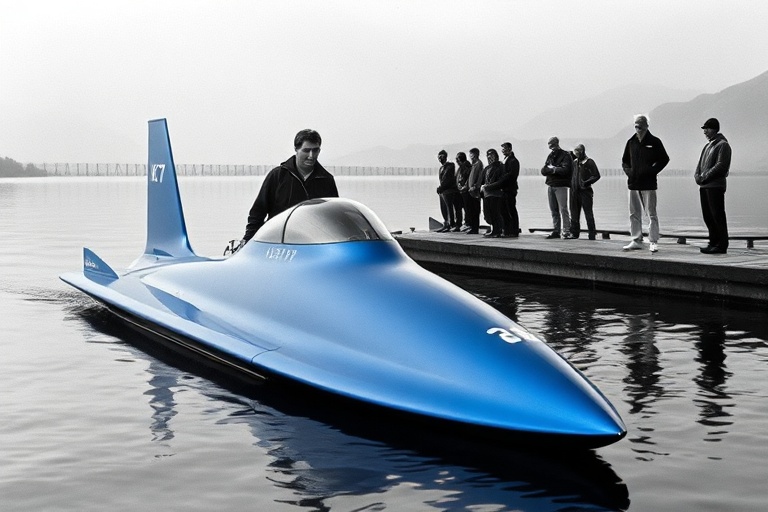
Campbell’s first major water record came in 1955, when he piloted Blue Bird K7—a sleek, jet-powered hydroplane—to 202.32 mph on Ullswater in the English Lake District. This was more than a personal triumph; it marked the beginning of a new era in water speed racing, one defined by jet propulsion and aerodynamic design.
A Global Obsession with Speed
Speed has always transcended borders. In the 1950s and 60s, as the Cold War fueled technological competition between nations, Campbell’s quest for records became a cultural touchstone. His Blue Bird vehicles—first on water, then on land—represented British engineering prowess at a time when the Empire was transitioning into the Commonwealth.
His 1959 land speed record of 333.1 mph at Bonneville was not just a British victory; it was celebrated across Europe and North America. Magazines like Life and Autocar featured him prominently, framing Campbell as a modern-day knight of speed. In Australia and South Africa, where land speed record attempts were also pursued, Campbell’s name became synonymous with courage and precision.
- 1955: Water speed record at 202.32 mph (Ullswater, UK)
- 1956: Water speed record at 225.63 mph (Lake Windermere, UK)
- 1957: Land speed record at 286.9 mph (Bonneville, USA)
- 1958: Land speed record at 301.13 mph (Bonneville, USA)
- 1959: Land speed record at 333.1 mph (Bonneville, USA)
His ability to straddle both land and water disciplines made him a unique figure in motorsport history. While others focused solely on cars or boats, Campbell fused the two, creating a hybrid legacy that remains unmatched.
The Bluebird Legacy: Innovation and Grit
Campbell’s Blue Bird vehicles were not just machines—they were works of art and engineering. Each iteration reflected years of trial, error, and refinement. The hydroplane Blue Bird K7, for example, was designed with a pointed nose, swept-back wings, and a de Havilland Goblin jet engine. It was built to cut through water like a knife, minimizing drag and maximizing stability at extreme speeds.
On land, Blue Bird CN7 was a different beast entirely—a four-wheeled missile with a Bristol-Siddeley Proteus gas turbine engine. Its streamlined aluminum body was shaped in a wind tunnel, a pioneering use of aerodynamic science in motorsport. When Campbell broke the 400 mph barrier in 1964, he became the first person to exceed 400 mph on land, a milestone that captured global headlines.
But speed came at a cost. Campbell faced skepticism from critics who called his attempts reckless. In 1960, he crashed Blue Bird K7 at 240 mph on Lake Ullswater, nearly losing his life. Yet he returned, rebuilt, and broke the record again in 1964 at 276.33 mph. His persistence mirrored the post-war spirit of resilience, a quality admired from London to Los Angeles.
The Final Attempt: A Global Audience Watches
By 1966, Campbell had turned his attention back to water. He set a new record of 285.21 mph on Lake Dumbleyung in Western Australia—his father’s old stamping ground. But he wasn’t satisfied. He wanted to exceed 300 mph on water, a target that seemed impossible even for a man who had shattered barriers on land.
On January 4, 1967, at Coniston Water in the English Lake District, Campbell prepared for his final run. Thousands of spectators lined the shores. Television cameras broadcast the attempt live. As Blue Bird K7 accelerated across the icy water, it reached 310 mph before becoming airborne. The hydroplane somersaulted and disintegrated in a fireball. Campbell was killed instantly.
The world mourned. Newspapers from The Times to The New York Times ran front-page obituaries. Flags flew at half-mast in Britain. In Australia, where he had been celebrated just months earlier, memorial services were held. Campbell’s death was not just a national loss—it was a global one, a reminder of the price of pushing human limits.
Campbell’s Enduring Influence and Cultural Resonance
Decades after his death, Donald Campbell remains a cultural icon. His story has been told in documentaries, books, and even a 1970s BBC drama series. Museums across the UK—including the Lakeland Motor Museum and the National Science and Media Museum—display artifacts from his life and career. In 2018, a memorial was unveiled at Coniston Water, where he died, by his daughter Gina Campbell, who has continued his legacy by breaking water speed records herself.
Campbell’s influence extends beyond motorsport. He embodied the mid-century belief in progress through technology—a belief that shaped everything from Formula 1 to the space race. His use of jet engines predated their widespread adoption in high-speed vehicles, and his aerodynamic designs influenced later racers, including those in Sports and Technology fields.
In Japan, where speed and precision are highly valued, Campbell’s records were studied by engineers designing bullet trains and high-speed boats. In the United States, hot rod culture embraced his spirit of innovation, while in Europe, his story became part of the narrative of postwar recovery and ambition.
Campbell’s life also raises enduring questions about risk, legacy, and the human drive to excel. Was he a hero or a daredevil? The answer lies in the eye of the beholder, but his impact is undeniable. He turned speed into a form of art, a blend of science, courage, and sheer will.
A Legacy That Crosses Continents
From the salt flats of Utah to the lakes of Australia and England, Donald Campbell’s journey reflects a global fascination with speed and innovation. His story resonates in countries where motorsport is a national passion—such as Italy, Germany, and Brazil—as much as in the UK. In an era before social media, Campbell’s records were global news, uniting audiences across continents in shared awe.
Modern speed record chasers, from Richard Noble to Andy Green, cite Campbell as an inspiration. The Bloodhound LSR project, aiming to break the land speed record with a rocket-powered car, continues the tradition he began. Campbell’s spirit lives on in every attempt to push the boundaries of what’s possible.
He was, in every sense, a man ahead of his time—a pioneer who raced not just against machines, but against the limits of human ambition.
Donald Campbell did not just break records. He broke barriers. And in doing so, he left a legacy that continues to inspire speed enthusiasts around the world.