Frontier Airlines Incident Raises Safety Questions in Low-Cost Aviation
Frontier Airlines Incident Highlights Broader Safety Concerns in Low-Cost Aviation
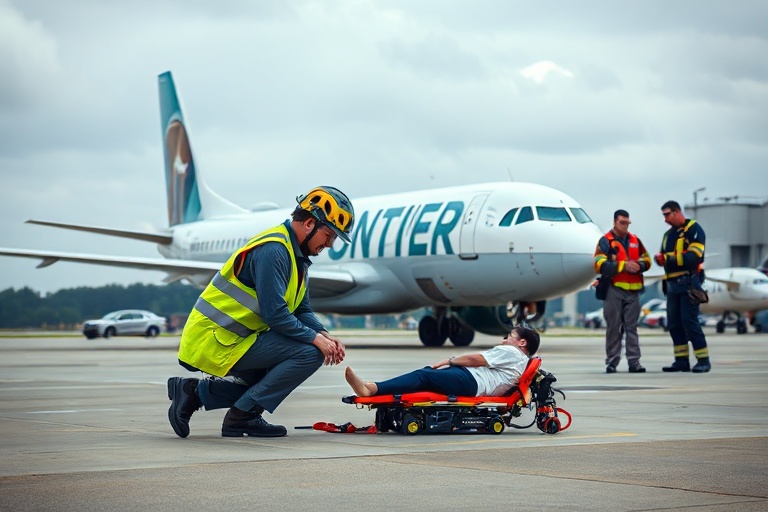
In a rare but alarming incident, Frontier Airlines found itself under scrutiny after a passenger was struck by an aircraft at Denver International Airport in late 2023. The event, while uncommon, has reignited discussions about safety protocols in the aviation industry, particularly among budget carriers operating in high-traffic hubs. Aviation authorities confirmed the incident involved a ground crew member who was inadvertently hit by a departing plane, raising questions about communication and operational oversight in fast-paced airport environments.
Such accidents are statistically infrequent but carry significant weight due to the inherent risks of air travel. While Frontier Airlines has not released detailed findings, preliminary reports suggest a lapse in ground crew positioning or a miscommunication during pushback procedures. The Federal Aviation Administration (FAA) has since launched a review of safety measures at Denver International, one of the busiest airports in the United States.
Global Context: How Often Do These Incidents Occur?
To understand the rarity of this event, it’s worth examining broader aviation safety trends. According to the International Air Transport Association (IATA), ground incidents account for less than 1% of all aviation accidents worldwide. However, when they do occur, the consequences can be severe. A 2022 report by the European Aviation Safety Agency (EASA) highlighted that ground handling—including baggage loading, refueling, and aircraft positioning—remains a high-risk area despite technological advancements.
Key statistics from global aviation safety bodies:
- Ground collisions make up approximately 0.8% of all aviation accidents globally (IATA, 2023).
- In the U.S., the FAA recorded 12 ground-related incidents in 2022, with two resulting in injuries.
- European airports reported 15 ground incidents in the same year, with three involving personnel injuries.
These numbers suggest that while ground incidents are uncommon, they are not isolated to any single region. Airports in densely populated areas, such as Dubai, London Heathrow, and Tokyo Narita, have also faced similar challenges, often attributed to high operational volumes and language barriers among ground staff.
The Role of Low-Cost Carriers in Safety Debates
Frontier Airlines, like many budget carriers, operates on a model designed to minimize costs while maximizing efficiency. This often translates to leaner ground crews, tighter turnaround times, and increased reliance on automated systems. Critics argue that such operational models may inadvertently elevate safety risks, particularly when combined with high passenger volumes and compressed schedules.
However, proponents of low-cost aviation point out that budget airlines are not inherently less safe. In fact, IATA data indicates that budget carriers often match or exceed the safety records of legacy airlines when normalized for flight hours. The issue, they argue, lies not in the business model itself but in the execution of safety protocols. For example, some budget carriers have invested heavily in real-time tracking systems for ground vehicles, reducing the likelihood of miscommunication.
Still, the Frontier incident serves as a reminder that safety cannot be compromised for cost savings. Airlines operating in competitive markets must balance efficiency with rigorous training and redundant safety checks. The FAA’s ongoing review at Denver International will likely set new benchmarks for ground operations, influencing carriers worldwide.
Cultural and Operational Differences in Aviation Safety
Aviation safety is not just a technical issue—it’s deeply intertwined with cultural and operational norms. For instance, in some Asian airports, ground crews follow a highly hierarchical structure, where junior staff may hesitate to voice concerns about safety protocols. In contrast, Western airports often emphasize a “speak-up culture,” where employees are encouraged to report potential hazards immediately.
This cultural divide was evident in a 2021 incident at Singapore Changi Airport, where a ground crew member was struck by a taxiing aircraft. Investigations revealed that language barriers and a reluctance to challenge senior staff contributed to the accident. Such findings underscore the need for standardized safety training that transcends regional differences.
Moreover, the rise of automation in aviation has introduced new variables. While automated systems can reduce human error, they also require crews to adapt to unfamiliar interfaces. A 2023 study by the University of California, Berkeley, found that airports with high levels of automation reported a 12% increase in ground incidents during the first year of implementation. This suggests that technology, while beneficial, must be complemented by robust human oversight.
What’s Next for Frontier Airlines and the Industry?
The immediate aftermath of the Frontier incident saw the airline re-evaluating its ground operations protocols. In a statement, Frontier Airlines emphasized its commitment to safety and announced a partnership with the FAA to conduct a comprehensive audit of its ground handling procedures. The airline also pledged to enhance communication training for its ground crews, including multilingual safety briefings.
Industry analysts expect the FAA’s findings to influence broader regulatory changes. Potential measures could include mandatory real-time tracking for ground vehicles, stricter penalties for non-compliance with safety protocols, and increased funding for ground crew training programs. Airlines may also face higher insurance premiums, prompting a reallocation of resources toward safety infrastructure.
For passengers, the incident serves as a reminder of the complexities behind air travel. While flying remains one of the safest modes of transportation, the Frontier Airlines event highlights the importance of continuous improvement in safety standards. Travelers can take solace in knowing that aviation authorities and airlines are likely to implement stricter measures in response to such incidents.
As the aviation industry evolves, the balance between cost efficiency and safety will remain a critical discussion. Airlines, regulators, and passengers must work together to ensure that incidents like the one involving Frontier Airlines remain exceedingly rare.
For more insights into aviation safety and industry trends, explore our Travel and News sections.