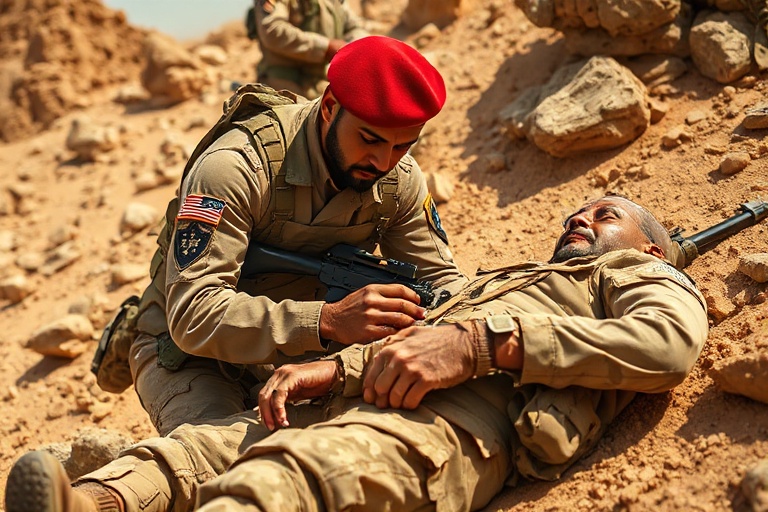
How Morocco’s Military Helped Recover a Missing US Soldier
Moroccan Military’s Role in the Recovery of a U.S. Soldier
The collaboration between Moroccan and American military forces has long been a cornerstone of regional security in North Africa. When a U.S. soldier went missing during a training exercise in the rugged Atlas Mountains in 2023, the rapid and coordinated response from both nations highlighted the depth of their partnership. This incident underscored Morocco’s strategic importance as a U.S. ally in the Maghreb, where shared counterterrorism efforts and joint military drills are commonplace.
The operation to locate and recover the soldier unfolded over 72 hours, involving hundreds of personnel from the Royal Moroccan Armed Forces, U.S. Africa Command (AFRICOM), and local search-and-rescue teams. The terrain posed significant challenges—steep slopes, dense cedar forests, and unpredictable weather—making the mission as much about endurance as it was about technology. Moroccan helicopters, equipped with thermal imaging, scoured the area while ground teams followed leads from local Berber communities, whose knowledge of the land proved invaluable.
This recovery effort was not an isolated incident. Morocco has been a key partner in U.S. military operations across Africa, from counterpiracy missions in the Gulf of Guinea to counterterrorism efforts in the Sahel. The country’s proximity to conflict zones like Libya and Mali, combined with its relatively stable political environment, makes it a critical hub for American strategic interests on the continent. Joint exercises such as African Lion, one of the largest military drills in Africa, regularly bring together thousands of troops from both nations to refine coordination in high-stakes scenarios.
Cultural and Geopolitical Context Behind the Partnership
Morocco’s relationship with the U.S. military is deeply rooted in history, dating back to the Cold War era. The two countries formalized their alliance in the 1980s, and since then, Morocco has been one of the few Arab nations to maintain strong defense ties with Washington. This bond was further solidified in 2020 when Morocco became the first Arab country to normalize relations with Israel through the Abraham Accords, a move that aligned with U.S. regional priorities.
The recovery mission also reflected the cultural synergy between Moroccan and American forces. Moroccan soldiers, often trained in both modern warfare and traditional survival techniques, demonstrated adaptability in the field. Meanwhile, U.S. service members brought advanced technology, including drones and satellite mapping, to supplement local expertise. The exchange highlighted how military cooperation transcends borders, blending tactical precision with mutual respect for each other’s strengths.
Geopolitically, the incident occurred against a backdrop of rising tensions in the Sahel, where militant groups affiliated with Al-Qaeda and ISIS have exploited weak governance to expand their influence. Morocco’s ability to assist in such a high-profile recovery bolstered its reputation as a stabilizing force in a volatile region. The operation also served as a reminder of how non-combatant countries can play pivotal roles in global security networks, often without the widespread recognition afforded to larger military powers.
Lessons Learned from the Recovery Operation
The successful recovery of the U.S. soldier yielded several key takeaways for both nations. First, the importance of pre-existing joint training programs cannot be overstated. Exercises like African Lion had already established protocols for communication, logistics, and crisis response, which were critical during the actual mission. Without these drills, the coordination between Moroccan and U.S. forces might have been less seamless.
Another lesson was the value of local knowledge. The Berber communities in the Atlas Mountains, who have inhabited the region for centuries, provided insights that military technology alone could not. Their understanding of hidden paths, water sources, and seasonal weather patterns helped narrow the search area. This underscores the broader principle that sustainable security solutions often require blending indigenous wisdom with modern military tactics.
The operation also exposed areas for improvement. Communication delays between Moroccan and U.S. command centers, though minor, highlighted the need for even tighter integration of communication systems. Additionally, the recovery team’s reliance on helicopters—limited in number—raised questions about diversifying search methods, such as increased use of ground-penetrating radar or thermal drones for night operations.
For U.S. military planners, the incident reinforced the strategic value of Morocco as a forward operating location. The country’s infrastructure, including ports and airfields, makes it an ideal staging ground for rapid deployments in West and North Africa. Meanwhile, Morocco benefits from enhanced training opportunities and access to advanced military technology, which strengthens its own defense capabilities.
A Broader View: Military Partnerships in the 21st Century
The Morocco-U.S. military recovery effort is part of a larger trend in 21st-century defense collaborations. As traditional warfare evolves into hybrid conflicts involving insurgencies, cyber threats, and climate-related disasters, nations are increasingly relying on partnerships rather than unilateral action. These alliances allow smaller countries to punch above their weight, while larger powers gain access to critical geographic and logistical advantages.
A few notable examples illustrate this dynamic:
- France and the Sahel: France has maintained a military presence in the Sahel for nearly a decade, collaborating with countries like Chad and Niger to combat Islamist militants. However, recent political shifts have led to calls for more African-led solutions.
- Turkey and Somalia: Turkey’s support for Somalia’s government includes military training, infrastructure development, and direct combat operations against Al-Shabaab. This partnership has helped stabilize the Horn of Africa.
- India and the Indo-Pacific: India’s growing defense ties with the U.S. and Japan aim to counterbalance China’s influence, showcasing how regional powers can shape global security architectures.
In this context, Morocco’s role in the U.S. soldier recovery is more than a humanitarian success—it’s a microcosm of how military alliances are adapting to modern challenges. These partnerships are not just about firepower; they’re about resilience, adaptability, and shared purpose. As climate change and political instability reshape global security landscapes, the ability to collaborate across cultures and terrains will become even more essential.
The recovery mission also serves as a reminder of the human element in military operations. Behind every mission are individuals—soldiers, civilians, and allies—whose skills and sacrifices make the difference. For the U.S. soldier rescued in Morocco, the operation was a lifeline. For the Moroccan troops involved, it was a testament to their professionalism and dedication. Together, they wrote a chapter in a story that continues to unfold across Africa and beyond.
As both nations reflect on the lessons from this operation, one thing is clear: the bonds forged in moments of crisis often define the strength of partnerships in the years to come.