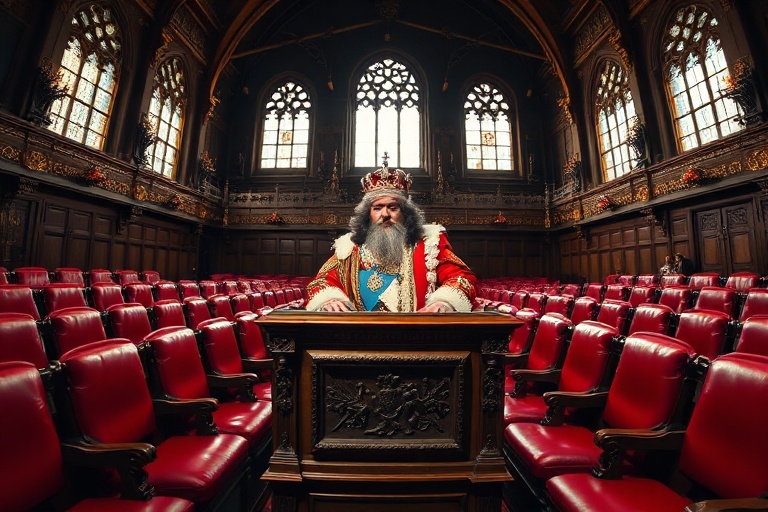
Every year, the State Opening of Parliament in the United Kingdom unfolds as a carefully choreographed spectacle, blending centuries-old tradition with the raw mechanics of modern governance. At its heart lies the King’s Speech, a constitutional obligation that transcends mere ceremony. It is a moment where monarchy and democracy intersect, where ritual meets policy, and where the symbolic weight of the Crown is publicly reaffirmed. This address, delivered by the monarch but written by the government, is not a personal declaration but a government statement presented in royal form. Its words carry the authority of the state, even though they originate from elected officials.
The speech sets the legislative agenda for the parliamentary year. It outlines the government’s priorities, proposed bills, and broader policy direction. While its contents are drafted by ministers, the constitutional fiction of royal assent—where the monarch “approves” the measures—remains a powerful emblem of the enduring, if largely ceremonial, role of the Crown in British politics. This ritual is not just symbolic; it reflects deep structural relationships between the monarchy, Parliament, and the executive branch.
The Constitutional Role of the King’s Speech
The King’s Speech is rooted in the constitutional principle of parliamentary sovereignty. According to the UK’s uncodified constitution, the monarch must remain politically neutral and refrain from interfering in government decisions. Yet, through the speech, the Crown is formally involved in the legislative process. This paradox is resolved by the convention that the speech is written by the Prime Minister and Cabinet, not by the monarch. The monarch’s role is to deliver the speech as a neutral conveyor of government policy.
This arrangement dates back to the 17th century, evolving after the Glorious Revolution of 1688, which established Parliament’s supremacy over the monarchy. The speech itself is a product of the constitutional settlement that followed, particularly the Bill of Rights 1689 and later the Act of Settlement 1701. These laws ensured that the Crown would govern only through ministers accountable to Parliament. Today, the speech is one of the few remaining formal occasions where the three branches of government—the Crown, the House of Commons, and the House of Lords—converge in a single event.
The speech is delivered in the House of Lords chamber, not the Commons, underscoring its ceremonial and non-partisan nature. The monarch enters the chamber in full regalia, accompanied by the House of Lords’ mace and the Yeomen of the Guard. The presence of MPs in the Lords—standing at the bar of the House—symbolizes the unity of the legislature under royal authority. Once the speech concludes, MPs return to the Commons to debate its contents in a session known as the “Humming of the Address,” where they formally respond to the government’s agenda.
What Happens During the Speech? Key Elements and Process
The State Opening of Parliament is a multi-day event, but the King’s Speech is its focal point. Below is an outline of the key stages in the process leading up to and including the speech:
- Preparation by the Government: The speech is drafted by the Prime Minister and Cabinet. Senior civil servants and the Government Legal Department review the proposed bills to ensure they are legally sound and politically viable.
- Approval by the Monarch: While the monarch does not influence the content, the speech is submitted for approval as a matter of constitutional courtesy. The monarch is briefed on its contents in advance.
- Black Rod’s Summons: On the day of the event, Black Rod, an official of the House of Lords, is sent to summon MPs from the Commons to the Lords’ chamber. This act symbolizes the independence of the two houses.
- The Procession: The monarch travels from Buckingham Palace to Parliament in the Irish State Coach, accompanied by a mounted escort from the Household Cavalry.
- Delivery of the Speech: In the Lords chamber, the monarch delivers the speech from the throne, reading from a printed text. The speech outlines government plans for the coming session, including draft legislation and policy priorities.
- Debate and Response: MPs return to the Commons to debate the speech’s contents. This debate lasts several days and often becomes a forum for political opposition to challenge the government.
The speech itself is structured into thematic sections, covering areas such as economic policy, social reform, foreign affairs, and constitutional matters. It typically includes references to proposed bills, such as those on healthcare, education, or national security. While the speech sets the legislative agenda, its contents do not bind the government to specific outcomes. Parliament remains sovereign; bills may be amended or rejected during the legislative process.
Symbolism and Modern Relevance: Why the Speech Still Matters
In an era of rapid political change, declining deference to institutions, and public skepticism toward elites, the King’s Speech retains surprising cultural and political significance. It is one of the few national events that still commands broad public attention, drawing millions of viewers and dominating news cycles. Its endurance speaks to the power of tradition in maintaining national identity and continuity.
Yet the speech is not without controversy. Critics argue that it reinforces an outdated and undemocratic system, where an unelected monarch lends legitimacy to government policies. Some constitutional reformers advocate for abolishing the monarchy or, at minimum, replacing the speech with a purely ceremonial address delivered by the Speaker of the House of Commons. Others point out that the speech’s non-partisan framing obscures the partisan nature of the government that drafts it.
Despite these debates, the speech serves a practical function. It provides a rare moment of national focus, a pause in the partisan fray where the government is compelled to articulate its vision in clear terms. For new governments, particularly after an election, the speech is a declaration of intent, a signal to voters and markets about the direction of policy. For established governments, it can be a tool for consolidating power or reshaping public perception.
Moreover, the speech is a global spectacle. Broadcast internationally, it reinforces the UK’s image as a stable parliamentary democracy. In a world of political instability and populist upheaval, the ritual offers reassurance: power may change hands, but the system endures. This continuity is itself a form of soft power, projecting stability and tradition.
Beyond the Ceremony: Broader Implications for Governance and Society
The King’s Speech is more than a pageant. It encapsulates the paradox at the heart of the British constitution: a system that blends democratic accountability with hereditary authority. This tension is not merely theoretical. It has real-world consequences for how power is perceived and wielded in the UK.
For instance, the speech often reflects the government’s attempt to frame its agenda within a narrative of national unity. By delivering the speech in the name of the monarch, the government positions its policies as serving the long-term interests of the country, rather than the short-term interests of a political party. This rhetorical strategy can be effective in softening opposition and appealing to a broader electorate.
Additionally, the speech provides a unique opportunity for political theater. Prime Ministers often use it to signal major reforms, such as the creation of new public institutions or the expansion of rights. For example, the 2022 speech under Boris Johnson included plans for voter ID laws and constitutional reforms, while the 2023 speech under Rishi Sunak emphasized economic growth and public service reform.
The speech also intersects with the monarchy’s own evolving role. As public attitudes toward the Crown become more questioning, the King’s Speech serves as a reminder of the institution’s symbolic value. The monarch’s presence lends gravitas to the proceedings, but it also ties the monarchy to the government’s successes and failures. A poorly received speech can reflect badly on the government; a well-received one can enhance the monarch’s standing.
From a constitutional perspective, the speech highlights the flexibility of the UK’s unwritten system. Unlike fixed-term parliaments or codified constitutions, the British system adapts through convention and precedent. The King’s Speech is a prime example: a centuries-old ritual that continues to evolve, even as its core purpose remains unchanged.
For citizens, the speech offers a moment of reflection. It prompts questions about representation, power, and the role of tradition in modern governance. Do we still need a hereditary head of state to open Parliament? Can democracy thrive without ceremonial symbols? These are not abstract questions. They go to the heart of how we understand authority, legitimacy, and national identity.
Ultimately, the King’s Speech is a living artifact of the British political system—part tradition, part governance, and entirely symbolic. It reminds us that democracy does not exist solely in ballots and debates, but also in rituals and pageantry. In an age of disruption, those rituals may be more important than ever.
Further Reading and Context
To better understand the constitutional and historical context of the King’s Speech, consider exploring these resources:
- Dave’s Locker: Politics Section – For ongoing analysis of UK governance, constitutional debates, and parliamentary developments.
- Dave’s Locker: News Section – For real-time coverage of major political events, including State Opening of Parliament.
Whether viewed as a quaint relic or a vital institution, the King’s Speech remains a cornerstone of British political life. It is a reminder that governance is not just about laws and policies—it is also about meaning, memory, and the stories we tell ourselves as a nation.