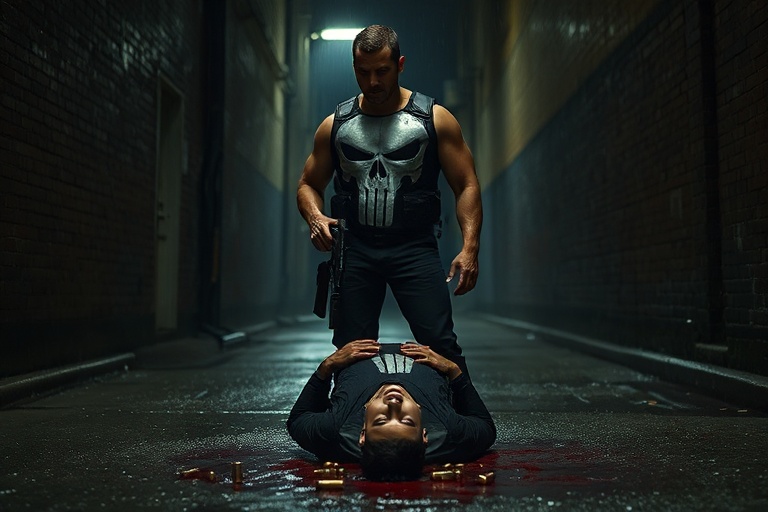
The Punisher has always occupied a unique space in the Marvel Universe. Unlike heroes who strive to save lives, Frank Castle operates from a place of vengeance, his mission defined by an unrelenting cycle of violence. The limited series Punisher: One Last Kill represents more than just another chapter in his story—it’s a deliberate meditation on moral decay, redemption, and the cost of absolute justice.
This narrative arrives at a time when audiences increasingly question the boundaries between heroism and brutality. One Last Kill doesn’t shy away from that tension. Instead, it forces readers to confront uncomfortable truths about vengeance as a motivator, the psychological toll of a life spent in the shadows, and whether Frank Castle’s war can ever truly end.
The Evolution of Frank Castle: From Soldier to Specter
Frank Castle’s origins are well-documented: a former Marine turned family man, his transformation into the Punisher followed the murder of his wife and children by the mob. What began as a personal vendetta evolved into a crusade against organized crime, and eventually, any criminal element that crossed his path. Over decades, the character has shifted from a brutal antihero to a figure of tragic complexity.
One Last Kill leans into this complexity. Set against the backdrop of Frank’s later years, the series explores a man who has outlived most of his enemies, who has seen cycles of violence repeat despite his efforts. The creative team behind this story—writer Greg Rucka and artist Salvador Larroca—craft a narrative that feels both inevitable and melancholic. Frank isn’t just fighting criminals anymore; he’s fighting time, memory, and the erosion of his own humanity.
This isn’t the first time the Punisher has faced existential questions. Previous stories like Welcome Back, Frank and Punisher MAX delved into his psychological state. But One Last Kill feels different. It’s less about his enemies and more about Frank himself—the weight of his choices, the loneliness of his existence, and the quiet despair that comes with knowing he may never stop, even if he wants to.
Narrative Structure: A Story of Colliding Fates
The series employs a non-linear structure, weaving together past and present to illustrate how Frank’s actions have reverberated across decades. The story follows three distinct timelines:
- 1971: A young Frank Castle, still in the Marines, witnesses the early corruption that will shape his future.
- 1995: The Punisher at the height of his war, targeting a crime syndicate that spans generations.
- 2023: An aging Frank, now a ghost of his former self, pursuing a final target who may not even remember their crimes.
This structure isn’t just stylistic—it’s thematic. Each timeline reinforces the idea that violence begets violence, that Frank’s war has no true beginning or end. The 1971 scenes show the first cracks in his moral foundation. The 1995 arcs highlight his peak ruthlessness. The 2023 chapters reveal a man who has become the very thing he once fought: a relic of a war that never concluded.
Critics have praised the series for its willingness to embrace ambiguity. Frank isn’t a hero here, nor is he purely a villain. He’s a man trapped in a loop, unable to escape the consequences of his actions. The final issue, in particular, lingers with readers, leaving them to question whether Frank’s “last kill” is a release or just another step in an endless cycle.
Broader Implications: The Punisher in Modern Storytelling
The Punisher’s enduring appeal speaks to a cultural fascination with vengeance narratives. In an era where audiences are bombarded with stories of justice served through extreme measures—from John Wick to The Batman—Frank Castle stands out as one of the most uncompromising examples. His refusal to compromise, his rejection of systemic solutions, and his embrace of solitary violence make him both compelling and problematic.
Yet One Last Kill complicates that narrative. It doesn’t glorify Frank’s methods. Instead, it asks whether his war has been worth the cost—not just to his enemies, but to himself. The series subtly critiques the idea of the “lone avenger,” positioning Frank as a cautionary figure rather than an aspirational one. His story becomes a reflection on the dangers of unchecked retribution, and the way violence, once unleashed, consumes everything in its path.
This theme resonates particularly in 2024, a year marked by political polarization, social unrest, and a growing distrust in institutions. Frank’s world—where justice is meted out in back alleys and abandoned warehouses—feels uncomfortably familiar. His story forces readers to confront uncomfortable questions: Is vigilante justice ever justified? Can violence truly solve anything? And when does the pursuit of justice become its own form of tyranny?
Legacy and Reception: A Fitting Farewell?
Reception to Punisher: One Last Kill has been overwhelmingly positive, with many critics calling it one of the definitive Punisher stories. The series has been lauded for its nuanced portrayal of Frank Castle, its emotional depth, and its refusal to provide easy answers. Fans and newcomers alike have praised its pacing, artwork, and thematic richness.
But the series also arrives at a crossroads for the character. Frank Castle has been killed, resurrected, and rebooted multiple times across Marvel’s history. One Last Kill doesn’t necessarily “end” his story—Marvel has a habit of reviving dead antiheroes—but it does offer a compelling conclusion to this particular iteration. Whether it’s a definitive end or just another chapter remains to be seen.
What’s undeniable is the impact of this story. It doesn’t just give Frank Castle a send-off; it recontextualizes his entire mythos. The Punisher has always been a character defined by his violence. One Last Kill asks us to look beyond the body count and see the man beneath the skull-emblazoned vest—a man who may have finally realized that his war was never winnable.
For readers, the story lingers like a bruise. It’s not just about whether Frank kills his final target. It’s about whether he can ever stop. And if he does, what does that even look like?
In the end, Punisher: One Last Kill isn’t just a story about a man with a gun and a mission. It’s a meditation on the cost of vengeance, the illusion of control, and the quiet despair of a life spent in the shadows. It’s a reminder that sometimes, the last kill isn’t an act of justice—it’s an admission of defeat.
Key Takeaways from Punisher: One Last Kill
- Frank Castle’s Humanity: The series strips away the myth of the Punisher, presenting Frank as a deeply flawed, exhausted man rather than a two-dimensional avenger.
- Non-Linear Storytelling: By weaving together past and present, the narrative highlights how Frank’s violence has shaped—and warped—his entire life.
- Critique of Vigilantism: The story doesn’t glorify Frank’s methods; instead, it questions whether his war has done more harm than good.
- Emotional Weight: The final issues carry a melancholic tone, emphasizing Frank’s loneliness and the futility of his endless cycle.
- Cultural Relevance: In an era of distrust in institutions, Frank’s story serves as a dark reflection on the dangers of unchecked retribution.
For those looking to explore more about antiheroes and their cultural impact, check out our Trending and Analysis sections for deeper dives into similar themes.
The Punisher’s war may never truly end. But One Last Kill gives us a moment to pause, to reflect, and perhaps to ask ourselves: Is there a difference between justice and vengeance? And if there is, does Frank Castle even care anymore?