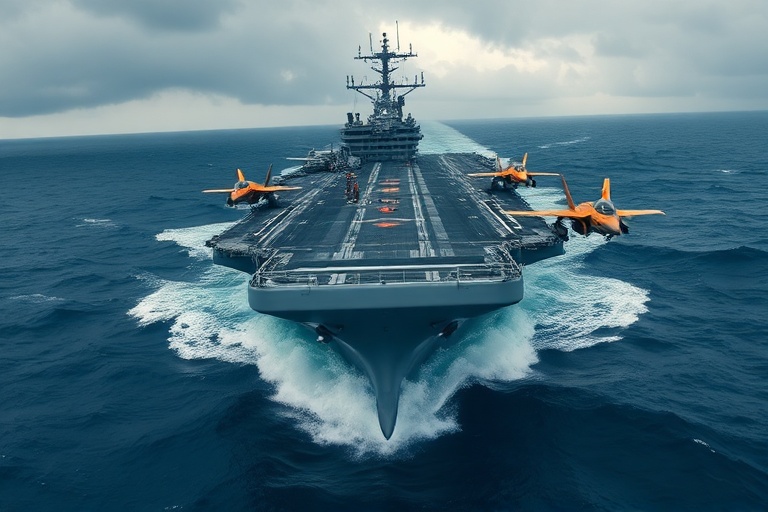
The USS Gerald R. Ford, the lead ship of the U.S. Navy’s newest class of supercarriers, has embarked on its latest deployment, marking another significant milestone in the vessel’s operational history. This deployment, which began in May 2024, underscores the Navy’s commitment to maintaining global maritime dominance while testing the carrier’s advanced capabilities in real-world conditions. The Ford’s deployment comes at a time of heightened geopolitical tensions, making its operational readiness a priority for defense analysts and military strategists alike.
Unlike traditional carrier deployments, the Gerald R. Ford’s current mission includes a series of firsts. It is the first deployment for a U.S. carrier equipped with the Electromagnetic Aircraft Launch System (EMALS) and Advanced Arresting Gear (AAG) on a sustained operational basis. These systems, designed to replace the older steam catapults, promise greater efficiency and flexibility in launching and recovering aircraft. The deployment also serves as a critical testbed for the carrier’s new dual-band radar and advanced weapons elevators, which are intended to streamline operations and reduce maintenance downtime.
The Gerald R. Ford’s Technological Advancements
The USS Gerald R. Ford represents a leap forward in naval technology, incorporating innovations that set it apart from its predecessors. At the heart of these advancements is the Electromagnetic Aircraft Launch System (EMALS), which replaces the steam catapults used on previous carriers. EMALS offers several advantages, including smoother acceleration for aircraft, reduced maintenance requirements, and the ability to launch a wider variety of aircraft, including unmanned systems. The system’s precision also minimizes stress on airframes, potentially extending the operational lifespan of embarked aircraft.
Another groundbreaking feature is the Advanced Arresting Gear (AAG) system, designed to replace the traditional hydraulic arresting wires. AAG uses energy-absorbing water turbines to slow and stop incoming aircraft, providing more consistent performance across different types of aircraft. This system is particularly critical for the F-35C Lightning II, the Navy’s newest stealth fighter, which requires precise handling during landing operations.
The carrier’s dual-band radar system integrates X-band and S-band frequencies, offering enhanced tracking capabilities for both air and surface targets. This radar system is part of the Navy’s Integrated Warfare System, which aims to provide a more cohesive and responsive picture of the operational environment. Additionally, the Ford features 11 advanced weapons elevators, which are designed to move ordnance from the ship’s magazines to the flight deck with unprecedented speed and efficiency. These elevators reduce the time required to resupply aircraft, thereby increasing the carrier’s sortie generation rate.
Operational Challenges and Training
Despite these technological advancements, the Gerald R. Ford’s deployment has not been without challenges. Early reports indicate that the ship’s crew has undergone extensive training to familiarize themselves with the new systems, a process that has required significant time and resources. The transition from steam catapults to EMALS, in particular, has demanded a steep learning curve for pilots and maintainers alike. The Navy has acknowledged that there have been some teething issues, including minor malfunctions in the EMALS system during initial testing phases. However, these issues are expected to be resolved as the crew gains more experience with the equipment.
Training exercises conducted prior to deployment have focused on integrating the Ford’s advanced systems with the embarked air wing. The carrier’s air wing, Carrier Air Wing 8, includes a mix of F/A-18E/F Super Hornets, E-2D Advanced Hawkeyes, and MH-60R Seahawk helicopters. The deployment has also included exercises with allied navies, demonstrating the Ford’s interoperability with NATO partners and other regional allies. These exercises are designed to enhance coordination and strengthen partnerships in the face of evolving security challenges.
Strategic Implications of the Deployment
The deployment of the USS Gerald R. Ford carries significant strategic implications, particularly in the context of rising tensions in the Indo-Pacific and the ongoing conflict in Ukraine. The carrier’s advanced capabilities make it a formidable asset in power projection, allowing the U.S. to maintain a credible military presence in critical regions. The Ford’s ability to operate for extended periods without replenishment, thanks to its nuclear propulsion, enhances its flexibility and endurance, making it a valuable tool for crisis response and deterrence.
In the Indo-Pacific, the Ford’s deployment sends a clear message to China, which has been rapidly expanding its naval capabilities. The carrier’s presence, combined with other U.S. assets in the region, reinforces America’s commitment to a free and open Indo-Pacific. The Ford’s advanced radar and sensor systems also provide a significant advantage in monitoring and responding to potential threats, including ballistic missile launches and submarine activity.
The deployment also underscores the U.S. Navy’s focus on maintaining a forward presence in the Mediterranean and the Middle East. The Ford’s ability to project power from the sea ensures that the U.S. can respond quickly to emerging crises, whether in the Strait of Hormuz, the Red Sea, or the Eastern Mediterranean. This capability is particularly important given the volatile security environment in these regions, where tensions remain high and the risk of conflict persists.
Logistics and Support
Supporting the USS Gerald R. Ford during deployment requires a robust logistics and supply chain network. The carrier is accompanied by a strike group that includes guided-missile cruisers and destroyers, which provide air defense, anti-submarine warfare, and surface warfare capabilities. This strike group also plays a critical role in protecting the carrier from potential threats, ensuring that it can operate effectively in contested environments.
The Ford’s nuclear propulsion system eliminates the need for frequent refueling, a significant advantage over conventionally powered ships. However, the carrier still requires regular replenishment of food, spare parts, and ordnance. The U.S. Navy’s Military Sealift Command plays a crucial role in this process, deploying replenishment ships to transfer supplies to the carrier while at sea. This logistics chain is essential for sustaining the Ford’s operational tempo and ensuring that it can remain on station for extended periods.
In addition to traditional logistics, the Ford’s deployment has highlighted the growing importance of cybersecurity and electronic warfare. The carrier’s advanced systems are highly dependent on networked technologies, making them potential targets for cyber attacks. The Navy has implemented stringent cybersecurity measures to protect the Ford’s systems, but the deployment serves as a reminder of the evolving threats in the digital domain.
The Future of Carrier Aviation
The USS Gerald R. Ford’s deployment is not just about the ship itself; it also represents a broader shift in the future of carrier aviation. The carrier’s advanced systems and capabilities are designed to support the next generation of naval aircraft, including the F-35C Lightning II and unmanned aerial systems. The Ford’s ability to launch and recover these aircraft efficiently will be critical as the Navy transitions to a more modern and flexible air wing.
One of the most significant developments in this regard is the Navy’s ongoing experimentation with unmanned systems. The Ford’s deployment includes tests of the MQ-25 Stingray, an unmanned aerial refueling tanker designed to extend the range and endurance of the carrier’s air wing. The MQ-25’s integration with the Ford represents a major step forward in the Navy’s efforts to incorporate unmanned systems into its operational framework. These systems have the potential to revolutionize naval aviation by reducing the burden on manned aircraft and increasing the carrier’s operational flexibility.
The Ford’s deployment also serves as a testbed for the Navy’s future force structure. The carrier’s advanced technologies and systems are expected to inform the design of the next generation of U.S. carriers, including the Gerald R. Ford-class carriers currently under construction. The lessons learned from the Ford’s deployment will be invaluable in refining these designs and ensuring that future carriers are even more capable and efficient.
Public Perception and Congressional Oversight
The USS Gerald R. Ford’s deployment has also drawn attention from policymakers and the public, particularly in light of the carrier’s significant cost and the ongoing debate over defense spending. The Ford’s total acquisition cost is estimated at over $13 billion, making it one of the most expensive ships ever built. Critics have questioned whether the carrier’s advanced systems are worth the investment, particularly given the challenges encountered during its development and testing phases.
In response to these concerns, the Navy has emphasized the Ford’s long-term value as a strategic asset. The carrier’s ability to project power and maintain a forward presence is seen as essential for deterring aggression and responding to crises. The Ford’s deployment is also viewed as a critical step in modernizing the Navy’s carrier fleet, ensuring that it remains a dominant force in the decades to come.
Congressional oversight has played a significant role in shaping the Ford’s deployment. Lawmakers have closely monitored the carrier’s progress, particularly in light of the delays and cost overruns that plagued its construction. The Government Accountability Office (GAO) and other oversight bodies have conducted reviews of the Ford’s systems and capabilities, providing recommendations for improvement. These reviews have helped to ensure that the carrier meets the Navy’s operational requirements and delivers on its promised capabilities.
Conclusion: A Milestone for the U.S. Navy
The deployment of the USS Gerald R. Ford marks a significant milestone for the U.S. Navy and the future of carrier aviation. The carrier’s advanced systems and capabilities represent a major leap forward in naval technology, offering greater flexibility, efficiency, and operational effectiveness. While the deployment has not been without challenges, the lessons learned will be invaluable in refining the Ford’s systems and informing the design of future carriers.
The Gerald R. Ford’s presence on the global stage also underscores the U.S. Navy’s commitment to maintaining maritime dominance and projecting power in critical regions. In an era of increasing competition and rising tensions, the carrier’s advanced capabilities provide a critical advantage, ensuring that the U.S. remains a stabilizing force in the international order.
As the Ford continues its deployment, the Navy will closely monitor its performance and gather data to inform future operations. The carrier’s success will depend not only on its advanced systems but also on the skill and dedication of its crew. With the right training and support, the USS Gerald R. Ford is poised to set a new standard for naval power and operational excellence.
For those interested in the broader context of U.S. naval strategy, be sure to explore our News section, where we cover the latest developments in military technology and defense policy. Additionally, our Analysis section offers in-depth insights into the strategic implications of these advancements.