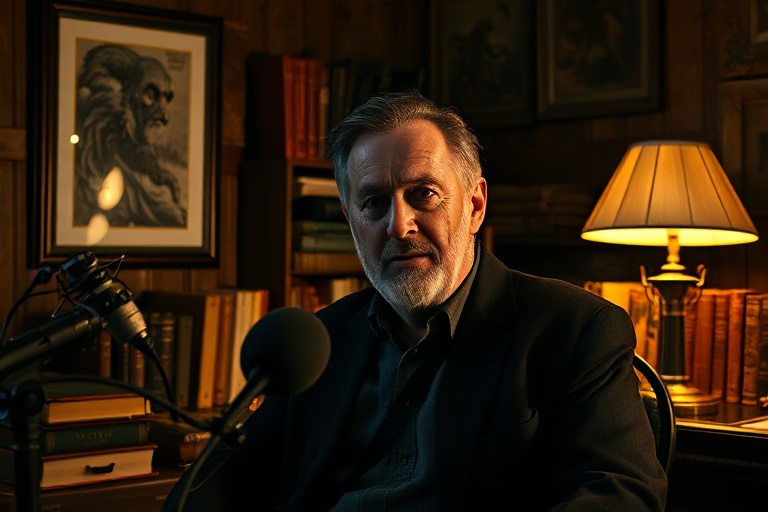
Few voices in gaming have left as indelible a mark as Wayne June’s. Over decades, his deep, resonant tone has become synonymous with some of the most memorable narrative experiences in interactive entertainment. Whether delivering ominous warnings in survival horror or narrating expansive fantasy worlds, June’s work transcends mere voice acting—it shapes how players perceive and remember entire games.
His career spans multiple generations of gamers, from early text-to-speech experiments to modern AAA titles. Yet, despite his ubiquity, Wayne June remains a name often overlooked outside dedicated gaming circles. That quiet recognition speaks to the power of his craft: when a voice is done right, it doesn’t need a spotlight—it simply becomes part of the experience.
The Early Years: From Radio to Gaming
Wayne June’s journey to becoming a gaming icon began long before video games dominated culture. Born in 1949, he developed an early passion for storytelling and performance. His background in radio and theater provided a strong foundation, honing his ability to convey emotion through voice alone. These skills translated naturally into the emerging world of video games as developers sought richer, more immersive ways to tell stories.
His earliest notable work in gaming came in the late 1990s, during a period when voice acting in games was still evolving. Developers recognized the potential of a distinctive voice to anchor player experiences, especially in narrative-driven titles. June’s deep, measured cadence stood out immediately, offering a gravitas that elevated the tone of entire projects.
Breaking Into the Scene
One of his first high-profile roles came in 1998 with Fallout 2, where his voice narrated the game’s manual and in-game terminal messages. Though not a central character, his performance set a standard for how environmental storytelling could enhance immersion. Players didn’t just play Fallout 2—they felt the weight of a world that existed beyond their screen, largely thanks to June’s narration.
This role was a turning point. It demonstrated that a voice actor could serve as the unseen guide, the silent storyteller who shapes a player’s understanding of the world. June’s ability to balance authority with mystery made him an ideal fit for games that thrived on atmosphere and lore.
Defining Roles: The Games That Cemented His Legacy
Wayne June’s most enduring contributions come from a handful of seminal titles. These games didn’t just feature his voice—they relied on it to function. His work in them didn’t just accompany the experience; it defined it.
-
The Elder Scrolls Series (2002–Present)
June’s voice is inseparable from The Elder Scrolls universe. As the iconic narrator of the game manuals, loading screens, and in-game lore texts, he became the authoritative voice of Tamriel. His narration isn’t just informative—it’s mythic. It transforms dense lore into an epic saga, encouraging players to see themselves not just as adventurers, but as participants in a living legend. -
Fallout Series (1998–Present)
From the vault terminals of Fallout to the narrated intros of modern entries, June’s voice is a constant. His dry, measured delivery perfectly matches the series’ blend of dark humor and post-apocalyptic dread. Players have come to associate his voice with survival, resilience, and the quiet absurdity of rebuilding civilization. -
Mass Effect Series (2007–2021)
While not a central character, June’s voice lent gravitas to the Mass Effect universe. His narration in the game’s codex and terminals added depth to the sci-fi setting, making the galaxy feel vast and lived-in. His performance helped bridge the gap between cinematic storytelling and interactive gameplay. -
Dishonored Series (2012–2016)
In Dishonored, June’s voice delivered the game’s hauntingly poetic lore entries. His narration elevated the world from a steampunk fantasy into a brooding, almost Shakespearean tragedy. The contrast between his voice and the game’s brutal gameplay created a striking duality—beauty and brutality intertwined.
These roles weren’t just jobs. They were collaborations between actor and medium, where June’s voice became part of the game’s identity. Players didn’t just hear his lines—they internalized them. They became part of the emotional landscape of each playthrough.
Why Wayne June’s Voice Resonates Beyond Gaming
Wayne June’s influence extends beyond the gaming screen. His voice has become a cultural touchstone, recognized by millions who may never have played the games he narrated. This cross-medium recognition speaks to the power of voice acting as a storytelling tool—one that transcends visuals and platforms.
His work has also influenced how narratives are structured in interactive media. Developers now understand that a strong narrator can anchor a player’s emotional journey, providing context, tone, and continuity even in sprawling open worlds. June’s performances helped establish the idea that a game’s story isn’t just told through characters and dialogue—it’s told through the air itself, through the tone that sets the stage.
The Hallmarks of His Style
Several elements define Wayne June’s vocal approach:
- Controlled Pacing: His delivery is deliberate, never rushed. Each word lands with intention, reinforcing the weight of the narrative.
- Emotional Restraint: He avoids overacting, instead conveying depth through subtlety. A sigh or a pause can say more than a shouted line.
- Tonal Versatility: Whether narrating a grimdark fantasy or a darkly comedic post-apocalypse, his voice adapts without losing its core identity.
- Authority Without Arrogance: His voice commands attention, but never feels domineering. It invites players into the world rather than imposing upon it.
This combination makes his performances feel timeless. They don’t rely on trends or flashy delivery—they endure because they’re rooted in authenticity.
The Future of Voice Narration in Gaming
As gaming continues to evolve, so too does the role of voice acting. With advancements in AI and procedural storytelling, some wonder whether narrators like Wayne June will remain relevant. Yet, his enduring presence suggests a different reality: that the human voice carries an intangible quality that technology cannot replicate.
June’s career also highlights the importance of continuity in gaming narratives. Players return to franchises like The Elder Scrolls and Fallout not just for the gameplay, but for the familiar voice that guides them. This loyalty speaks to the power of consistency—a reminder that in an industry obsessed with innovation, some traditions remain essential.
Looking ahead, Wayne June’s legacy offers a blueprint for how voice actors can shape a medium. His work demonstrates that narration isn’t just a functional element—it’s a character in its own right. A game’s story isn’t complete without it.
A Career Worth Celebrating
Wayne June’s contributions to gaming are often unnoticed until they’re absent. That’s the mark of true mastery. When a voice is perfect, it doesn’t demand attention—it simply becomes part of the experience, woven into the fabric of the game itself.
For millions of players, his voice is tied to some of their most memorable gaming moments. Whether it’s the thrill of exploring a new continent in The Elder Scrolls or the dread of navigating a ruined world in Fallout, June’s narration is the thread that connects those experiences. It’s the voice in the back of their minds, reminding them that they’re part of something larger.
In an era where gaming is finally receiving the critical and cultural recognition it deserves, voices like Wayne June’s deserve their place in the spotlight. They are the unsung architects of immersion, the silent guides who turn pixels into worlds and code into stories.
As gaming continues to grow, so too will the demand for voices that can carry its narratives forward. And if history is any indication, Wayne June’s voice will remain at the forefront—a testament to the enduring power of storytelling, one spoken word at a time.
For fans of his work, that’s something to celebrate. For the industry, it’s a reminder of how much a single voice can change everything.
To experience his legacy firsthand, revisit the games that defined him—or simply close your eyes and listen. The voice is still there, waiting to guide you.
And that’s the magic of Wayne June.
Explore more about gaming narratives and voice acting on Dave’s Locker Entertainment and Dave’s Locker Gaming.