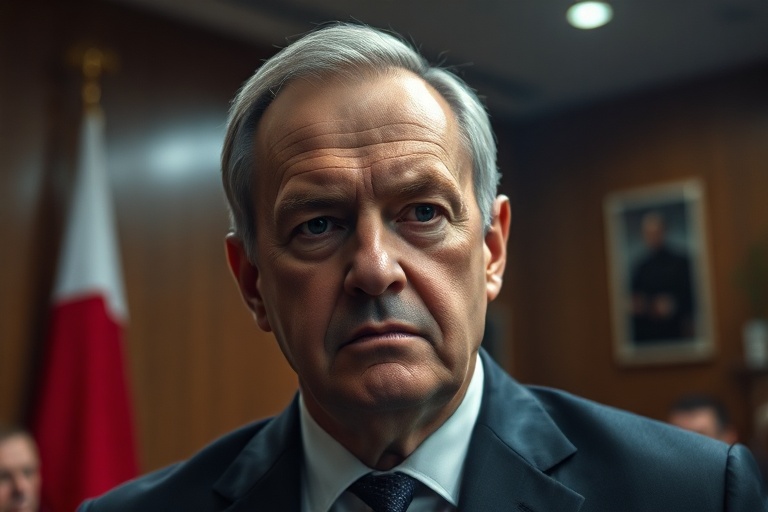
In the shifting sands of Poland’s political landscape, few figures have provoked as much controversy—or wielded as much influence—as Zbigniew Ziobro. As a founding member of the ruling Law and Justice (PiS) party, former Minister of Justice, and architect of sweeping judicial reforms, Ziobro has become a lightning rod for both fierce loyalty and sharp criticism. His career reflects the turbulent intersection of law, power, and ideology in modern Poland, where legal institutions often mirror the nation’s deep political divides.
The legal changes implemented under his watch have not only reshaped Poland’s judiciary but also strained its relationship with the European Union. While supporters praise his efforts to dismantle what they see as a corrupt, post-communist legal establishment, critics warn of democratic backsliding and the erosion of judicial independence. To understand Ziobro’s impact, one must look beyond the headlines and examine the legal philosophy driving his actions.
The Rise of a Political and Legal Powerhouse
Born in 1970 in Kraków, Zbigniew Ziobro studied law at Jagiellonian University before entering politics in the late 1990s. His early career was marked by rapid ascent within the conservative movement. He co-founded PiS in 2001 alongside Lech and Jarosław Kaczyński, positioning himself as a staunch defender of traditional values and national sovereignty.
His first major role came in 2005 when he was appointed Minister of Justice under Prime Minister Kazimierz Marcinkiewicz. At just 35, he became the youngest person ever to hold the position. During his tenure, he launched high-profile anti-corruption campaigns, targeting both political opponents and business elites. These efforts solidified his reputation as an uncompromising enforcer of the law—at least in the eyes of his supporters.
Ziobro’s influence grew significantly after PiS regained power in 2015. Reappointed as Minister of Justice, he launched a comprehensive overhaul of Poland’s judiciary, arguing that courts were dominated by judges appointed under the previous system, which he claimed lacked democratic legitimacy. His reforms included lowering the retirement age for Supreme Court justices, giving the government greater control over judicial appointments, and creating new disciplinary chambers to oversee judges.
Key Reforms Under Ziobro’s Leadership
The scope of Ziobro’s judicial reforms cannot be overstated. They represent one of the most ambitious attempts to reshape a European judiciary in decades. Below are the core components of his legal agenda:
- Supreme Court Overhaul: Lowered the mandatory retirement age from 70 to 65, forcing dozens of judges into early retirement and replacing them with PiS-approved appointees.
- Disciplinary System Expansion: Established new bodies to investigate and sanction judges, raising concerns about political interference in judicial independence.
- Constitutional Tribunal Packing: Advocated for changes to the Constitutional Tribunal’s composition, further centralizing power within the ruling coalition.
- Media and Judicial Control: Supported laws granting the justice ministry greater oversight over state media and court administration.
These reforms have drawn sharp rebukes from the European Commission, which argues that they undermine the rule of law and violate EU treaties. Poland has faced multiple infringement procedures, fines, and even the unprecedented activation of Article 7 of the EU Treaty, which can suspend a member state’s voting rights. Yet Ziobro has remained defiant, framing the criticism as an attack on Polish sovereignty.
A Legal Vision Rooted in Sovereignty and Tradition
Ziobro’s legal philosophy is rooted in a belief that Poland’s post-1989 judicial system was fundamentally flawed—stacked with judges appointed under communist-era structures or later by liberal governments. He argues that true legal sovereignty requires a complete reset, one that prioritizes national identity over international norms.
His vision aligns closely with the broader ideology of PiS, which emphasizes “Polishness” in law, education, and culture. This includes resistance to what he calls “foreign interference,” particularly from the EU and international courts. In speeches, he often invokes the language of defense—defending Poland’s borders, its history, and its legal autonomy.
“We are not building a new system. We are restoring a system that was stolen from us. A system that respects the will of the Polish people, not the whims of distant bureaucrats.”
This rhetoric resonates deeply with PiS’s electoral base, particularly in rural areas and among older voters who associate the pre-1989 era with stability and national pride. Yet it also alienates urban, younger, and more cosmopolitan Poles who see such reforms as a threat to liberal democracy and EU integration.
Broader Implications: Europe, Democracy, and the Rule of Law
The consequences of Ziobro’s reforms extend far beyond Poland’s borders. They have become a flashpoint in the broader European debate over the future of liberal democracy and the role of courts in safeguarding it. The EU’s response—legal pressure, funding cuts, and political isolation—has not deterred Ziobro. Instead, it has reinforced his narrative of Poland as a besieged nation fighting for its right to self-determination.
Domestically, the reforms have deepened political polarization. While PiS supporters view Ziobro as a hero restoring justice, critics—including judges, opposition parties, and human rights organizations—see a dangerous concentration of power. The Supreme Court, in a series of landmark rulings, has repeatedly struck down key aspects of the reforms, only for the government to ignore or circumvent them.
This cycle has created a legal limbo in which Poland operates under two competing visions of justice: one imposed by the state, the other defended by the courts. The result is a judicial system in flux, where rulings are as political as they are legal.
Long-Term Consequences
Looking ahead, several potential outcomes emerge:
- Judicial Paralysis: Continued conflicts between courts and the government could lead to prolonged uncertainty, undermining public trust in all legal institutions.
- EU Confrontation: Poland may face further sanctions or even a loss of EU funds, particularly under the new rule-of-law conditionality mechanism tied to budgetary allocations.
- Judicial Reform from Below: Lower courts, less directly controlled by the government, may become bastions of resistance, creating parallel legal systems.
- Political Realignment: As PiS’s popularity wanes, Ziobro could position himself as a key figure in a post-Kaczyński era—either as a unifier or a further divider of the right.
Ziobro’s legacy will ultimately depend on whether his reforms are seen as a correction or a distortion of justice. Supporters credit him with purging a corrupt elite and restoring moral order. Detractors warn of a slide into authoritarianism disguised as legal reform. What is certain is that his actions have redefined Poland’s place in Europe and challenged the continent’s consensus on judicial independence.
Conclusion: A Legacy Still Being Written
Zbigniew Ziobro remains one of the most consequential—and divisive—figures in modern Polish history. His legal reforms have not only reshaped Poland’s judiciary but have also forced a continent to confront fundamental questions about sovereignty, democracy, and the limits of power. Whether these changes will be remembered as a restoration of justice or an erosion of the rule of law depends largely on who writes the history—and when.
As Poland continues to navigate its complex relationship with the EU and its own democratic ideals, Ziobro’s role will likely evolve. He may yet become a transitional figure—one whose vision either fades with time or hardens into lasting institutional change. One thing is clear: in Poland’s ongoing struggle over the soul of its legal system, Zbigniew Ziobro is not just a participant. He is a central architect.