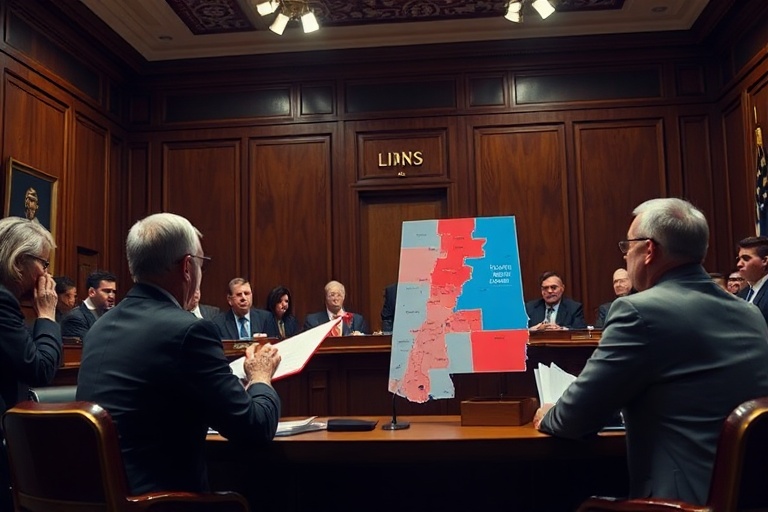
The legal battle over Alabama’s congressional district map has intensified, drawing national attention to issues of racial gerrymandering and electoral fairness. A recent lawsuit challenges the state’s redistricting decisions, arguing they dilute the voting power of Black residents. The case has already reached the U.S. Supreme Court once and may return there soon, making it one of the most consequential voting rights disputes in years.
The Origins of the Legal Conflict
In 2021, Alabama redrew its congressional districts after the 2020 census. Civil rights groups immediately challenged the new map, claiming it packed Black voters into a single district while diluting their influence across the remaining six districts. The plaintiffs argued this violated Section 2 of the Voting Rights Act, which prohibits voting practices that discriminate based on race.
The case, Allen v. Milligan, reached the Supreme Court in 2023. By a 5-4 vote, the Court upheld a lower ruling that found Alabama’s map likely violated the Voting Rights Act. The decision forced the state legislature to redraw the districts, creating a second majority-Black district. However, the legal saga didn’t end there.
In October 2023, the same plaintiffs filed a new lawsuit, alleging the redrawn map still violated the Voting Rights Act. They pointed to the legislature’s decision to place Black voters in the new Second District while keeping the First District majority-white. The lawsuit claims this configuration still minimizes Black voting power despite the changes.
Key Arguments in the Lawsuit
- Plaintiffs’ Position: The redrawn map continues to violate the Voting Rights Act by diluting Black voting strength. They argue that Alabama’s Black residents, who make up 27% of the state’s population, should have the opportunity to elect representatives of their choice in at least two districts.
- State’s Defense: Alabama officials contend the map complies with the Voting Rights Act and the Supreme Court’s ruling. They argue the new Second District gives Black voters a fair chance to elect a candidate of their choice, even if they don’t always succeed.
- Expert Testimony: Political scientists and demographers have weighed in on both sides. Some argue the map still packs Black voters into one district, while others claim the changes meet legal requirements.
Broader Implications of the Case
The Alabama lawsuit is part of a larger national conversation about voting rights and racial equity in redistricting. Similar cases have emerged in other states, including Louisiana, Georgia, and South Carolina, where plaintiffs challenge congressional maps they argue dilute minority voting power. The Supreme Court’s involvement in Allen v. Milligan signals the high stakes of these disputes.
If the Supreme Court revisits the case, its decision could reshape how states draw district lines nationwide. A ruling against Alabama could set a precedent requiring states to create additional majority-minority districts in areas with significant minority populations. Conversely, a ruling in favor of Alabama could embolden states to adopt more aggressive gerrymandering tactics, further entrenching partisan and racial divides.
The case also highlights the tension between legal mandates and political realities. Even after the Supreme Court’s 2023 decision, Alabama’s legislature resisted creating a second majority-Black district, illustrating how political resistance can complicate efforts to achieve fairness. This dynamic underscores the need for ongoing judicial oversight in redistricting processes.
What Comes Next?
The lawsuit is currently before the U.S. District Court for the Northern District of Alabama. Oral arguments have been scheduled for early 2024, with a ruling expected later in the year. If the court sides with the plaintiffs, Alabama may be forced to redraw its map again, potentially altering the state’s political landscape ahead of the 2024 elections.
Regardless of the outcome, the case is likely to have lasting effects. Civil rights organizations are closely watching the proceedings, ready to bring similar challenges in other states. Meanwhile, Alabama’s political leaders are bracing for the possibility of further legal battles, which could delay primary elections and create uncertainty for candidates and voters alike.
The broader implications extend beyond Alabama. A decision that strengthens protections for minority voters could energize voting rights advocates and lead to more legal challenges nationwide. On the other hand, a ruling that weakens those protections could embolden states to further marginalize minority communities in the redistricting process.
Why This Matters for Democracy
At its core, the Alabama congressional map lawsuit is about fairness. It asks whether the electoral system is truly representative of all citizens, or whether it is rigged to favor certain groups over others. The case forces the nation to confront uncomfortable questions about race, power, and democracy.
For advocates of voting rights, the lawsuit is a critical test of the legal system’s ability to protect minority voters. For critics of racial gerrymandering, it represents an opportunity to challenge entrenched power structures. And for everyday Americans, it serves as a reminder of the importance of staying engaged in the political process, whether through voting, advocacy, or legal action.
As the case unfolds, it will serve as a bellwether for the state of voting rights in America. The outcome could either reinforce the principles of fairness and equity or signal a retreat from those ideals. Either way, the consequences will be felt far beyond Alabama’s borders.
For those interested in following the legal and political ramifications of this case, staying informed is crucial. The decisions made in the coming months will shape the electoral landscape for years to come.
For more context on voting rights and redistricting, explore our Politics and Analysis sections on Dave’s Locker.