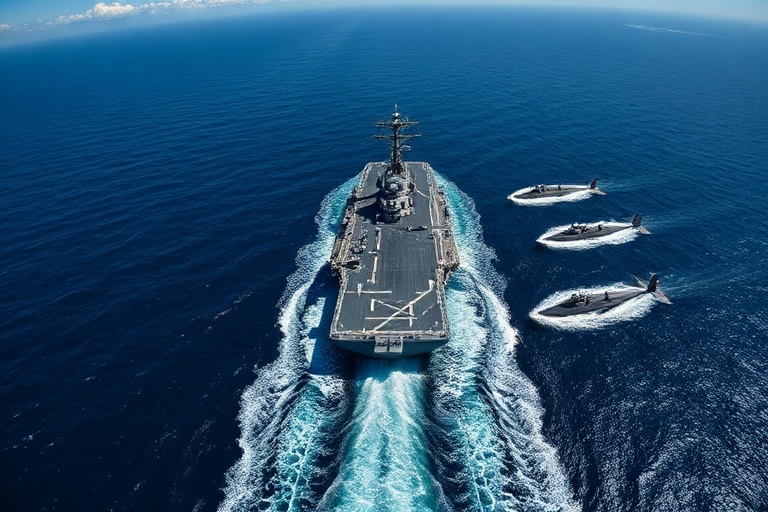
Carrier Strike Group: How Floating Fortresses Shape Global Power
The carrier strike group (CSG) represents one of the most potent and complex military formations in existence today. These floating fortresses combine aircraft carriers, destroyers, cruisers, submarines, and support vessels into a single, self-sustaining combat unit capable of projecting power across thousands of miles. Their continued evolution reflects broader shifts in naval strategy, technology, and geopolitical realities.
As tensions rise in key maritime regions and new threats emerge, understanding the structure and function of CSGs becomes essential. These formations are not merely symbols of military might—they serve as critical tools for deterrence, power projection, and rapid response in an increasingly contested global environment.
The Anatomy of a Carrier Strike Group
A modern CSG is a carefully balanced ecosystem of naval and aerial assets, each playing a distinct role in the group’s overall effectiveness. At its core is the aircraft carrier, typically a Nimitz-class or Gerald R. Ford-class vessel in the U.S. Navy. These carriers serve as the primary launch platform for fixed-wing aircraft, helicopters, and unmanned systems, with flight decks spanning more than three acres.
Surrounding the carrier is a protective screen of escort ships, including:
- Arleigh Burke-class destroyers: Equipped with advanced radar systems, Aegis combat systems, and a mix of offensive and defensive weaponry, these destroyers handle air defense, anti-submarine warfare, and surface strike missions.
- Ticonderoga-class cruisers: Larger than destroyers, cruisers provide enhanced air defense capabilities, land-attack missile strikes, and command-and-control functions for the entire strike group.
- Virginia-class or Los Angeles-class submarines: These nuclear-powered submarines operate independently within the CSG’s area of operations, conducting reconnaissance, intercepting enemy vessels, and providing an additional layer of defense against submarine threats.
- Supply ships and logistics vessels: These support ships ensure the CSG can sustain operations for months without returning to port, carrying fuel, ammunition, food, and spare parts.
The coordination between these assets is managed through a sophisticated network of sensors, communications systems, and data fusion technologies. The result is a formation that can detect, track, and engage threats while maintaining the ability to launch and recover aircraft in nearly any weather condition.
Power Projection and Strategic Deterrence
The primary mission of a CSG is power projection—the ability to deploy military force from a position of strength without necessarily engaging in direct combat. This capability serves as both a strategic deterrent and a rapid-response tool for addressing crises.
During periods of tension, the presence of a CSG in a disputed region can deter aggression by signaling resolve and capability. For example, the deployment of the USS Nimitz to the Persian Gulf in 2020 served as a direct response to escalating tensions with Iran, demonstrating the United States’ commitment to regional stability. Similarly, CSGs have been instrumental in enforcing no-fly zones, conducting maritime interdiction operations, and supporting allied forces in conflicts ranging from the Balkans to the South China Sea.
Beyond deterrence, CSGs provide unmatched flexibility in crisis response. With a single carrier capable of launching up to 240 sorties per day, these formations can deliver overwhelming firepower or humanitarian aid with equal efficiency. Their ability to operate independently for extended periods makes them ideal for rapid deployment to areas where land-based air support is unavailable or impractical.
The Evolving Threat Landscape
The operational environment for CSGs has grown increasingly complex in recent years. The rise of anti-access/area-denial (A2/AD) systems, advanced ballistic and cruise missiles, and cyber warfare capabilities has forced naval planners to rethink how these formations operate.
One of the most significant challenges is the proliferation of long-range anti-ship missiles, such as China’s DF-21D and DF-26, which can target aircraft carriers from hundreds of miles away. In response, the U.S. Navy has invested in layered defense systems, including the SM-6 missile, the E-2D Advanced Hawkeye early warning aircraft, and the development of directed-energy weapons like the Laser Weapon System (LaWS).
Another growing concern is the threat posed by cyber warfare and electronic attack. Modern CSGs rely heavily on networked systems for command and control, navigation, and weapons guidance. Disrupting these systems could severely degrade a CSG’s effectiveness, making cybersecurity a critical component of naval operations.
The role of unmanned systems is also expanding. The MQ-25 Stingray, a carrier-based unmanned aerial refueling tanker, is already in service, while future unmanned surface and subsurface vehicles are expected to play a larger role in scouting, mine countermeasures, and even strike missions. These systems promise to enhance the CSG’s situational awareness and reduce risk to personnel.
Global Reach and Geopolitical Implications
The deployment of a CSG is as much a political statement as it is a military operation. These formations serve as visible symbols of a nation’s military strength and global reach, reinforcing alliances and deterring adversaries.
In the Western Pacific, the U.S. Navy’s CSGs operate alongside allied forces to counter China’s growing naval ambitions. The presence of these formations in the South China Sea and Taiwan Strait underscores America’s commitment to freedom of navigation and regional security. Similarly, in the Mediterranean and Black Sea, CSGs have been deployed to reassure NATO allies amid Russian aggression in Ukraine.
The rise of other naval powers, such as China and Russia, has led to a renewed focus on carrier warfare. China’s first domestically built aircraft carrier, the Fujian, is expected to enter service in the coming years, while Russia has reactivated its Admiral Kuznetsov carrier for operations in the Mediterranean and North Atlantic. These developments signal a shift toward a more multipolar naval environment, where carrier strike groups could become key instruments of competition and coercion.
For smaller nations, the deployment of a CSG can be a game-changer in regional conflicts. During the 2006 Lebanon War, the deployment of the USS Enterprise and its escort ships helped evacuate American citizens and demonstrated U.S. support for Israel. In the Indo-Pacific, the presence of a CSG can deter aggression against smaller states, providing a stabilizing influence in an otherwise volatile region.
Conclusion: The Future of Carrier Strike Groups
The carrier strike group remains a cornerstone of modern naval power, but its future is not guaranteed. The high cost of aircraft carriers, the evolving threat landscape, and the rise of alternative power projection methods—such as long-range bombers, hypersonic missiles, and land-based unmanned systems—pose significant challenges.
However, the versatility and resilience of CSGs ensure their continued relevance. As technology advances, these formations will adapt, incorporating new sensors, weapons, and unmanned systems to maintain their edge. The geopolitical realities of the 21st century, marked by great power competition and regional instability, demand flexible, forward-deployed forces capable of rapid response. In this context, the carrier strike group is likely to remain a critical tool for projecting power and preserving peace.
For nations seeking to assert their influence on the global stage, the deployment of a CSG is a clear and unmistakable signal: the seas may be vast, but the reach of these floating fortresses is even greater.
To learn more about naval strategy and military technology, explore our Technology and News sections.