Published on Dave’s Locker
The Chinook Helicopter: A Workhorse of Modern Military Aviation
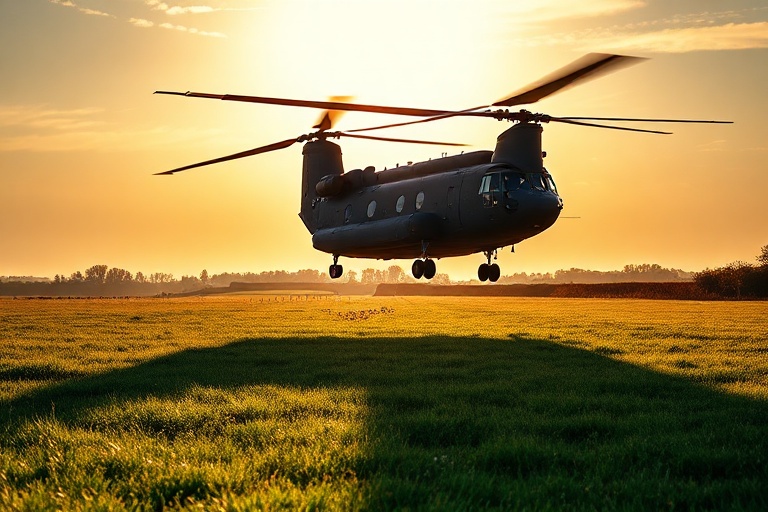
The Boeing CH-47 Chinook has long been the backbone of heavy-lift helicopter operations worldwide. Its tandem rotor design provides exceptional lift capacity, versatility, and reliability in even the most challenging conditions. At Bromyard Field, this aircraft has demonstrated its critical capabilities in training exercises and operational deployments.
The Chinook’s origins trace back to the Vietnam War, where its ability to carry large payloads and troops over long distances proved indispensable. Today, its advanced avionics, improved fuel efficiency, and enhanced survivability features make it a cornerstone of military transport fleets. Bromyard Field serves as a key location for Chinook training, where pilots refine their skills in precision maneuvering and cargo operations.
The aircraft’s dual-rotor system eliminates the need for a tail rotor, providing greater stability and lifting power. This design allows the Chinook to transport everything from armored vehicles to humanitarian aid supplies with remarkable precision. At Bromyard Field, these capabilities are put to the test in realistic scenarios that prepare crews for real-world missions.
Bromyard Field: A Strategic Training Ground
Bromyard Field, located in the heart of Herefordshire, has become a critical training site for Chinook helicopter operations in the UK. Its open expanse and varied terrain offer ideal conditions for practicing takeoffs, landings, and tactical maneuvers. The field’s proximity to military bases such as RAF Hereford ensures seamless integration with broader defense training programs.
Training at Bromyard Field focuses on two primary areas: cargo operations and troop insertion. The Chinook’s ability to carry underslung loads—such as artillery pieces, fuel bladders, or even light vehicles—requires precise piloting and coordination. Crews practice these techniques under simulated combat conditions, ensuring readiness for deployment in conflict zones.
Additionally, the field serves as a staging area for joint exercises involving the Royal Air Force, British Army, and allied forces. These drills emphasize interoperability, testing the Chinook’s ability to operate alongside other aircraft and ground units. Bromyard Field’s role in these exercises underscores its importance in maintaining operational readiness across the UK’s defense infrastructure.
Key Capabilities of the Chinook at Bromyard Field
The Chinook’s performance at Bromyard Field highlights several key capabilities that set it apart from other helicopters:
- Heavy-Lift Capacity: The Chinook can carry up to 55 troops or 24,000 pounds (10,886 kg) of cargo, including vehicles and equipment.
- Versatile Deployment: Its ability to operate in diverse environments—from deserts to mountainous regions—makes it adaptable to global missions.
- Speed and Range: With a top speed of 170 knots (196 mph) and a range of 400 nautical miles, the Chinook can rapidly deploy forces over long distances.
- Survivability Features: Advanced armor, countermeasures, and redundant systems enhance crew and passenger safety in hostile environments.
- Underslung Load Operations: The Chinook excels at transporting external loads, a critical capability for logistics and emergency response.
These features are regularly demonstrated at Bromyard Field, where crews train to maximize the aircraft’s potential. The field’s open space allows for realistic simulations of real-world scenarios, from humanitarian aid drops to combat insertions.
Broader Implications: The Chinook in Modern Defense Strategy
The Chinook’s role at Bromyard Field extends beyond training—it reflects broader trends in military aviation and defense strategy. As global conflicts become more complex, the demand for rapid, flexible, and high-capacity transport solutions has grown. The Chinook meets these needs, providing a critical link between strategic and tactical operations.
One of the most significant implications of the Chinook’s capabilities is its contribution to military technology. The aircraft’s continuous upgrades—such as the introduction of the CH-47F and the upcoming CH-47F Block II—ensure it remains relevant for decades. These advancements include improved engines, avionics, and structural enhancements that extend its service life well into the 21st century.
The Chinook also plays a vital role in international defense collaborations. Allied nations, including the United States, Canada, and Australia, operate Chinook fleets, fostering interoperability and shared operational standards. Training exercises like those at Bromyard Field help standardize procedures, ensuring seamless coordination during multinational missions.
Furthermore, the Chinook’s humanitarian missions highlight its versatility beyond combat. In disaster relief operations, such as the 2010 Haiti earthquake or the 2017 Caribbean hurricane responses, Chinooks delivered critical aid to inaccessible areas. Bromyard Field’s training prepares crews for these missions, bridging the gap between military and humanitarian operations.
Looking Ahead: The Future of Chinook Operations
The future of the Chinook helicopter remains robust, with ongoing modernization efforts ensuring its continued relevance. The UK’s Ministry of Defence has invested in upgrading its Chinook fleet, incorporating advanced avionics, improved defensive systems, and enhanced connectivity. These upgrades will enable the aircraft to operate in increasingly contested environments, where electronic warfare and anti-aircraft threats are prevalent.
At Bromyard Field, the focus will likely shift toward preparing crews for these evolving challenges. Training will increasingly incorporate electronic warfare simulations, cyber defense integration, and multi-domain operations. The Chinook’s ability to adapt to these new threats will be critical in maintaining its edge as a premier military transport aircraft.
Additionally, the Chinook’s role in emerging technologies such as unmanned cargo systems and autonomous flight could redefine its capabilities. While the Chinook is unlikely to be fully replaced by drones, hybrid systems that combine manned and unmanned operations may become a reality. Bromyard Field could serve as a testing ground for these innovations, ensuring the Chinook remains at the forefront of military aviation.
Conclusion
The Chinook helicopter’s operations at Bromyard Field exemplify its enduring importance in military aviation. From heavy-lift missions to humanitarian aid, the aircraft’s versatility and reliability make it indispensable. As defense strategies evolve, the Chinook’s role will continue to expand, ensuring it remains a cornerstone of global military transport.
Bromyard Field, with its strategic location and ideal training conditions, will remain a vital hub for Chinook operations. The skills honed here will not only prepare crews for combat but also equip them to respond to crises worldwide. In an era of shifting geopolitical dynamics, the Chinook’s legacy as a workhorse of the skies is secure.