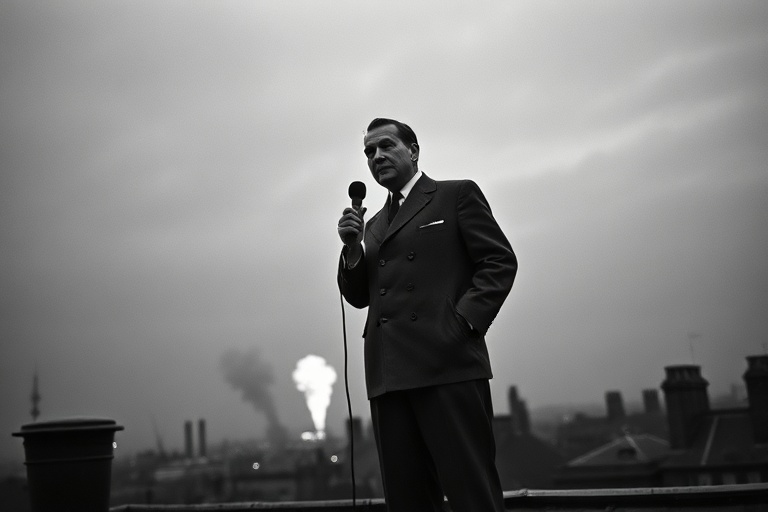
Edward R. Murrow stands as one of the most influential figures in the history of journalism. His career spanned radio and television during the mid-20th century, a period when the media landscape was rapidly evolving. Murrow’s work set new standards for integrity, courage, and clarity in reporting, leaving a legacy that continues to shape modern journalism.
Born Egbert Roscoe Murrow in 1908 in Greensboro, North Carolina, he grew up in a modest household before earning a degree in speech from Washington State College. His early career included roles in education and international broadcasting, but it was his coverage of World War II that catapulted him to prominence. As a radio correspondent for CBS, Murrow’s vivid, on-the-ground reports brought the realities of war directly to American audiences, redefining how news was delivered.
Early Career and World War II Reporting
Murrow joined CBS in 1935, initially working in the network’s European division. By the late 1930s, he became the head of CBS’s bureau in London, where he covered the rise of fascism and the lead-up to World War II. His broadcasts during the Blitz—particularly his live reports from rooftops in London as German bombs fell—captured the urgency and terror of the moment with unmatched immediacy.
His signature sign-off, “This… is London,” became synonymous with wartime journalism. Unlike the sanitized reports of many other correspondents, Murrow’s accounts were raw and unfiltered, often concluding with phrases like “Good night, and good luck,” a phrase that later became the title of a 2005 film about his life and work. These broadcasts didn’t just inform; they immersed listeners in the experience, fostering a deeper connection between the home front and the war abroad.
A New Standard for Broadcast Journalism
After the war, Murrow transitioned to television, where he continued to push boundaries. In 1951, he launched See It Now, a pioneering news program that combined investigative reporting with in-depth interviews. The show’s most famous episode aired in 1954 and featured Murrow’s devastating critique of Senator Joseph McCarthy, a moment that is often credited with contributing to McCarthy’s downfall.
Murrow’s confrontation with McCarthy was more than just a broadcast—it was a masterclass in journalistic courage. While many in the media avoided criticizing McCarthy due to fear of backlash, Murrow used his platform to expose the senator’s tactics, delivering a scathing editorial that questioned not just McCarthy’s methods but the complicity of the press in enabling them. The episode remains a defining moment in the history of broadcast journalism and a testament to Murrow’s belief in the power of the press to hold power to account.
The Murrow Style: Clarity, Courage, and Integrity
What set Murrow apart was his commitment to truth above all else. He believed journalism should serve the public interest, not the interests of powerful figures or corporate sponsors. This philosophy was evident in his reporting, which prioritized facts over sensationalism and context over soundbites.
Murrow’s approach to storytelling was also deeply human. Whether he was interviewing a war survivor, exposing government corruption, or profiling an ordinary American, he had a knack for making complex issues accessible and relatable. His interviews were never mere exchanges; they were conversations that revealed the humanity behind the headlines.
His work also demonstrated an early understanding of the ethical responsibilities of journalism. In an era when advertising dollars often dictated editorial decisions, Murrow insisted on independence. He famously rejected a sponsorship deal from a tobacco company, declaring, “I will not take money from people whose product, if used as directed, will kill me.” This stance reflected his broader belief that journalism’s primary duty was to the public, not to advertisers or politicians.
Challenges and Criticisms
Despite his reputation as a journalistic icon, Murrow’s career was not without controversy. Some critics argued that his reporting on McCarthy was too late, coming after years of McCarthy’s damaging rhetoric had already taken a toll on American society. Others pointed out that his later work in television often struggled to match the impact of his radio broadcasts, as the medium’s constraints limited his ability to dive as deeply into stories.
Murrow also faced criticism for his perceived elitism. His on-air persona was polished and authoritative, which some argued alienated working-class audiences. Additionally, his later years at CBS were marked by tensions with network executives, who often prioritized ratings over journalistic integrity. His departure from CBS in 1961, after the network canceled See It Now, was seen by many as a symbol of the erosion of serious journalism in favor of entertainment.
Legacy and Influence on Modern Journalism
Edward R. Murrow’s impact on journalism cannot be overstated. His work laid the foundation for investigative reporting and set a benchmark for journalistic integrity that many still aspire to today. His belief in the press as a watchdog for democracy remains a cornerstone of ethical journalism, even as the industry faces new challenges in the digital age.
Murrow’s influence extends beyond journalism. His commitment to truth and his willingness to challenge power have made him a model for journalists, activists, and public figures alike. Institutions like the Edward R. Murrow College of Communication at Washington State University and the annual Murrow Awards for excellence in electronic journalism continue to honor his legacy.
In an era of misinformation and eroding trust in media, Murrow’s principles are more relevant than ever. His famous charge to his colleagues—“We must not confuse dissent with disloyalty. We will not walk in fear, one of another”—serves as a reminder of the role journalism must play in a healthy democracy. As media organizations grapple with the pressures of digital transformation, Murrow’s insistence on clarity, courage, and integrity offers a guiding light.
Lessons for Today’s Journalists
Murrow’s career offers several enduring lessons for modern journalists. First, his work demonstrates the importance of being present in the moment. Whether reporting from a war zone or a Senate hearing, Murrow’s ability to immerse himself in the story brought authenticity to his broadcasts. Today’s journalists, even those working in digital spaces, can learn from his commitment to on-the-ground reporting.
Second, Murrow’s career highlights the necessity of editorial independence. In an industry increasingly dominated by corporate interests and algorithm-driven content, his refusal to compromise his principles is a stark contrast. Modern journalists must navigate the pressures of clicks, shares, and viral content, but Murrow’s legacy reminds them that the pursuit of truth should always come first.
Finally, Murrow’s work underscores the power of storytelling. His ability to make complex issues understandable and relatable was a hallmark of his success. In an age of information overload, journalists must continue to prioritize storytelling that connects with audiences on a human level.
For those interested in exploring more about the evolution of broadcast journalism, Dave’s Locker News offers a range of articles on media history and contemporary challenges in the field. Similarly, Dave’s Locker Analysis provides deeper insights into the ethical and technological shifts shaping modern journalism.
Conclusion: A Lasting Beacon for Journalism
Edward R. Murrow’s career was defined by his unwavering commitment to truth, his courage in the face of power, and his ability to connect with audiences in profound ways. Though he passed away in 1965, his legacy endures as a reminder of what journalism can—and should—be. In an era where the media landscape is more fragmented and contested than ever, Murrow’s principles offer a roadmap for journalists seeking to uphold the highest standards of their craft.
As we reflect on his contributions, it’s clear that Murrow’s work was not just about reporting the news; it was about shaping a better-informed, more engaged public. His life and career challenge us to ask: What kind of journalism do we want in the world today? And how can we, like Murrow, ensure that it serves the public good above all else?