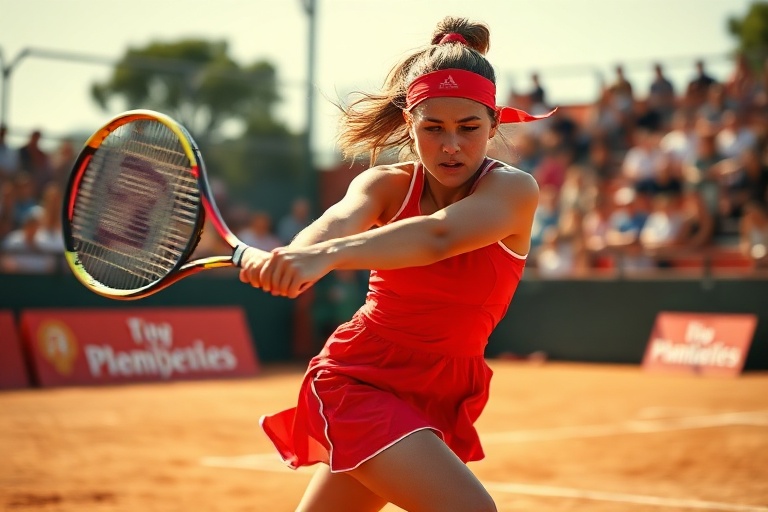
Tennis has always celebrated players who blend power with unpredictability, but few have embodied this combination as fiercely as Jeļena Ostapenko. Born in Riga, Latvia, in 1997, Ostapenko rose from a nation with limited tennis tradition to become one of the sport’s most thrilling competitors. Her game is defined by aggressive baseline play, a fearless approach to the net, and an unshakable belief in her shots.
Ostapenko’s journey to the top of women’s tennis has been marked by both stunning triumphs and challenging moments. She claimed her first Grand Slam title at the 2017 French Open, stunning the tennis world with her fearless style and emotional intensity. Since then, she has continued to push boundaries, both on and off the court, making her one of the most compelling figures in modern tennis.
The Rise of a Tennis Prodigy
Jeļena Ostapenko’s introduction to tennis came early. Raised in a family with no direct connection to the sport—her mother was a psychologist and her father a former soccer player—Ostapenko began playing at age five. Her early training was unconventional. Instead of joining a traditional academy, she trained under her mother’s guidance before moving to train in the Czech Republic, a decision that shaped her development.
By age 15, Ostapenko was already making waves on the junior circuit. In 2014, she reached the final of the Australian Open Junior Championships, losing to Elizaveta Kulichkova. That same year, she turned professional at just 17, foreshadowing a career that would defy expectations. Her breakthrough came in 2016 when she won her first WTA title in Quebec City, defeating top seed Alison Van Uytvanck in the final.
Her rapid ascent was not just about results—it was about style. Ostapenko played with a swagger and audacity rarely seen in women’s tennis. She attacked every ball, often trading precision for power, and built a reputation as a player who thrived under pressure. This mindset would soon catapult her to the pinnacle of the sport.
A French Open Fairytale
The 2017 French Open remains Ostapenko’s defining moment. Entering the tournament ranked No. 47 in the world, she was not expected to challenge for the title. Yet, her fearless play carried her through the draw. She defeated former champions such as Samantha Stosur and Timea Bacsinszky, then stunned world No. 3 Karolína Plíšková in the quarterfinals.
In the final, she faced Simona Halep, the tournament favorite and eventual world No. 1. Ostapenko lost the first set 4–6, but she responded with a breathtaking second set, saving four set points and winning 6–4. In the decider, she continued her relentless assault, breaking Halep twice and clinching the title 4–6, 6–4, 6–3. At 19, she became the first Latvian player to win a Grand Slam singles title and the first unseeded French Open champion since 1933.
The victory was more than a personal triumph. It symbolized a shift in women’s tennis toward players who embrace risk and reward. Ostapenko’s celebration—complete with emotional outbursts and a spontaneous dance on court—captured the raw joy of sport. She had not just won a major; she had redefined what it meant to compete with passion.
The Playing Style: Power, Passion, and Precision
Ostapenko’s game is a fusion of raw power and tactical intelligence. She strikes the ball with heavy topspin, particularly on her forehand, which averages over 70 mph and dips sharply over the net. This shot, combined with a two-handed backhand that generates depth and angle, makes her one of the most aggressive baseliners on tour.
Her serve, though not the fastest, is strategically placed, often setting up weak returns she can attack immediately. At the net, she is surprisingly agile, using sharp volleys and drop shots to keep opponents off balance. What sets her apart, however, is her mental approach. Ostapenko rarely tightens up under pressure. Instead, she leans into the moment, trusting her instincts even when the odds are against her.
This style has drawn comparisons to past champions like Maria Sharapova and Victoria Azarenka—players who dominated through sheer force of will. Yet Ostapenko’s game is uniquely her own. She doesn’t rely on consistency alone; she wins points with winners, not errors. In 2023, she hit the most winners of any player on tour, averaging over 30 per match. This statistic underscores her commitment to an all-or-nothing philosophy.
The Challenges of Consistency and Injury
Despite her undeniable talent, Ostapenko’s career has been a rollercoaster of highs and setbacks. After her 2017 breakthrough, she struggled to maintain consistency. Inconsistent results led to fluctuations in ranking, and injuries began to take a toll. A wrist injury in 2018 sidelined her for months, and repeated back issues have forced her to withdraw from multiple tournaments.
These challenges have tested her resilience. Unlike players who rely on technical refinement, Ostapenko’s game is built on instinct. When her body cooperates, she is unstoppable. But when injuries flare up, her aggressive style becomes harder to sustain. In 2021, she underwent wrist surgery, raising concerns about her long-term durability.
Yet, Ostapenko has shown remarkable adaptability. She has shortened her backswings, adjusted her movement, and focused more on shot selection. The results have been telling. In 2023, she reached the semifinals of Wimbledon and the quarterfinals of the US Open, proving she could still compete at the highest level.
Beyond the Court: A Voice for Change and Authenticity
Ostapenko’s influence extends beyond her on-court performances. She is known for her authenticity, often speaking openly about her emotions, struggles, and goals. In an era where athletes are increasingly expected to curate their public image, Ostapenko has remained refreshingly genuine.
She has also used her platform to advocate for mental health awareness, particularly among young athletes. In interviews, she has discussed the pressure of expectations, the loneliness of professional sport, and the importance of self-belief. Her transparency has resonated with fans, especially younger players who see her as a role model.
Off the court, Ostapenko is multilingual—she speaks Latvian, Russian, English, and Czech—and has a keen interest in fashion and design. She has collaborated with brands and even launched her own clothing line, blending her creative side with her athletic identity. This duality reflects her multifaceted personality: fierce on the court, thoughtful off it.
The Future: Can Ostapenko Return to the Top?
At 27 years old, Ostapenko is in the prime of her career, but the window for a second Grand Slam title is narrowing. The women’s tour is dominated by younger stars like Iga Świątek, Coco Gauff, and Aryna Sabalenka—players with deep runs in majors and consistent top finishes. To reclaim the top 10 and challenge for another Slam, Ostapenko must find a balance between aggression and control.
Her path forward may lie in refining her serve and improving her movement. She has already shown she can adapt. In 2024, she hired a new coach, David Ferrer, a former top-10 player known for his tactical acumen. This partnership could help her add structure to her game without stifling her natural flair.
What remains certain is her competitive spirit. Whether she wins another major or not, Ostapenko has already cemented her legacy as one of tennis’s most exciting players. She has redefined success—not by trophies alone, but by the way she plays, the way she lives, and the way she inspires.
Conclusion: A Legacy of Fearless Play
Jeļena Ostapenko’s journey is a testament to the power of authenticity in sports. She has never fit into a mold, and she has never tried to. Her game is chaotic, her emotions visible, her spirit unbroken. In a sport often defined by precision and patience, Ostapenko has carved out a space for those who play with fire.
As she continues her career, fans will watch not just for titles, but for moments of brilliance—those jaw-dropping winners, the emotional victories, the sheer unpredictability that makes tennis unpredictable. One thing is clear: Jeļena Ostapenko is not just a tennis player. She is a phenomenon, a storyteller, and a force of nature.
And in tennis, where tradition often dictates style, she remains a breath of fresh air.
Related Content
Explore more on women’s tennis and rising stars:
- Sports – Stay updated on tennis and other athletic events.
- Entertainment – Discover profiles of athletes and artists shaping culture.