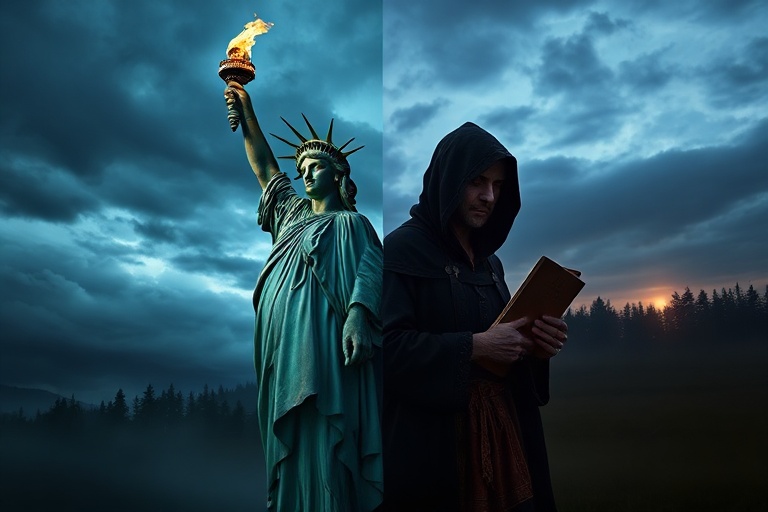
Liberty and the Sacred: A Global Tension Between Freedom and Mysticism
The modern world prides itself on liberty—freedom of thought, speech, and self-determination. Yet alongside this secular ideal thrives an ancient countercurrent: mysticism, the belief in hidden truths, spiritual authority, and the supernatural. These forces often clash, reshaping societies in subtle and dramatic ways. From the secular democracies of the West to the theocratic republics of the East, the friction between liberty and mysticism defines cultural identity, governance, and daily life. Understanding this dynamic requires looking beyond headlines and into the lived experiences of people across continents.
Mysticism is not merely a relic of the past. It persists in organized religions, folk traditions, and even in contemporary spiritual movements. At its core, mysticism posits that ultimate truth is not accessible through reason alone but through direct experience, revelation, or communion with the divine. Liberty, in contrast, champions individual autonomy and rational inquiry. This contrast plays out in law, education, and public discourse, often creating tension between personal freedom and communal tradition.
The Roots of the Conflict: Enlightenment vs. Sacred Tradition
The Enlightenment of the 17th and 18th centuries championed reason as the path to human progress. Thinkers like Voltaire and Kant argued that freedom flourished when superstition was dismantled. Yet even as Europe embraced secularism, mystical traditions endured in private devotion and public ritual. Today, this tension is visible in debates over religious symbols in public spaces, the teaching of creationism alongside evolution, and the role of faith in shaping laws.
In France, the principle of laïcité—strict secularism—has led to bans on religious attire in schools and burkinis on beaches. Critics argue these policies infringe on personal liberty, while supporters claim they preserve a neutral public sphere. Meanwhile, in India, the rise of Hindu nationalism has intertwined state power with religious identity, raising questions about whether a pluralistic society can accommodate mystical worldviews without undermining individual freedoms.
This historical divide persists in unexpected places. In the United States, the First Amendment guarantees religious freedom, yet court battles rage over whether businesses can deny services based on faith. In Poland, the Catholic Church wields significant cultural influence, shaping attitudes toward LGBTQ+ rights and reproductive freedoms. These examples show how mysticism and liberty are not abstract ideals but lived realities that shape policy and identity.
Cultural Expressions: Where Mysticism Meets Modern Freedom
Across the globe, mysticism finds expression in festivals, art, and daily rituals. In Mexico, Día de los Muertos blends indigenous beliefs with Catholic traditions, celebrating death as a passage rather than an end. While the holiday is embraced by many as cultural heritage, critics argue some modern interpretations commodify the sacred, diluting its spiritual significance. In Japan, Shinto and Buddhist practices coexist with rapid technological progress, creating a unique balance between tradition and innovation.
In the West, mysticism has been repackaged into New Age spirituality, yoga retreats, and psychedelic experiences. These movements often market liberation—freedom from stress, from societal expectations, from the constraints of the ego. Yet they also create new forms of exclusivity, where access to “enlightenment” becomes a luxury commodity. The irony is palpable: a quest for inner freedom can become another consumer choice, stripped of its communal and ethical roots.
Consider the rise of astrology apps and tarot readings among millennials. While some view these practices as harmless self-reflection, others see them as a retreat from critical thinking. Sociologists note that in times of uncertainty—economic instability, political upheaval—people often turn to mysticism for comfort and control. This cyclical relationship between crisis and spirituality reveals how deeply mysticism is woven into the human psyche.
Case Studies: Governance and the Sacred
Nations navigate the tension between liberty and mysticism in distinct ways. In Iran, the Islamic Republic enforces religious law through a theocratic system, where clerics interpret divine will as state policy. Critics argue this system suppresses dissent under the guise of divine mandate. By contrast, Turkey’s secular constitution—once a model for Muslim-majority democracies—has faced erosion as President Erdoğan’s government promotes Sunni Islam in public life.
In Israel, the Chief Rabbinate controls marriage, divorce, and conversion, effectively tying personal status to religious authority. This system privileges Orthodox Judaism while limiting the freedoms of Reform and Conservative Jews, as well as non-Jewish citizens. Meanwhile, in Ireland, a 2018 referendum legalized abortion after decades of Catholic doctrine shaping national policy. The shift reflects a broader trend: as societies modernize, mystical authority often recedes, though not without resistance.
Even in secular nations, mysticism influences governance. In the United States, the phrase “In God We Trust” on currency and the oath to uphold the Constitution reflect a blend of civic nationalism and vague spirituality. While not overtly coercive, such symbols embed mystical assumptions into national identity, subtly privileging certain worldviews over others.
The Future: Can Liberty and Mysticism Coexist?
The question is not whether mysticism will disappear—it has persisted for millennia—but how societies will reconcile it with the demands of modern liberty. One path forward lies in pluralism: the recognition that multiple truths can coexist without one dominating the public sphere. The Netherlands, for instance, allows for religious exemptions in certain contexts while maintaining secular institutions. This model acknowledges mysticism’s role in personal life without letting it dictate policy.
Education offers another frontier. In Finland, schools teach about world religions and philosophies as part of the curriculum, fostering critical thinking without dismissing spiritual traditions. This approach equips students to navigate a diverse, interconnected world where mysticism remains a powerful force.
Yet challenges remain. In Poland, the government has restricted LGBTQ+ education under the guise of “protecting children from ideology,” framing secular values as a threat to the nation’s Catholic soul. In India, vigilante groups have attacked individuals accused of “beef eating” or “love jihad,” enforcing mystical norms through violence. These examples show how the tension between liberty and mysticism can escalate into oppression when one side seeks dominance.
Ultimately, the balance between liberty and mysticism may hinge on a shared commitment to dialogue. Communities that foster open conversations—where skeptics and believers, reformers and traditionalists can speak without fear—are more likely to find equilibrium. This is not about erasing difference but about ensuring that no single worldview monopolizes power or identity.
As the world grows more interconnected, the stakes of this balance rise. Will societies cling to mystical certainties as anchors in turbulent times, or will they embrace the uncertainty of liberty as a path to progress? The answer may well define the cultural and political landscape of the 21st century.
A Final Note on Perspective
It is worth remembering that both liberty and mysticism emerge from deep human needs: the desire for meaning and the desire for autonomy. The challenge is not to reject one in favor of the other but to create systems where both can thrive. This requires humility—the recognition that no single worldview holds all the answers.
In an age of algorithmic feeds and echo chambers, the call for genuine dialogue has never been louder. Whether through art, education, or policy, societies must carve out spaces where the sacred and the secular can converse. Only then can the tension between liberty and mysticism become a source of strength rather than division.