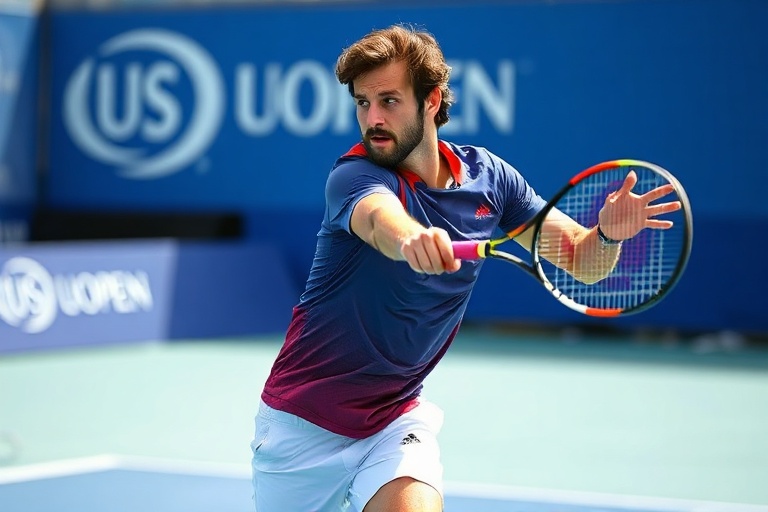
nikoloz basilashvili
Nikoloz Basilashvili has carved out a distinct identity in professional tennis through sheer determination and an aggressive playing style. Born on February 23, 1992, in Tbilisi, Georgia, Basilashvili overcame early challenges to rise through the ranks, eventually becoming the first Georgian man to break into the ATP top 20. His journey from a war-torn region to international courts is marked by resilience, tactical evolution, and a willingness to embrace high-risk, high-reward strategies.
At 6’1″ and with a compact yet explosive physique, Basilashvili brings a brand of tennis that is physically demanding and psychologically taxing for opponents. Known for his thunderous forehand and relentless baseline game, he has become a mainstay in the ATP Tour’s mid-tier elite, regularly challenging the sport’s traditional powerhouses. His rise coincides with a shift in men’s tennis toward more athletic, aggressive players—an evolution in which he plays a starring role.
Early Life and Career Beginnings in a Challenging Environment
Basilashvili’s childhood was shaped by the political and economic instability in Georgia during the 1990s. Raised in Tbilisi, he began playing tennis at the age of six, inspired by his older brother, who introduced him to the sport. The local tennis infrastructure was underdeveloped, and access to quality coaching and facilities was limited. Despite these obstacles, Basilashvili trained diligently at the Tbilisi Tennis Academy, where he honed his raw power and competitive instincts.
His early career was defined by steady progress on the ITF Futures circuit. Basilashvili turned professional in 2011 and spent several years climbing the lower rungs of the professional ladder. Financial constraints and logistical challenges forced him to travel extensively across Europe in often makeshift conditions. Yet, his results began to improve, and by 2014, he had cracked the ATP top 200—a milestone that signaled his arrival on the global stage.
This period was critical in shaping his mental toughness. Basilashvili learned to thrive under pressure, a trait that would later define his breakthrough moments. His first ATP main-draw win came in 2014 at the Kremlin Cup, where he defeated world No. 89 Teymuraz Gabashvili. Though still a relative unknown, the win was a quiet declaration of intent from a player who refused to be underestimated.
Breakthrough in 2018: From Challenger Player to ATP Title Winner
The year 2018 was transformative for Basilashvili. After years of grinding on the Challenger Tour, he secured his first ATP title at the 2018 German Open in Hamburg. Playing on red clay, he defeated a field that included top-30 players like Philipp Kohlschreiber and Leonardo Mayer. The victory was historic—Basilashvili became the first Georgian man to win an ATP title and the first from his country to reach the top 50.
His performance in Hamburg showcased his signature style: relentless baseline rallies, explosive forehands, and a refusal to retreat from the baseline. He averaged over 20 winners per match during the tournament and outlasted opponents in long, grinding exchanges. This triumph catapulted him into the top 40 and earned him a direct entry into Grand Slam events for the first time.
Later that year, he reached the quarterfinals of the US Open, defeating then-world No. 10 David Goffin en route. The run established him as a legitimate threat on hard courts and proved that his game could translate beyond clay. Basilashvili’s rise was not just about talent; it was about timing and seizing opportunities when others faltered.
By the end of 2018, he had climbed to No. 21 in the world, a meteoric ascent that few had predicted. This success also brought increased attention to tennis in Georgia, inspiring a new generation of young players from the region.
Playing Style: Aggression, Endurance, and the Psychology of Pressure
Basilashvili’s game is built on three core pillars: power, endurance, and mental resilience. His forehand, often hit with heavy topspin and at acute angles, is one of the most feared shots on tour. Combined with a two-handed backhand that generates deep, penetrating depth, he can dominate baseline exchanges and dictate play from deep positions.
However, his aggressive approach comes with risks. Basilashvili leads the ATP Tour in unforced errors in several seasons. His high-risk strategy—pushing deep behind the baseline and going for winner after winner—can lead to spectacular wins but also costly collapses. Opponents often exploit this by drawing him into long rallies, forcing errors, or targeting his weaker backhand side.
His fitness level is exceptional. Basilashvili has completed multiple five-set matches in tight conditions, including a five-hour victory over Roger Federer in the third round of the 2021 Australian Open. That match, though ultimately lost in five sets, showcased his physical and mental stamina. It also highlighted his ability to compete with the very best, even when outmatched in experience.
Despite his aggressive nature, Basilashvili has shown tactical adaptability. He has improved his serve, particularly his second serve, and developed a more nuanced drop shot and slice to disrupt opponents’ rhythm. His net play remains underdeveloped, but he has made incremental progress in coming forward when the opportunity arises.
Strengths and Weaknesses at a Glance
- Strengths: Explosive forehand, deep groundstrokes, endurance, mental toughness, movement
- Weaknesses: High unforced error rate, inconsistent serve, limited net play, predictable patterns in tight moments
Career Highlights, Setbacks, and Comebacks
Basilashvili’s career has been a cycle of breakthroughs and setbacks, each followed by a determined return to form. After his 2018 breakthrough, he reached a career-high ranking of No. 21 in May 2019. That year included another ATP title at the Bavarian International Tennis Championships and a fourth-round appearance at Wimbledon, where he pushed eventual champion Novak Djokovic to five sets.
However, injuries and inconsistency began to affect his form. A wrist injury in 2020 sidelined him for several months, and he struggled with motivation during the COVID-19 pandemic. His ranking slipped outside the top 50 by early 2021. Many questioned whether the intensity of his game would catch up with him physically.
But Basilashvili defied expectations. He returned in 2021 with renewed focus, reaching the quarterfinals of the Australian Open and winning the Qatar Open in Doha. His 2022 season, though inconsistent, included a strong run at the Western & Southern Open in Cincinnati, where he defeated world No. 5 Carlos Alcaraz in straight sets. That win was a statement—proof that he could still compete with the new generation of tennis stars.
In 2023, he reached the semifinals of the Dubai Tennis Championships and continued to be a consistent presence in ATP 500 events. Despite not winning another title, he maintained a top-50 ranking and remained one of the most unpredictable players on tour—capable of defeating anyone on any given day.
The Georgian Tennis Revolution and Cultural Impact
Basilashvili’s success has had a profound impact beyond his personal achievements. He is a national hero in Georgia, where tennis was once a niche sport. His rise has inspired a surge in youth participation, with more children taking up the sport in clubs across Tbilisi and Batumi. The Georgian Tennis Federation has credited him with raising the profile of the sport domestically.
He has also become a role model for resilience. Coming from a country with limited sporting infrastructure and facing financial and logistical hurdles early in his career, Basilashvili’s story resonates with aspiring athletes worldwide. His journey underscores the importance of self-belief and adaptability in the face of adversity.
Off the court, Basilashvili is known for his quiet demeanor and disciplined lifestyle. He avoids excessive media attention and focuses on his training and family. In interviews, he often emphasizes the importance of hard work and patience—a philosophy that has guided him through the highs and lows of professional tennis.
His influence extends to the broader tennis community. He is part of a generation of players—alongside the likes of Karen Khachanov and Miomir Kecmanović—who have brought a new level of physicality and intensity to men’s tennis. Their games reflect the sport’s shift toward athleticism and power, challenging the traditional dominance of technical purists like Federer and Nadal.
Looking Ahead: Can Basilashvili Reach the Next Level?
At 32 years old, Basilashvili is in the latter stages of his prime. His path to further success will depend on several factors. First is injury prevention. His aggressive style is physically taxing, and avoiding long-term wear and tear will be crucial. Second is tactical refinement. To consistently challenge the top 10, he must reduce unforced errors and develop more variety in his game.
His serve remains a key area for improvement. While not a liability, it lacks the consistency to be a true weapon. Improving placement and adding a reliable second serve could add another dimension to his game. Additionally, developing a more effective drop shot or lob could help him break the rhythm of opponents who thrive in baseline exchanges.
Mentally, Basilashvili has already proven his resilience. But in an era where mental conditioning is as important as physical training, refining his approach between points and during critical moments could be the difference between good and great.
Looking ahead, his focus may shift toward mentoring younger Georgian players or contributing to tennis development in his home country. He has already expressed interest in coaching and promoting the sport in Georgia, ensuring his legacy extends beyond his playing career.
For now, Nikoloz Basilashvili remains a compelling figure in men’s tennis—a player who has redefined what it means to compete with heart, power, and unrelenting intensity. His story is not just one of personal triumph, but a testament to the transformative power of sport in shaping identities and inspiring nations.
As