Rugby union stands as one of the most physically demanding and strategically rich team sports in the world. With a history stretching back to the early 19th century in England, the game has evolved into a global phenomenon, played by millions across five continents. Its blend of speed, strength, and tactical nuance continues to captivate audiences, from grassroots clubs to packed stadiums hosting elite international competitions.
Unlike its cousin rugby league, rugby union maintains a strict amateur-to-professional transition model, preserving elements of tradition while embracing modern athleticism. The sport’s governing body, World Rugby, oversees a sprawling calendar of events, including the pinnacle of international rugby: the Rugby World Cup, held every four years. This tournament alone draws over two million spectators and billions of television viewers, underscoring the game’s widespread appeal.
The Origins and Evolution of Rugby Union
The story of rugby union begins in 1823 at Rugby School in Warwickshire, England, where, according to legend, a pupil named William Webb Ellis picked up a soccer ball during a match and ran with it. While the details remain debated, this act is often credited as the birth of rugby. By 1871, the sport had formalized its rules, and the first international match was played between Scotland and England at Raeburn Place in Edinburgh.
Rugby union’s early years were marked by amateurism, a principle so deeply ingrained that players were not compensated for their efforts. This tradition persisted until 1995, when the International Rugby Board (now World Rugby) declared the sport open to professionalism. The change revolutionized the game, enabling athletes to train full-time, leading to faster play, higher skill levels, and increased global competition.
The sport’s global expansion accelerated in the late 20th and early 21st centuries. Nations like New Zealand, South Africa, and Australia became powerhouses, while emerging rugby nations such as Japan, Argentina, and Georgia have made significant strides. The inclusion of rugby sevens—a faster, seven-player variant—in the Olympic Games since 2016 has further elevated the sport’s profile, introducing it to new audiences worldwide.
Key Milestones in Rugby Union History
- 1871: First international match between Scotland and England.
- 1886: Formation of the International Rugby Board (IRB), now World Rugby.
- 1987: First Rugby World Cup held in New Zealand and Australia.
- 1995: End of amateurism; rugby union becomes professional.
- 2016: Rugby sevens debuts at the Rio Olympics.
The Structure of Rugby Union: From Club to International Play
Rugby union is organized hierarchically, with domestic leagues serving as the foundation for international competition. At the club level, leagues such as England’s Premiership, France’s Top 14, and New Zealand’s Mitre 10 Cup represent the highest echelons of club rugby. These leagues attract top talent from around the world, often featuring players from Tier 1 nations like South Africa, New Zealand, and France.
Below the elite club level, rugby union thrives in grassroots communities. Clubs like those featured on Dave’s Locker provide pathways for local talent, emphasizing development and inclusivity. Schoolboy and university rugby also play a crucial role, particularly in countries like England, Wales, and South Africa, where the sport is deeply embedded in the education system.
On the international stage, rugby union is divided into three tiers based on World Rugby rankings. Tier 1 nations—New Zealand, South Africa, England, Ireland, Australia, France, Wales, Scotland, Argentina, and Italy—dominate the sport financially and competitively. Tier 2 nations, such as Japan, Georgia, and Fiji, have shown remarkable progress, often upsetting higher-ranked teams in major tournaments. Tier 3 nations, including the United States, Spain, and Romania, are working to grow the game through development programs and strategic investments.
The Physical and Tactical Demands of Rugby Union
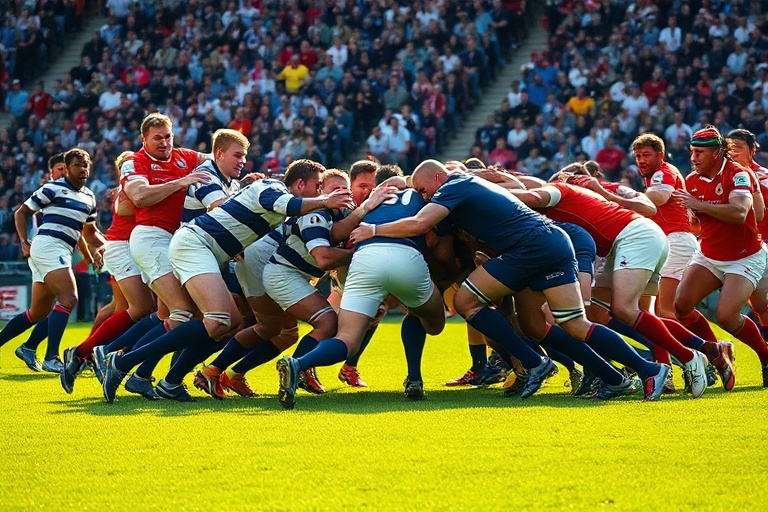
Rugby union is a sport of extremes. Forwards, who make up the bulk of the team’s pack, engage in physical battles in the scrum and lineout, requiring brute strength and technique. Props and hookers, for example, must combine power with precision to win possession, while locks use their height and jumping ability to secure the ball in the lineout. These players often endure the most physical contact, with collisions generating forces equivalent to those in American football.
Backs, on the other hand, rely on speed, agility, and tactical awareness. Fly-halves (or stand-offs) act as the team’s playmakers, directing attacks and making split-second decisions under pressure. Wings and fullbacks combine pace and evasiveness to exploit defensive gaps, while centres use strength and vision to break through tackles. The game’s flow is dictated by phases of play, where teams attempt to advance the ball through running, passing, and kicking, often leading to high-stakes moments like tries, penalties, and conversions.
Tactically, rugby union is a chess match played at high speed. Coaches must balance attack and defense, possession retention, and territorial gain. Modern teams increasingly emphasize set-piece innovation, such as the “1-3-1” scrum formation or the “pod” system in the backline, where forwards join attacks to create mismatches. Defensive systems, like the blitz defense popularized by teams such as the All Blacks, prioritize aggressive line speed to disrupt opponents’ attacking rhythms.
Positions in Rugby Union
- Props (Loosehead and Tighthead): Anchor the scrum and provide power in rucks and mauls.
- Hooker: Wins possession in the scrum and throws the ball in at lineouts.
- Locks (Second Row): Provide height and strength in lineouts and scrums.
- Flankers (Blindside and Openside): Support the breakdown and make tackles in open play.
- Number 8: Links the forwards and backs, often carrying the ball into space.
- Scrum-half: Directs play, passes the ball from the base of rucks, and delivers quick ball.
- Fly-half: The primary decision-maker, kicking and running to create scoring opportunities.
- Centres (Inside and Outside): Break tackles, offload the ball, and score tries.
- Wings: Fast finishers who finish attacking moves.
- Fullback: Last line of defense and a counter-attacking threat.
The Cultural Impact and Future of Rugby Union
Rugby union’s cultural significance extends far beyond the field. In countries like New Zealand, South Africa, and Wales, the sport is intertwined with national identity. The haka, a traditional Māori war dance performed by the All Blacks before matches, symbolizes the cultural depth and intensity of rugby union. Similarly, the Springboks’ 1995 World Cup victory in South Africa became a unifying moment for a nation transitioning from apartheid, illustrating the sport’s power to transcend politics.
In recent years, rugby union has faced challenges, particularly in expanding its reach beyond traditional markets. While Tier 1 nations dominate financially, Tier 2 and 3 nations struggle with funding and infrastructure. World Rugby has responded with initiatives like the Global Rugby Fund, which aims to grow the game in emerging markets. The inclusion of rugby sevens in the Olympics has also provided a platform for lesser-known nations to showcase their talent, with Fiji’s gold medal in Rio 2016 serving as a prime example.
The sport’s future also hinges on innovation and adaptability. Concussion protocols, such as the Head Injury Assessment (HIA), have been tightened to prioritize player welfare. Technology, including Hawk-Eye for goal-line decisions and GPS tracking for performance analysis, is increasingly integrated into the game. Meanwhile, the rise of women’s rugby has been one of the most encouraging trends, with the Women’s Rugby World Cup gaining prominence and professional leagues like England’s Premier 15s leading the way.
For fans and players alike, rugby union offers a unique blend of tradition, physicality, and strategy. Whether it’s the camaraderie of a local club match or the electric atmosphere of a sold-out international game, rugby union continues to inspire passion and loyalty. As the sport evolves, its ability to unite diverse communities and push the boundaries of athletic achievement ensures its place as a cornerstone of the global sporting landscape.
The journey of rugby union—from a schoolyard experiment to a worldwide spectacle—reflects the enduring appeal of a game built on teamwork, resilience, and respect. As new generations take up the oval ball, the sport’s legacy will undoubtedly grow, weaving itself deeper into the fabric of global culture.