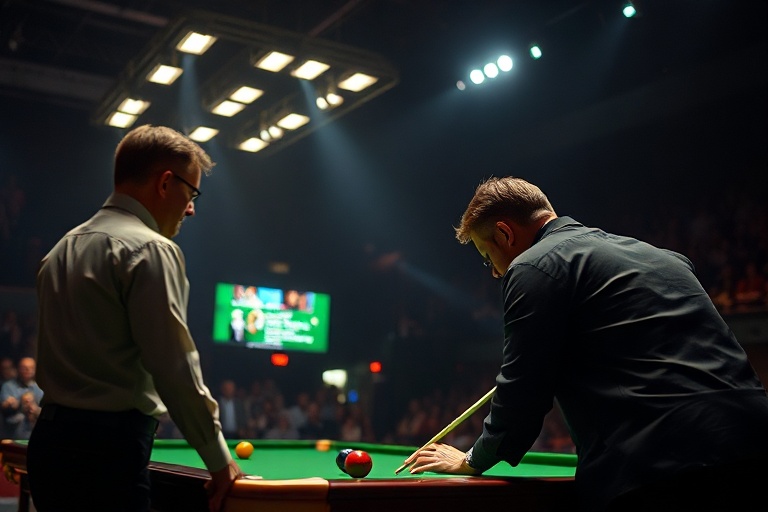
The World Snooker Championship stands as the pinnacle of professional snooker, a tournament that blends athletic precision, mental fortitude, and historical significance. Held annually at the Crucible Theatre in Sheffield, England, this event has defined careers, created legends, and captivated audiences for over four decades. More than just a sporting occasion, it represents the essence of cue sports—where split-second decisions and unwavering focus determine champions.
The Crucible’s intimate setting, with its distinctive red seating and hushed atmosphere, transforms the venue into a theatre of tension. Here, the click of ivory balls colliding echoes through the hall, each shot carrying the weight of months—sometimes years—of preparation. The championship isn’t merely about winning frames; it’s about surviving the crucible of pressure, where the finest margins separate glory from defeat.
The History and Evolution of the Championship
First established in 1927 at the Royal Automobile Club in London, the World Snooker Championship predates television coverage and modern sports science. Early tournaments were sporadic, often interrupted by global conflicts, but they laid the foundation for what would become a global spectacle. The move to the Crucible Theatre in 1977 marked a turning point, giving the event a permanent home and introducing it to a wider audience through BBC’s coverage.
In its early years, the championship was dominated by British players like Joe Davis, who claimed the first 15 titles. However, as the sport expanded internationally, players from Asia and Europe began to assert their dominance. The 1980s and 1990s saw the rise of legends such as Steve Davis and Stephen Hendry, whose rivalry and dominance redefined the competition. Hendry, in particular, became synonymous with the Crucible, winning seven titles in the 1990s and cementing his status as one of the greatest players of all time.
The tournament’s format has evolved alongside its reputation. Originally a challenge-based system, it transitioned to a knockout format in 1969. Today, it features a grueling best-of-19-frames final, a test of endurance that can span multiple days. This evolution reflects the growing demands of the sport and the increasing skill levels of its competitors.
Key Moments in Championship History
The World Snooker Championship is rich with defining moments that have shaped its legacy. One of the most iconic occurred in 1985, when Dennis Taylor and Steve Davis contested a final that would become known as the “Black Ball Final.” Tied 17-17 in the final frame, Taylor’s nerve-shredding escape from a snooker, followed by a dramatic pot on the black ball, secured his first world title. The image of Taylor punching the air in celebration remains one of the most enduring in snooker history.
Another unforgettable moment came in 2005, when Shaun Murphy claimed his first world title as a qualifier. His journey to the Crucible had been unheralded, but his performances were anything but. Murphy’s victory underscored the tournament’s unpredictability and the potential for underdogs to rise to the occasion. It also marked a shift in the sport’s power dynamics, as Asian players began to dominate the rankings.
The 2010s witnessed the emergence of Ronnie O’Sullivan as the dominant force, with his blend of flair, speed, and mental resilience. O’Sullivan’s sixth world title in 2020, achieved at the age of 44, highlighted his longevity and adaptability. His rivalry with Judd Trump, another modern great, has added fresh dynamism to the championship, drawing global attention to the sport.
The Crucible Theatre: A Unique Stage for Snooker
The Crucible Theatre is more than just a venue; it is the spiritual heart of the World Snooker Championship. Opened in 1971 as a theatre for drama and live performances, the Crucible’s intimate setting with its 980 seats creates an atmosphere unlike any other in professional sports. The red upholstery, the low lighting, and the hushed tones of the crowd amplify every shot, every miss, and every triumph.
Players often describe the Crucible as a place where time slows down. The pressure to perform in front of a home crowd—many of whom are fellow professionals—adds another layer of intensity. For first-time qualifiers, stepping onto the stage can be overwhelming. Yet, it is this very pressure that forges champions. The Crucible doesn’t just test skill; it tests character.
The theatre’s layout also plays a tactical role. The close proximity of the tables to the audience means players must contend with distractions, from coughs to whispers. Some players, like Mark Williams, have thrived in this environment, using it to their advantage. Others have struggled, their focus shattered by the weight of expectation. The Crucible’s quirks ensure that no two championships are ever the same.
The Modern Era: Globalization and Commercial Growth
In recent years, the World Snooker Championship has transcended its British roots, becoming a truly global event. The rise of players from China, such as Ding Junhui and Yan Bingtao, has introduced new audiences to the sport. China’s snooker boom, fueled by state-backed initiatives and television coverage, has transformed the game’s landscape. Today, the championship attracts millions of viewers from Asia, Europe, and beyond, making it one of the most-watched snooker events of the year.
Commercial growth has also reshaped the tournament. Sponsorship deals, digital streaming platforms, and social media engagement have elevated the championship’s profile. World Snooker Tour, the governing body, has leveraged these opportunities to expand the sport’s reach. However, this growth has not been without challenges. Critics argue that the increased commercialization risks diluting the sport’s traditional values, turning it into a spectacle rather than a test of skill.
Yet, the core of the championship remains unchanged. The best-of-19-frames format, the best-of-the-rest qualifying rounds, and the unforgiving Crucible stage ensure that only the most resilient players can claim the title. The modern era has brought new narratives—rivalries between players of different generations, the rise of female snooker players, and the integration of technology to enhance the viewing experience—but the essence of the tournament endures.
The Role of Technology and Innovation
Technology has played an increasingly significant role in the World Snooker Championship, both on and off the table. Hawk-Eye, the ball-tracking system, has been introduced to enhance television coverage, allowing viewers to see the exact path of the cue ball and the angles of shots. This innovation has added a layer of transparency, helping referees make accurate decisions and fans understand the complexities of the game.
Off the table, digital platforms have revolutionized how fans engage with the tournament. Social media channels provide real-time updates, behind-the-scenes content, and interactive features. The World Snooker Tour’s YouTube channel, for example, offers highlights, player interviews, and analysis, making the championship accessible to a younger audience. Meanwhile, betting companies have integrated live odds and statistics, further embedding the tournament into the global sports betting landscape.
However, technology’s influence is not without controversy. Some purists argue that it detracts from the human element of the game, reducing snooker to a series of data points. Others worry about the potential for over-reliance on technology to resolve disputes, fearing it could erode the authority of referees. As the championship continues to evolve, finding the balance between tradition and innovation will be crucial.
Why the World Snooker Championship Matters
The World Snooker Championship is more than a sporting event; it is a cultural institution. For players, it represents the ultimate test of skill and mental strength. For fans, it offers drama, suspense, and moments of sheer brilliance. For the sport itself, it is the pinnacle that drives ambition and excellence.
The championship also plays a vital role in promoting snooker as a global sport. Its accessibility, combined with the relatively low cost of equipment, makes it a game that can be played and enjoyed by people of all ages and backgrounds. Initiatives like the World Snooker Federation’s development programs aim to grow the sport in emerging markets, ensuring its future remains bright.
Moreover, the World Snooker Championship serves as a reminder of the power of sport to unite people. In an era of division, the Crucible Theatre becomes a temporary sanctuary where differences fade away, and the only thing that matters is the next shot. Whether you are a lifelong fan or a casual observer, the championship offers something for everyone—drama, inspiration, and the sheer joy of witnessing sporting greatness.
As the 2024 championship approaches, anticipation builds. Will a new champion emerge to etch their name into history? Will an old rival finally claim the title they’ve long coveted? One thing is certain: when the first ball is struck at the Crucible, the world will be watching.
For those looking to explore more about snooker’s rich history and its impact on global sports culture, Dave’s Locker Sports section offers a wealth of articles and insights. Whether you’re interested in the technical aspects of the game or the stories of its greatest players, there’s always more to discover.