Asteroid 2026 JH2’s Close Approach: What You Need to Know
A Celestial Close Call: What We Know About Asteroid 2026 JH2’s Earth Approach
On a quiet Tuesday morning in March 2026, astronomers at the Minor Planet Center in Cambridge, Massachusetts, will turn their telescopes toward a speck of light streaking through the constellation Leo. Designated 2026 JH2, this near-Earth object has captured the attention of space agencies worldwide—not because it poses an immediate threat, but because it offers a rare opportunity to study a cosmic neighbor up close.
The asteroid, measuring between 150 and 300 meters in diameter, will pass within 4.2 million kilometers of Earth, a distance equivalent to roughly 11 times the gap between our planet and the Moon. While this may sound like a vast expanse, in astronomical terms, it’s a close shave. For context, NASA’s Planetary Defense Coordination Office classifies any object passing within 7.5 million kilometers of Earth as a Potentially Hazardous Asteroid (PHA). 2026 JH2 comfortably fits that definition, though its trajectory has been meticulously mapped and poses no risk of impact.
The Science Behind the Flyby
Discovered in May 2024 by the Pan-STARRS telescope in Hawaii, 2026 JH2 belongs to the Apollo group of asteroids, a family of space rocks whose orbits cross Earth’s path. These objects are of particular interest to scientists because they offer clues about the early solar system. Unlike the more distant Kuiper Belt or Oort Cloud objects, Apollo asteroids are thought to have originated closer to the Sun, possibly even within the orbit of Mars.
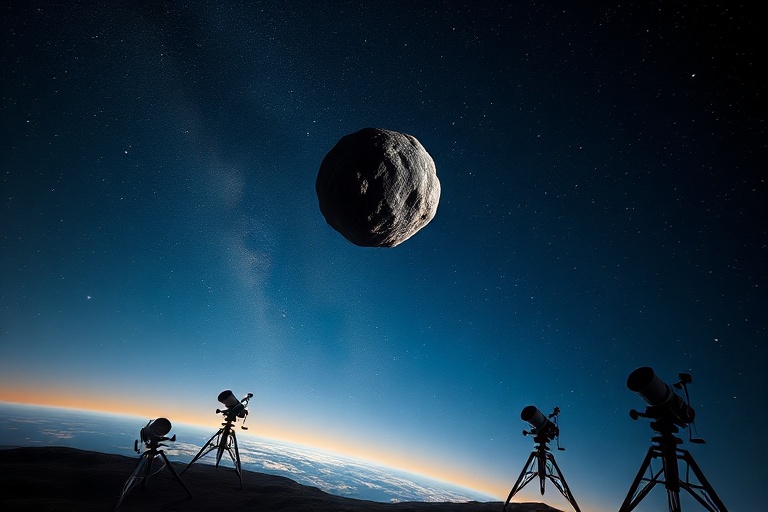
As 2026 JH2 approaches Earth, astronomers will deploy a suite of instruments to study its composition, rotation, and surface features. Radar observations from the Deep Space Network’s Goldstone facility in California and optical telescopes in Chile and Australia will provide high-resolution data. “This is a chance to see an asteroid in motion,” said Dr. Elena Vasquez, a planetary scientist at the European Space Agency. “We’ll be looking for signs of surface regolith, possible craters, or even boulders that could tell us about its history.”
The asteroid’s flyby also presents a logistical challenge. Space agencies must coordinate tracking efforts to avoid interference from other missions, including those targeting the Moon and Mars. The European Space Agency’s Science division has already begun scheduling observations around the flyby window, which opens on March 12 and closes on March 20, 2026.
Cultural Echoes: How the World Reacts to Cosmic Visitors
While scientists approach 2026 JH2 with precision, the public’s reaction is harder to predict. Over the past decade, near-Earth objects have become a staple of both scientific discourse and pop culture. Films like Don’t Look Up and Armageddon have conditioned audiences to see asteroids as either existential threats or heroic rescue missions. Yet 2026 JH2 defies these narratives—it’s neither a doomsday scenario nor a salvation plot.
In Japan, where ancient folklore often ties celestial events to destiny, some Shinto priests have begun performing rituals to “calm the sky.” Meanwhile, in the United States, social media platforms are already abuzz with memes and conspiracy theories. A viral tweet claims that 2026 JH2 is actually a “secret alien probe,” while Reddit threads debate whether governments will use the flyby to test planetary defense technologies. These reactions underscore a broader cultural tension: humanity’s awe for the cosmos is often tempered by fear and misinformation.
Governments are taking note. NASA’s Technology blog recently published a guide on how to safely observe near-Earth objects, emphasizing the importance of verified sources. “We want people to be informed, not alarmed,” said a spokesperson for the agency. “This is a reminder of our place in the universe—not a cause for panic.”
Lessons from the Past, Preparations for the Future
The study of 2026 JH2 is more than an academic exercise. It’s a test run for humanity’s ability to track, analyze, and potentially deflect hazardous asteroids. The last major close approach was asteroid 99942 Apophis in 2029, which passed within 31,000 kilometers of Earth—closer than some satellites. That event spurred international collaboration, leading to the formation of the International Asteroid Warning Network (IAWN).
Today, IAWN coordinates observations and risk assessments from institutions across the globe, including the Russian Academy of Sciences, China’s National Space Science Center, and Brazil’s Southern Astrophysical Research Telescope. Their goal is twofold: to improve detection methods and to develop contingency plans for deflection missions. NASA’s Double Asteroid Redirection Test (DART) mission, which successfully altered the orbit of asteroid Dimorphos in 2022, proved that humanity can change the trajectory of a celestial object—at least on a small scale.
For 2026 JH2, deflection isn’t on the table. Its orbit is too well understood, and its distance too great. Instead, the flyby serves as a reminder of the work still to be done. A 2023 report by the U.S. National Academies of Sciences found that only about 40% of near-Earth objects larger than 140 meters have been identified. The remaining 60% could pose a significant risk if their orbits were to intersect Earth’s.
How to Witness the Flyby (Safely and Responsibly)
For those eager to catch a glimpse of 2026 JH2, professional and amateur astronomers alike will have opportunities to observe the asteroid. Here’s how to prepare:
- Timing: The asteroid will be brightest between March 14 and March 18, 2026, when it reaches magnitude 13. This is within the range of backyard telescopes with apertures of 8 inches or larger.
- Location: Observers in the Northern Hemisphere will have the best views, particularly in the hours after midnight when Leo is high in the sky.
- Tools: Use star charts or astronomy apps like Stellarium or SkySafari to locate the asteroid. It will appear as a slow-moving point of light, distinct from the fixed stars.
- Safety: Never attempt to view the asteroid with the naked eye or unfiltered binoculars. Always use proper eye protection when observing celestial objects.
Public observatories and planetariums worldwide will host viewing events. The Griffith Observatory in Los Angeles, the Royal Observatory in Greenwich, and the Tokyo National Museum of Nature and Science have all announced special programs. These events offer a chance to learn from experts and engage with the science behind the flyby.
A Moment of Cosmic Perspective
As 2026 JH2 races past Earth, it will do so at a leisurely 12 kilometers per second—a cosmic crawl by human standards. In the grand timeline of the universe, this encounter is fleeting, a brief alignment of orbits that will never repeat in quite the same way. For scientists, it’s a data point. For the public, it’s a spectacle. For humanity as a whole, it’s a reminder of our shared vulnerability and curiosity.
In an age where conflict and division often dominate headlines, events like this offer a rare opportunity for unity. The study of 2026 JH2 transcends borders, languages, and ideologies. It’s a testament to what we can achieve when we look outward, together. As Dr. Vasquez put it, “This asteroid doesn’t care about our politics or our wars. It’s a reminder that we’re all passengers on the same pale blue dot.”
Whether you’re an astronomer, a student, or simply someone who gazes at the night sky in wonder, 2026 JH2’s flyby is an invitation. An invitation to learn, to observe, and to appreciate the vast, dynamic universe we call home.