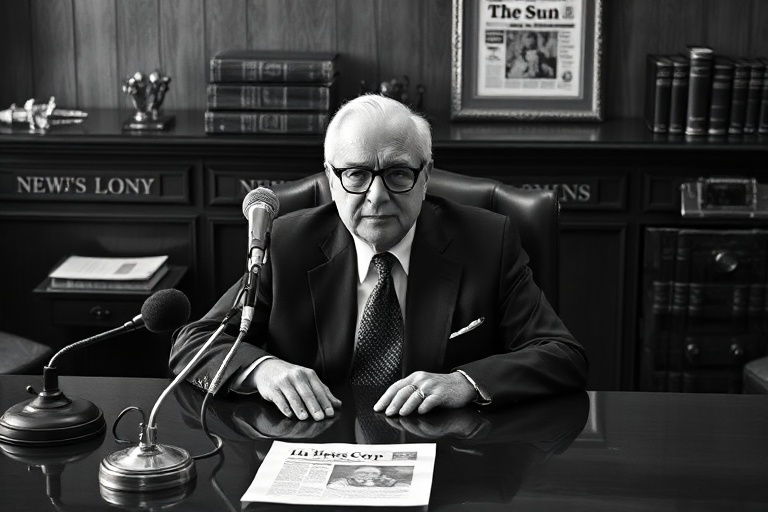
How Rupert Murdoch Built and Shaped the Modern Media Landscape
Rupert Murdoch: The Media Titan Who Shaped Global Communication
Rupert Murdoch’s name stands synonymous with media influence, corporate power, and the transformation of how news and entertainment are delivered worldwide. For over six decades, Murdoch has built an empire that spans continents, cultures, and industries, reshaping public discourse while navigating political currents and technological revolutions. His career reflects the evolution of mass media—from newspapers to 24-hour news channels and digital platforms—each phase marked by bold acquisitions and calculated risks.
Born in Melbourne, Australia, in 1931, Murdoch inherited a small newspaper from his father and expanded it into a global conglomerate. Today, News Corp and Fox Corporation—two pillars of his business empire—control a vast network of print, broadcast, and digital media outlets. While his influence has been undeniable, it has also sparked intense debate over media ethics, political bias, and the concentration of power in the hands of a few. This dual legacy—of innovation and controversy—defines Murdoch’s place in modern history.
The Rise of a Media Empire: From Adelaide to New York
Murdoch’s early career in the 1950s and 1960s was defined by aggressive expansion. After taking over the Adelaide News in 1952, he quickly rebranded it with sensationalist headlines and populist content, increasing circulation dramatically. This formula—blending scandal, sports, and local news—became a hallmark of his approach. By the 1960s, he had acquired newspapers in Sydney and London, including the News of the World, which became one of the UK’s most widely read tabloids.
His move into television in the 1980s marked a turning point. The launch of Sky Television in the UK in 1989 and later its merger into British Sky Broadcasting (BSkyB) positioned Murdoch as a dominant force in European broadcasting. Meanwhile, in the United States, his acquisition of 20th Century Fox in 1985 and the launch of Fox Broadcasting Company in 1986 challenged the dominance of the Big Three networks—ABC, CBS, and NBC. Entertainment was no longer just a side venture; it became a core component of his strategy.
The 1996 launch of Fox News Channel further cemented his impact on American media. Positioned as a conservative alternative to mainstream outlets, Fox News rapidly grew into the most-watched cable news network in the U.S., influencing political discourse and public opinion. Murdoch’s ability to identify and dominate emerging media trends—whether tabloids, satellite TV, or cable news—demonstrates a rare instinct for what audiences crave.
Cultural and Political Influence: A Double-Edged Sword
Murdoch’s media properties have not only informed but also shaped cultural and political narratives across the globe. In the UK, newspapers like The Sun and The Times wielded immense influence over public opinion, particularly during elections. In Australia, News Corp’s dominance in print media has raised concerns about media diversity and editorial independence. Critics argue that Murdoch’s outlets often align closely with conservative viewpoints, reinforcing partisan divides.
In the U.S., Fox News became a central player in the country’s polarized media landscape. Its programming, including opinion shows hosted by figures like Sean Hannity and Tucker Carlson, has drawn both loyal viewership and sharp criticism for its perceived slant. Supporters credit Fox with giving voice to perspectives often marginalized by mainstream media, while detractors accuse it of spreading misinformation and deepening societal divisions.
Murdoch’s influence extends beyond news. Through Fox Entertainment and 20th Century Studios, he has shaped the global film and television industry. Hits like The Simpsons, Avatar, and The X-Factor reflect the reach of his entertainment ventures. Meanwhile, digital expansion through platforms like Technology acquisitions and investments in streaming services has kept his companies relevant in an era of rapid change.
The Controversies and Scandals That Defined an Era
No discussion of Murdoch’s legacy would be complete without addressing the scandals that have punctuated his career. The 2011 phone-hacking scandal involving News of the World remains one of the most damaging. Investigations revealed that journalists had illegally intercepted voicemails of public figures, crime victims, and even families of soldiers killed in action. The scandal led to the closure of the 168-year-old newspaper, criminal prosecutions, and a significant reputational blow to News Corp.
Murdoch himself faced intense scrutiny during parliamentary hearings in the UK and the U.S. While he denied direct involvement, the scandal underscored the risks of unchecked media power and the ethical failures that can occur when profit motives overshadow journalistic integrity.
Other controversies have included allegations of anti-competitive practices, such as the 2019 decision by the U.S. Department of Justice to block the merger of Fox’s regional sports networks due to antitrust concerns. In Australia, critics have long argued that News Corp’s market dominance stifles smaller publishers and limits media pluralism.
The following list highlights key moments in Murdoch’s career that have sparked public debate:
- 1969: Acquisition of The Sun in the UK, which later became the best-selling newspaper in the country.
- 1986: Launch of Fox Broadcasting Company, challenging the dominance of U.S. network television.
- 1996: Creation of Fox News Channel, which redefined cable news and political commentary.
- 2011: Closure of News of the World amid the phone-hacking scandal.
- 2023: Completion of the Fox Corporation spin-off from News Corp, formalizing the separation of his print and broadcast interests.
A Legacy of Innovation and Ethical Dilemmas
Murdoch’s career offers a paradox: he is both a visionary and a polarizing figure. On one hand, his ability to anticipate and capitalize on media trends has made him one of the most successful business leaders of the 20th and 21st centuries. He understood early on that audiences wanted not just information but entertainment, and that news could be both a product and a persuasive tool. His companies have pioneered satellite broadcasting, 24-hour news cycles, and digital content distribution.
On the other hand, his influence has raised fundamental questions about the role of media in democracy. When a handful of conglomerates control the flow of information, who decides what is news? How does concentrated ownership affect editorial independence? Can media companies truly serve the public interest when their primary goal is profit? Murdoch’s career forces us to confront these challenges.
As Murdoch approaches his tenth decade, questions linger about the future of his empire. With his sons Lachlan and James now leading Fox and News Corp respectively, the next chapter will test whether the company can maintain its relevance in an era of social media, streaming platforms, and user-generated content. The rise of digital-first outlets and the decline of traditional print and broadcast media pose existential threats to legacy models.
Yet, if history is any guide, Murdoch and his successors are likely to adapt. Whether through further acquisitions, strategic partnerships, or bold technological bets, the Murdoch name will likely remain a fixture in global media for years to come.
His story is not just one of business success but of the evolving relationship between media, power, and society. In an age where trust in institutions is fragile and misinformation spreads rapidly, the lessons from Murdoch’s career—both its triumphs and its failures—remain vitally important.