How the Tampa Bay Rays Defy MLB Odds with Smart Baseball
The Tampa Bay Rays have carved out a unique identity in Major League Baseball over the past two decades. Despite operating with one of the league’s smallest payrolls, the franchise has consistently remained competitive, reaching the postseason in 11 of the last 15 seasons. This sustained success stems from a combination of shrewd front-office decisions, innovative player development, and a commitment to analytics that most franchises only aspire to match.
While the Rays have yet to capture a World Series title, their ability to maximize limited resources has set a benchmark for small-market teams. The organization’s approach—often referred to as the “Tampa Bay Way”—prioritizes adaptability, focusing on undervalued talent, defensive versatility, and bullpen depth over high-priced stars. This philosophy has not only kept the team competitive but has also redefined how success can be achieved in modern baseball.
The Tampa Bay Way: A Blueprint for Small-Market Success
At the heart of the Rays’ sustained competitiveness is their organizational philosophy, widely known as the “Tampa Bay Way.” This approach emphasizes three core principles: player development, financial prudence, and adaptability. Unlike franchises that rely on splashy free-agent signings, the Rays have thrived by identifying undervalued players through advanced analytics, developing them within their farm system, and deploying them in roles that maximize their strengths.
The Rays’ minor league system has been particularly noteworthy for producing major league talent. Players like Evan Longoria, Blake Snell, and Randy Arozarena emerged from the organization’s farm before becoming key contributors at the MLB level. The team’s emphasis on pitching development—especially with young arms—has been a cornerstone of their success, with starters often outperforming their pre-draft expectations.
Financial restraint has also been critical. The Rays have regularly ranked near the bottom of MLB in payroll, yet they’ve managed to retain core players by leveraging arbitration and club-friendly contracts. This fiscal discipline allows them to reinvest in player development and analytics, creating a self-sustaining cycle of competitiveness.
Key Contributions to the “Tampa Bay Way”
- Player Development: A focus on cultivating talent rather than acquiring established stars.
- Analytical Edge: Heavy reliance on data to identify undervalued players and optimize in-game decisions.
- Positional Flexibility: Emphasizing defensive versatility to maximize roster spots.
- Pitching Emphasis: Prioritizing young arms and bullpen arms to control costs and performance.
Recent Seasons: A Pattern of Resilience and Near-Misses
The Rays’ 2023 season exemplified their resilience. Despite losing key players to injuries and trades, they finished with a 99-63 record, securing the American League Wild Card spot. Their bullpen, often their greatest strength, posted a league-leading 3.05 ERA, while young stars like Wander Franco and Randy Arozarena provided offensive firepower.
However, the postseason has remained elusive. In 2020, Tampa Bay reached the World Series for the first time in franchise history but fell to the Los Angeles Dodgers in six games. The following year, they were eliminated in the Division Series by the eventual champion Boston Red Sox. These near-misses underscore both the team’s competitive edge and the fine margins that separate good teams from champions.
One of the Rays’ most impressive recent achievements was their 2022 campaign, when they won 86 games despite a midseason sell-off of key players. This demonstrated their ability to adapt mid-season, a testament to manager Kevin Cash’s leadership and the organization’s depth.
The Ballpark Experience: Tropicana Field’s Unique Challenges
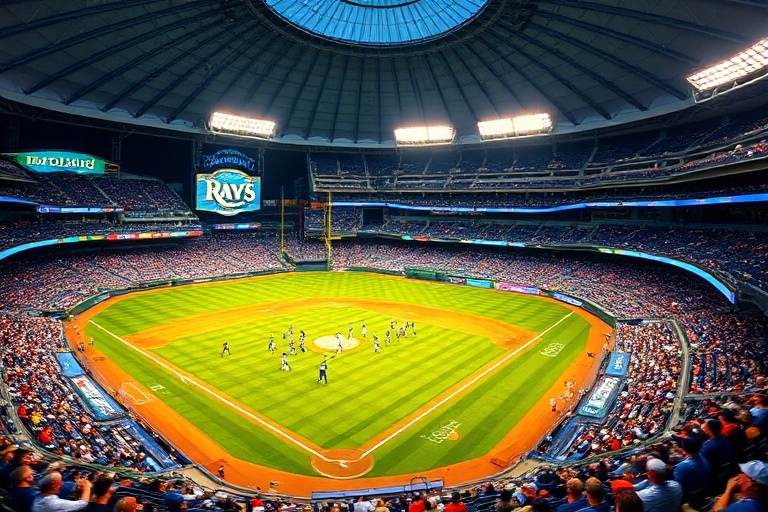
Tropicana Field, the Rays’ home since 1998, is one of the most unusual venues in professional sports. Originally designed as a multi-purpose stadium, its fixed roof, artificial turf, and cavernous dimensions have long been criticized—yet it remains a defining aspect of the franchise. The Rays have sought to improve the fan experience through renovations, including expanded concourses and enhanced video boards, though attendance has remained a persistent challenge.
The stadium’s location in St. Petersburg also presents logistical hurdles. With Tampa Bay’s vibrant cultural scene nearby, the Rays compete not just with other sports teams but with entertainment options across the region. The franchise has experimented with promotions, themed nights, and community engagement to draw fans, yet the stadium’s reputation as a “dome of doom” lingers in the public imagination.
Despite these challenges, Tropicana Field offers advantages. The controlled indoor environment ensures fewer weather-related disruptions, and the Rays have leveraged technology to enhance the in-game experience, from mobile ticketing to augmented reality features in the app.
The Future: Can Tampa Bay Break Through?
The Rays’ future hinges on their ability to retain young talent while continuing to develop affordable replacements. The franchise’s draft strategy remains a model for others, but the risk of losing stars to free agency—or, as seen with Wander Franco, to contract disputes—looms large. The organization’s recent trade of top prospect Curtis Mead to the Miami Marlins for veteran pitcher Tyler Glasnow illustrates their willingness to make bold moves to bolster the major league roster.
Another factor is the potential for a new stadium. For years, the Rays have explored relocation or renovation options, with sites in Tampa and Hillsborough County discussed. While no definitive plan has materialized, the need for a modern, fan-friendly ballpark could define the next phase of the franchise’s evolution.
Despite these uncertainties, the Rays’ model remains compelling. In an era where financial disparities in MLB continue to grow, Tampa Bay’s approach offers a blueprint for sustainable success. Whether they ultimately win a championship or not, their impact on the game’s future is undeniable.
For fans of small-market baseball, the Rays represent more than a team—they embody a philosophy. And as long as they continue to defy expectations, they’ll remain a franchise worth watching.
For more insights into baseball’s evolving landscape, explore our Sports and Analysis sections.