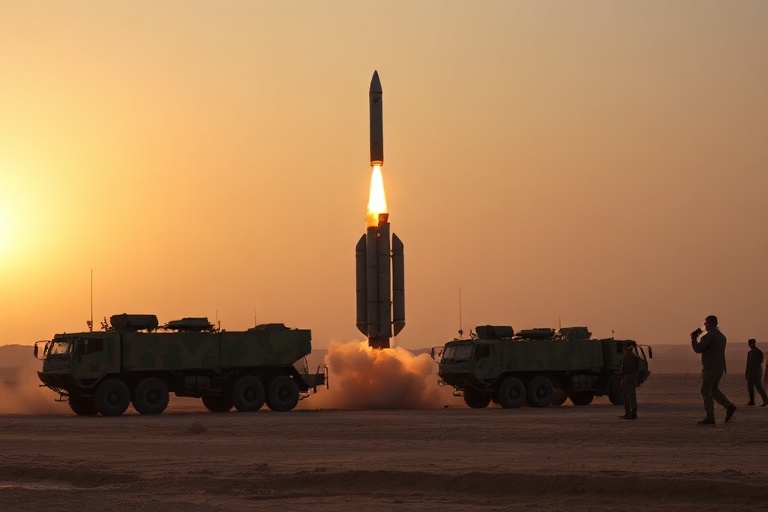
Iran’s Missile Program: Power, Politics, and Global Tensions
Iran’s Ballistic Arsenal: A Technical Overview
Iran’s missile program has evolved from a defensive necessity into a cornerstone of its military doctrine. Since the 1980s, the Islamic Republic has developed a diverse range of ballistic missiles, with ranges spanning from short-range systems capable of striking targets within 500 kilometers to medium-range missiles like the Shahab-3, which can reach up to 2,000 kilometers. This expansion reflects a strategic shift from reliance on foreign suppliers—particularly during the Iran-Iraq War—to indigenous production.
The country’s most advanced systems, such as the Sejjil and Emad missiles, incorporate precision guidance and maneuverable warheads, complicating interception efforts. These advancements are not merely technological; they represent Iran’s determination to counter perceived threats from regional rivals like Israel and Saudi Arabia, as well as the broader influence of Western powers in the Middle East.
Key Features of Iran’s Missile Arsenal
- Range and Payload: Iran’s missiles vary widely in capability. The Shahab-3, for example, has a reported range of 1,300–2,000 km with a payload of up to 1,000 kg. Meanwhile, the newer Khorramshahr-4 can reportedly strike targets up to 2,000 km away with a heavier payload.
- Guidance Systems: Many of Iran’s missiles now feature inertial navigation systems paired with GPS and terrain-matching technology, improving accuracy. The Emad, for instance, boasts a circular error probable (CEP) of under 50 meters, making it one of the most precise missiles in the region.
- Maneuverable Warheads: Systems like the Sejjil and Fateh-110 incorporate maneuverable re-entry vehicles (MaRVs), allowing them to evade missile defense systems by altering their trajectory during descent.
- Solid vs. Liquid Fuel: While older missiles like the Shahab-3 use liquid fuel, newer designs such as the Fateh and Zolfaghar rely on solid propellants, which offer faster deployment and greater reliability.
Geopolitical Implications: Deterrence or Provocation?
Iran’s missile program is inextricably linked to its broader geopolitical ambitions and security concerns. For Tehran, these weapons serve as both a deterrent and a tool of asymmetric warfare. The program’s development has intensified regional arms races, particularly with Saudi Arabia and Israel, both of which view Iran’s missile capabilities as existential threats.
The 2015 Joint Comprehensive Plan of Action (JCPOA), which temporarily curbed Iran’s nuclear activities, did little to constrain its missile program. In fact, the years following the deal saw a marked acceleration in testing and deployment. Iran’s leadership has consistently framed its missile program as defensive, arguing that it is necessary to counter U.S. military presence in the Gulf and Israeli threats. However, critics argue that these systems are inherently offensive, given their potential to deliver nuclear warheads—a capability Iran has not yet demonstrated but continues to pursue.
Regional Responses and Arms Races
The proliferation of Iran’s missiles has triggered a cascade of responses across the Middle East:
- Israel’s Iron Dome and David’s Sling: Israel has invested heavily in missile defense systems, including the Iron Dome, which has intercepted thousands of rockets fired from Gaza and Lebanon. However, these systems are not foolproof, particularly against longer-range threats.
- Saudi Arabia’s Ballistic Shield: Saudi Arabia has acquired advanced missile defense systems from the U.S., including the THAAD (Terminal High Altitude Area Defense) system, to counter Houthi missile attacks from Yemen, which are often supplied or influenced by Iran.
- U.S. and Allied Posturing: The U.S. has deployed additional missile defense assets in the region, including Aegis-class destroyers and Patriot missile systems, to reassure allies and deter Iranian aggression.
- Proxy Warfare: Iran’s support for groups like Hezbollah in Lebanon and the Houthis in Yemen has allowed it to project power without direct confrontation, often using missile technology as a key bargaining chip.
The International Response: Sanctions and Diplomacy
Iran’s missile program has been a focal point of international sanctions, particularly under U.S. administrations. The Trump administration’s withdrawal from the JCPOA in 2018 and subsequent reimposition of sanctions targeted Iran’s missile development, banking, and oil sectors. The Biden administration has maintained a hardline stance, though it has engaged in indirect talks with Iran to revive the nuclear deal while addressing missile concerns.
However, multilateral efforts to curb Iran’s missile program have faced significant hurdles. Russia and China have often shielded Iran at the United Nations, arguing that the missile program is not a violation of international law as long as it remains non-nuclear. Meanwhile, Iran has circumvented sanctions through illicit networks, smuggling components and technology from countries like North Korea and China.
Economic and Diplomatic Fallout
- Sanctions Evasion: Iran has relied on front companies, cryptocurrency transactions, and barter agreements to sustain its missile and nuclear programs despite economic isolation.
- Diplomatic Isolations: Iran’s missile tests have repeatedly drawn condemnation from the U.N. Security Council, the European Union, and regional organizations like the Arab League.
- Alliance Building: Despite international pressure, Iran has deepened ties with Russia and China, particularly through the 25-year strategic partnership signed in 2021, which includes cooperation on missile technology and defense systems.
Future Trajectories: What Lies Ahead?
Looking forward, Iran’s missile program is poised for further expansion, with several key trends likely to shape its development. First, the integration of hypersonic technology could revolutionize Iran’s arsenal, enabling missiles to travel at speeds exceeding Mach 5 while remaining highly maneuverable. Such systems would pose unprecedented challenges to existing missile defense networks.
Second, Iran’s growing collaboration with Russia and North Korea could accelerate its technological capabilities. Reports indicate that Iran has received assistance from both countries in developing solid-fuel missiles and potentially hypersonic glide vehicles. These partnerships could also facilitate the transfer of advanced propulsion systems and guidance technologies.
Third, the outcome of ongoing nuclear negotiations will significantly influence Iran’s missile program. A revived JCPOA might include restrictions on missile development, though past experience suggests that Iran would resist such limits. Alternatively, a failure to reach a deal could embolden Iran to accelerate both its nuclear and missile programs, further destabilizing the region.
Finally, domestic politics in Iran will play a critical role. The Islamic Revolutionary Guard Corps (IRGC), which oversees the missile program, holds substantial influence within Iran’s political and economic structures. Hardline factions within the IRGC may push for more aggressive missile testing to demonstrate Iran’s defiance of Western pressure, particularly in the lead-up to the 2024 parliamentary elections.
Potential Scenarios
- Technological Leap: Iran could achieve a breakthrough in hypersonic missile technology, altering the regional balance of power and forcing adversaries to invest in new defense systems.
- Escalation or Restraint: Depending on the outcome of nuclear talks and regional dynamics, Iran may either double down on missile development or seek limited compromises to ease sanctions.
- Proxy Escalation: Increased missile transfers to proxies in Yemen, Syria, or Lebanon could trigger broader conflicts, drawing in regional powers and global actors.
- Diplomatic Realignment: A shift in U.S. policy under a new administration or a breakthrough in China-Russia mediated talks could create unexpected opportunities for de-escalation.
The story of Iran’s missile program is one of resilience, innovation, and high-stakes geopolitics. Whether viewed as a legitimate deterrent or a destabilizing force, its trajectory will continue to shape the security landscape of the Middle East and beyond. For policymakers, the challenge lies in balancing deterrence with diplomacy, ensuring that technological advancements do not spiral into unchecked escalation.
For further reading on regional security dynamics, explore our News and Analysis sections, where we delve deeper into the intersections of technology, politics, and global affairs.